Clones are everywhere now. Type any famous fragrance into a search engine, and you'll find a dozen versions selling for a fraction of the original price. Some are obvious knockoffs. Others are so close to the source material that even experienced collectors have trouble telling them apart blind.
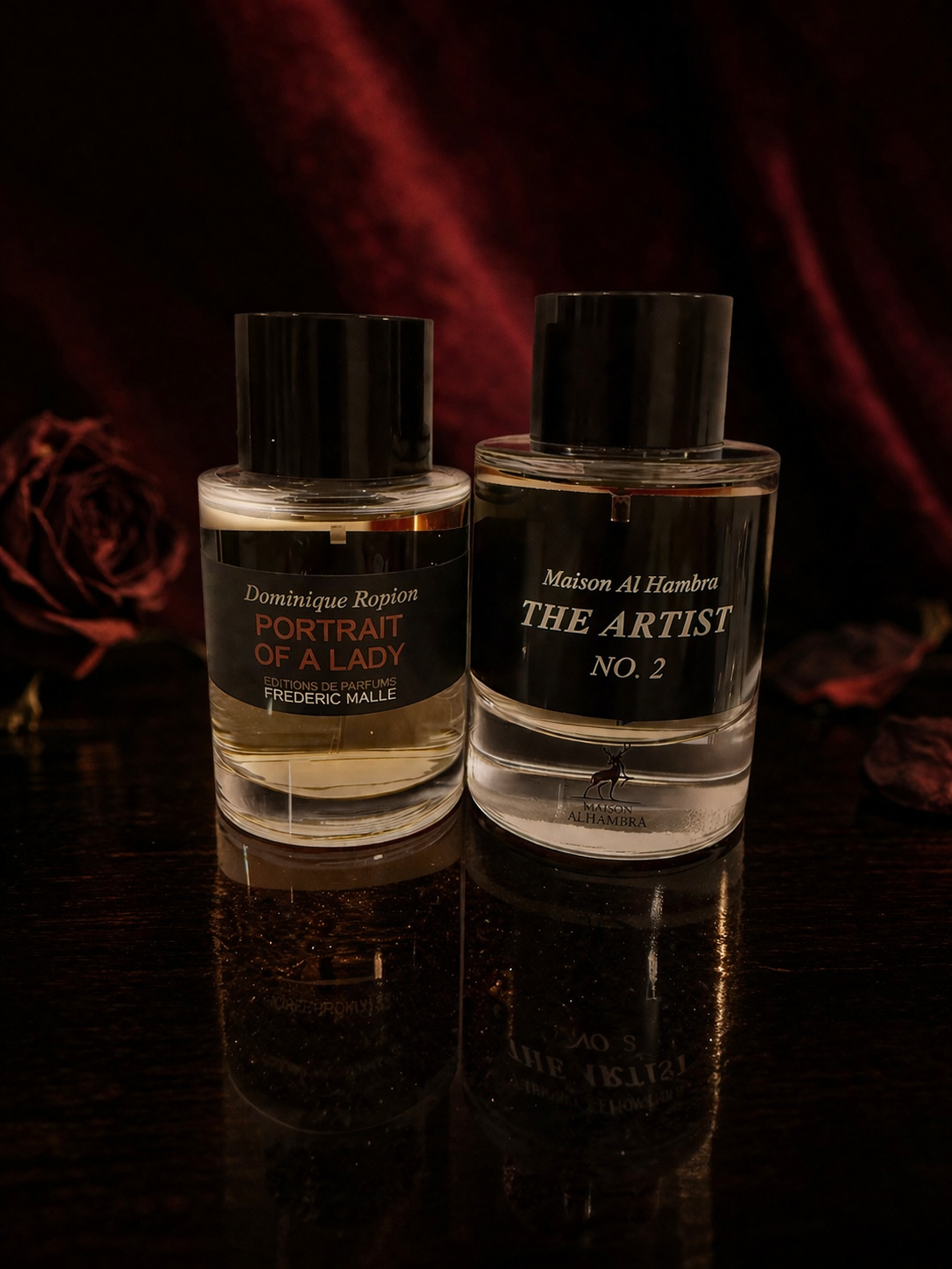
Frederic Malle Portrait of a Lady (left) alongside Maison Al Hambra The Artist No. 2 (right). Similar DNA but very different price points. The bottles might be similar but the juice inside tells a different story.
This Isn't New. What Changed Is the Scale.
The perfume industry has always had imitation. What's changed is the scale, the quality, and the conversation around it. Perfumers have always worked across multiple houses, and similar materials naturally produce similar results. Perfumer Michel Girard created both Dior's Dune and Davidoff's Cool Water within a few years of each other. Jean-Claude Ellena's fingerprint is recognizable across his work for Hermès and his earlier projects. When the same nose works for different brands, the lines between homage and imitation blur. Fashion houses have known this for decades. The difference now is that clone brands make the comparison explicit. They name the original right on the bottle.
The Mainstream Clone Market
A decade ago, clone brands were a quiet corner of the market. Hobbyists knew about them. Most consumers didn't. Today they're mainstream. Companies like Dua, Alexandria Fragrances, Armaf, and Lattafa have built real audiences by positioning themselves explicitly as alternatives to luxury originals. Some have millions of followers. The framing has shifted from "cheap imitation" to "smart buy."
The quality argument is harder to dismiss than it used to be. Raw materials and production techniques have improved significantly. A $30 clone of a $350 niche fragrance might get you 80 to 90 percent of the way there. Sitting next to someone on the subway, you wouldn't know the difference. Crammed into a busy restaurant, sitting two feet from a stranger, you might not notice. For casual wearers, that gap may not matter much.
The Legal Picture
For the original houses, the impact is complicated. There's a landmark legal case worth knowing here. In 2006, a French court ruled that fragrance is an art form and therefore qualifies for copyright protection. It was a significant moment, but the practical effect has been limited. Fragrance formulas remain notoriously difficult to patent and enforce globally. A house like Creed or Louis Vuitton loses nothing legally in most markets when someone buys a clone. On the other hand, the perception of exclusivity takes a real hit when your signature scent smells like something widely available for $25.
What the Houses Can't Be Copied On
Some houses have responded by doubling down on what can't be copied. Captive ingredients are one approach. Creed's Ambergris, Louis Vuitton's proprietary ingredients developed exclusively with Givaudan, and certain rose materials from Grasse that only a few houses can access. These materials create a ceiling that clone brands simply can't reach at their price point. The gap may be subtle, but it's there for trained noses.
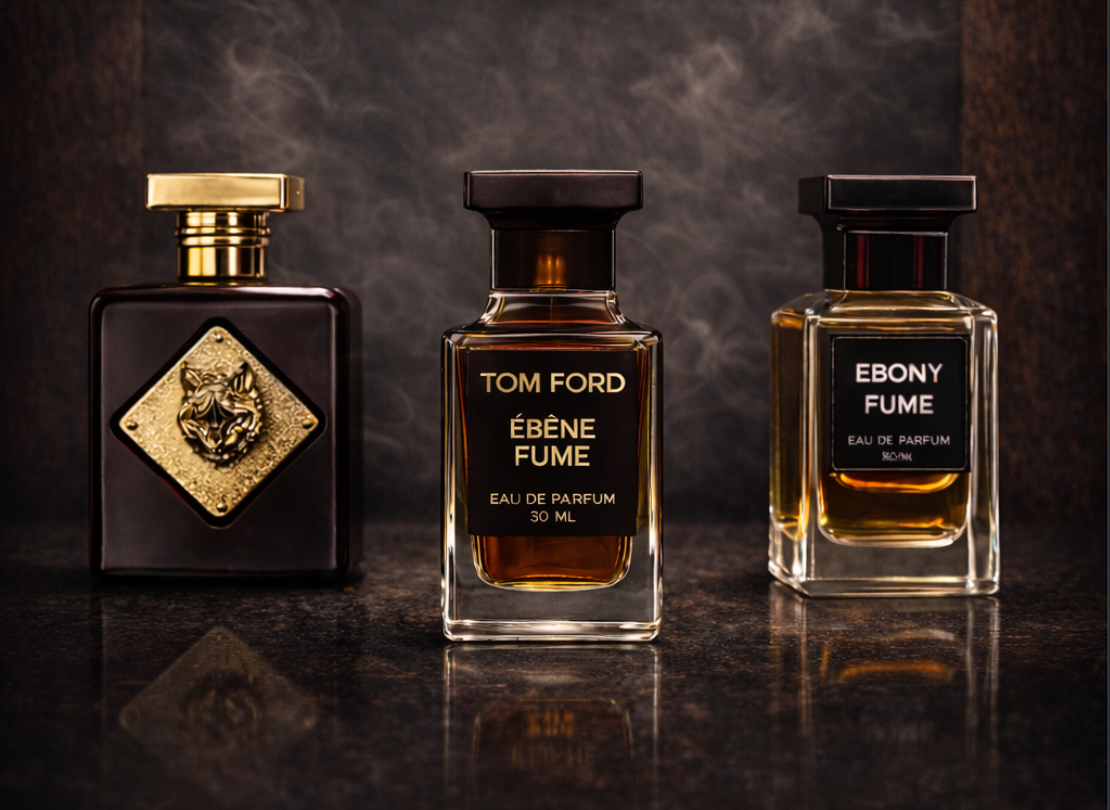
Tom Ford Ebene Fume (center) alongside two clones, Fragrance World's Alpha on the left, and Fragrance World's Ebony Fume on the right. While the bottle on the right has a similar shape and name, its finish and overall experience are different.
Packaging and the buying experience are another front entirely. The bottle design, the retail environment, the tissue paper, the cap weight. Houses like Maison Margiela have built entire brand identities around the unboxing and the concept of memory. You can clone the juice. You can't clone the moment of walking into a boutique and being handed something wrapped in tissue by someone who knows the story behind it. Online shopping has made this distinction even sharper: a YouTube video saying "this $25 bottle smells identical to the $400 original" is a powerful marketing tool that costs the clone brand nothing to produce, but it can't replicate any of that.
Where the Industry Goes From Here
The collector community is split. Some see clones as a gateway. You smell a clone, love it, seek out the original, go deeper. Others feel the proliferation cheapens something they care about.
What's clear is that the fragrance itself is no longer the only thing being sold. Houses are competing on heritage, materials, experience, and story. Those things are harder to copy than a formula. That shift is permanent, and it was clones that forced it.