America turns 250 today. Its spirits industry goes back nearly that far. Its perfume industry is much younger. This piece covers both, across two installments here, with Tiki and non-whisky American spirits still to come as a separate series.

A 1930s postcard, “Making Moonshine in Great Smoky Mountains National Park, Tenn.” The practice flourished in the remote valleys of the Smokies before the park existed, and stayed part of its lore long after the stills were gone. Courtesy of University of Tennessee, Knoxville, Special Collections.
America's 250th — A Four-Part Series
1. A Nation Built While Someone Was Distilling
The country's oldest spirit predates the country. William Laird, a Scottish immigrant, began distilling apple brandy in colonial New Jersey in 1698. His great-grandson Robert incorporated Laird & Company in 1780, seven years before the Constitution existed. George Washington liked what the Lairds were making enough to write and personally request their recipe. Robert Laird served under Washington in the Revolutionary Army and supplied his troops with applejack at the Battle of Monmouth. Laird & Company still operates today, the oldest licensed distillery in the United States, and it was making apple brandy before there was a state of Kentucky, let alone a bourbon industry.
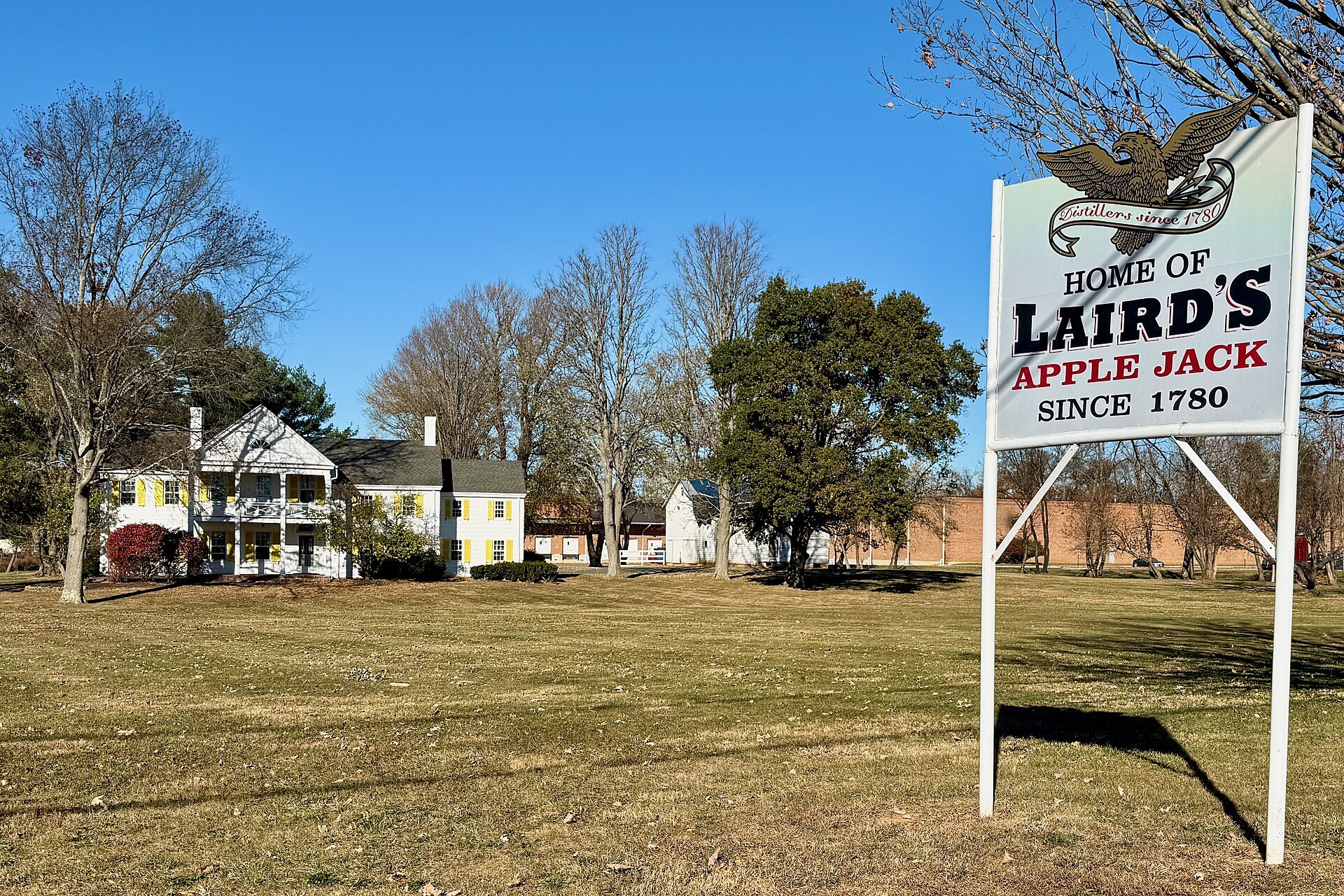
Laird & Company's grounds in Scobeyville, New Jersey. Distillers since 1780.
Applejack was not the only spirit in the room. Rum was the dominant drink of colonial America, and by Mount Vernon's own estimate, colonists consumed something like 3.7 gallons of it per person annually by the time of the Revolution. That popularity came from a supply chain worth naming honestly: rum production was tied directly into the triangular trade, and the sugar and molasses behind it were produced by enslaved labor in the Caribbean. Rum's place in early American life cannot be told as a purely charming colonial story, because it wasn't one.
Bourbon, the spirit most people now think of as definitively American, is actually the newest arrival of the three. It doesn't show up as a distinct regional identity until the 19th century, and its rise to prominence has a lot to do with what happens next.
2. The Whiskey Rebellion, Moonshine, and Taxation
Whiskey production spread fast on the American frontier after the Revolution. Corn grew easily, transporting it as grain was expensive, and converting it into whiskey solved both problems at once. Farmers used it as currency in places where cash was scarce.
In 1791, Treasury Secretary Alexander Hamilton pushed through an excise tax on domestically distilled spirits, aimed at paying down Revolutionary War debt. It was a reasonable idea on paper. In practice, it hit frontier farmers in western Pennsylvania hardest. These were small operators who used whiskey as currency because they rarely saw cash, and a cash-only tax on a product they didn't sell for cash was, functionally, a tax they could not pay.
Resistance built for three years. Tax collectors were tarred and feathered. In July 1794, roughly 500 armed men attacked and burned the home of federal tax inspector John Neville outside Pittsburgh. Washington responded by personally leading a militia of nearly 13,000 men into western Pennsylvania, the only time a sitting president has commanded troops in the field. The rebels dispersed before any real fighting happened. Two men were convicted of treason. Washington pardoned both of them.
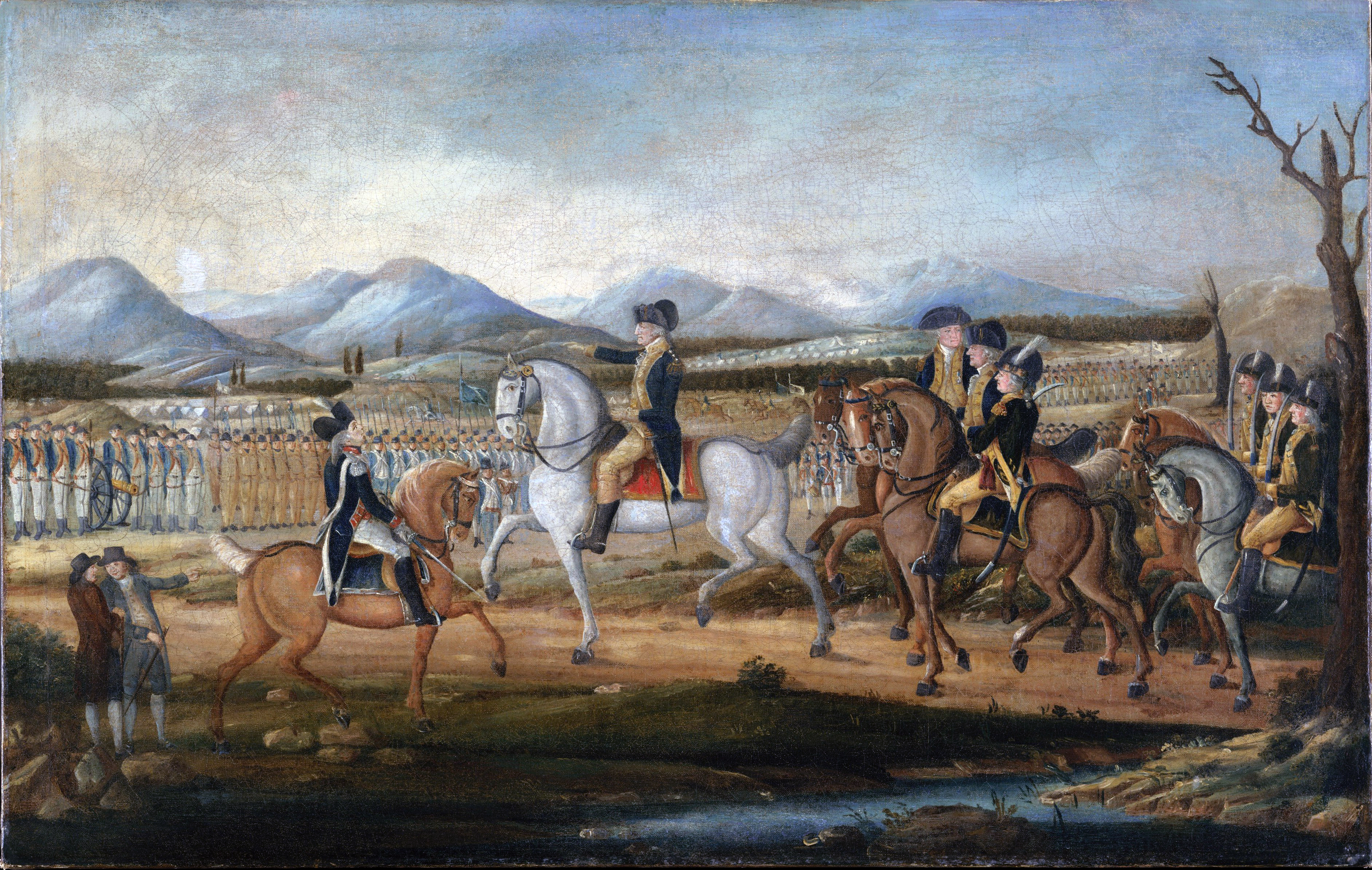
Washington reviewing the militia before marching into western Pennsylvania. Frederick Kemmelmeyer, circa 1795.
Jefferson repealed the tax in 1802, the moment he had the votes to do it. That repeal didn't end illegal distilling. It just pushed it further underground and further west.
Many of the frontier distillers behind the rebellion, most of them Scots-Irish immigrants, moved into Kentucky and Tennessee, specifically to get beyond federal reach. Appalachian terrain made stills hard for tax agents to find, and corn was worth far more as whiskey than as raw grain, one horse could carry ten times the value in liquor that it could in corn. That migration is a real, documented reason bourbon took root where it did.
The tax came back with the Civil War. The Revenue Act of 1862 funded the war and revived the standoff between moonshiners and the agents sent after them, known as revenuers. That standoff lasted for decades and hardened into a distinct Appalachian culture built around evading federal reach, the same instinct Hamilton's original tax provoked in 1791.
By the 1880s, legal whiskey had its own problem. Rectifiers blended neutral grain spirits with iodine, tobacco, prune juice, and sometimes worse, to fake the color and taste of properly aged bourbon. Consumers had no way to know what was actually in the bottle. Honest distillers were losing customers to cheaper, adulterated competitors.
Colonel E.H. Taylor Jr., a Kentucky distiller, led the public fight against rectifiers, though the bill itself came together through Congressman Walter Evans and Treasury Secretary John G. Carlisle. The Bottled-in-Bond Act passed on March 3, 1897, the first federal consumer protection law in American history, nine years before the Pure Food and Drug Act.
The law ran on the same tax infrastructure Hamilton had built in 1791. To carry the bonded label, whiskey had to come from one distiller, at one distillery, in one distillation season, aged at least four years in a federally supervised warehouse. Producers got a tax deferral for participating. Consumers got a government guarantee that what was in the bottle matched the label.
Prohibition turned moonshining into a national business. Bootleggers modified cars to outrun revenue agents on mountain roads, mostly Ford V8s with reinforced suspension and bored-out engines. Junior Johnson started running moonshine at 13, later won 50 NASCAR races, and became one of the sport's first stars. NASCAR's origin traces directly back to those chases.
Tennessee legalized regulated distilleries outside a handful of counties in 2009. Unlicensed moonshine was and still is a federal felony everywhere, that part never changed, what changed was where a license could be legally issued. Ole Smoky opened the first federally licensed moonshine distillery in Gatlinburg on July 4, 2010. Estimates for the legal moonshine industry's size vary widely depending on what gets counted, but figures in the billions of dollars show up consistently.
The same legal principle, not sentiment, still separates a licensed craft distillery today from an illegal one. Unlicensed distilling remains a federal felony, and the federal excise tax on distilled spirits sits at $13.50 per proof gallon, Hamilton's 1791 idea, still on the books, 235 years later.
3. Founding Fathers Actually Drank a Lot
Not many people know the Founding Fathers drank this much.
On September 14, 1787, three days before the Constitution was signed, Washington hosted the First Troop Philadelphia City Cavalry, his longtime Light Horse escort, for dinner at City Tavern. The surviving bill lists 55 gentlemen's dinners, 54 bottles of Madeira, 60 of claret, 8 of Old Stock whiskey, 22 of porter, 8 of cider, 12 of beer, and 7 bowls of punch. That's roughly two bottles of wine per person before anyone touched the whiskey or the punch. Adjusted for inflation, the bill runs to something like $15,600.
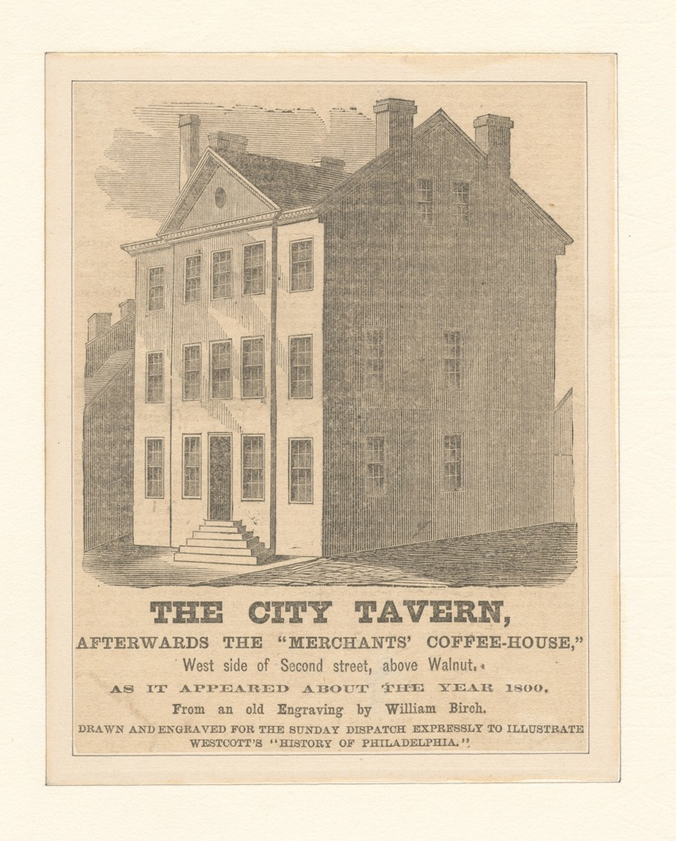
City Tavern as it appeared around 1800, from an engraving by William Birch.
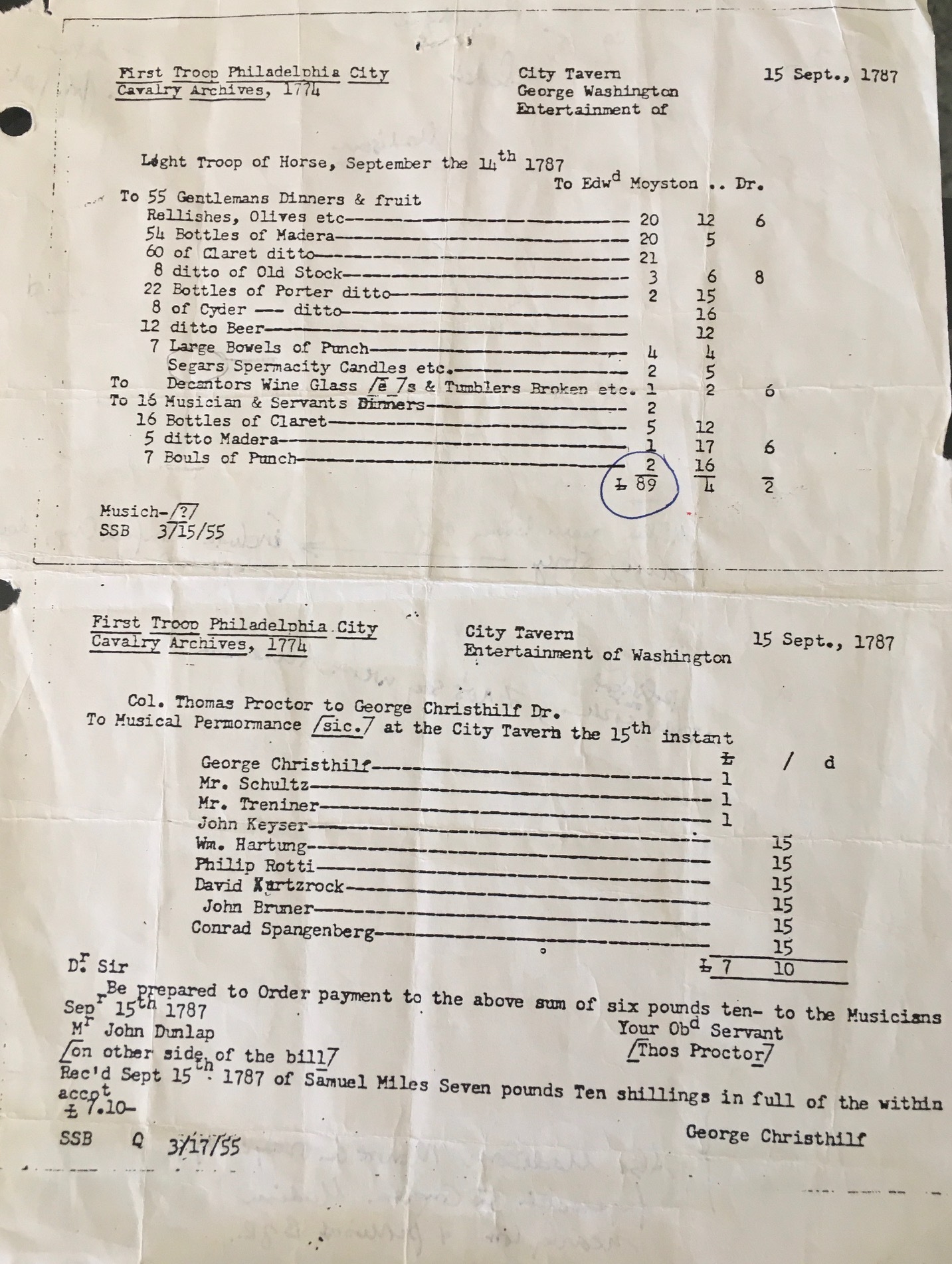
The actual bill from Washington's September 14, 1787 dinner. Courtesy of Dr. Gordon Lloyd, Pepperdine University.
Washington's own relationship with spirits went well past hosting. After his presidency, he built one of the largest whiskey distilleries in the country at Mount Vernon, producing around 11,000 gallons in 1799 alone. Mount Vernon picked July 4th to release its first bourbon, timed to America's 250th anniversary. Spirit of '76 Cask Strength, seven years old, about 350 bottles, sold only at the estate.

The reconstructed Distillery at Mount Vernon, marking its 1797 construction.
Two recipes survive from that era, and they take genuinely different approaches to entertaining.
Martha Washington's Rum Punch
- 3 oz white rum
- 3 oz dark rum
- 3 oz orange curaçao
- 4 oz simple syrup
- 4 oz lemon juice
- 4 oz fresh orange juice
- 3 lemons, quartered
- 1 orange, quartered
- ½ tsp grated nutmeg
- 3 cinnamon sticks, broken
- 6 cloves
- 12 oz boiling water
Developed by Mount Vernon and the Distilled Spirits Council as an interpretation of what Martha likely served at the estate, not a literal 18th-century written recipe. Serves 6-10. Mash the orange, lemons, cinnamon, cloves, and nutmeg together in a container. Add the syrup, lemon juice, and orange juice. Pour the boiling water over the mixture and let it sit a few minutes so the spices open up. Once cool, stir in both rums and the curaçao. Strain well into a pitcher or punch bowl. Serve over ice, garnished with citrus wheels.
Benjamin Franklin's Milk Punch is the more unusual of the two. This one isn't folklore. Franklin wrote out the recipe himself and mailed it. On October 11, 1763, preparing to leave Boston for Philadelphia, Franklin sent a letter to his friend James Bowdoin enclosing a recipe “To make Milk Punch.” The original letter survives at the Massachusetts Historical Society. It's a clarified punch, a technique where hot milk curdles on contact with citrus and alcohol, then gets strained until the liquid runs clear, closer to kitchen science than anything most people picture from the 1760s. Franklin's original recipe made an enormous batch. What follows is the Historical Society's own scaled-down version, at one quarter of his original proportions.
Benjamin Franklin's Milk Punch
- 6 cups (3 pints) brandy
- 11 lemons, zested
- 2 cups fresh lemon juice
- 4 cups spring water
- 1 whole nutmeg, grated
- 1 1/8 cups sugar
- 3 cups whole milk
Steep the lemon zest in the brandy for 24 hours, then strain it out. Add the water, lemon juice, sugar, and nutmeg to the brandy and stir until the sugar dissolves. Bring the milk to a boil and add it hot to the brandy mixture, it will curdle on contact. Let the punch stand for two hours, then strain through a jelly bag or cheesecloth until it runs clear. Serve cold.
Martha's punch is warm and built for a crowd. Franklin's is closer to kitchen science, producing something that looks nothing like what went into it. Both still worth making 250 years later.
4. Immigrants Built This
Immigration is the through-line across almost everything in this section.
William Laird brought Scottish distilling knowledge directly to New Jersey and created America's first native spirit. The Scots-Irish farmers who resisted the whiskey tax and then relocated to Kentucky and Tennessee carried their stills and their distilling traditions with them, and that migration is a direct line to bourbon as it exists today.
Heaven Hill's own founders were immigrants too. Five Shapira brothers, sons of a Lithuanian Jewish immigrant, bought out the original investors within two years of the 1935 founding. Descendants of the family still run it today.
Enslaved and free Black distillers are part of this story too, and it's one this site has already told properly rather than compress into a paragraph here. Nathan “Nearest” Green taught Jack Daniel how to distill whiskey, and the Black distillers, perfumers, and blenders building on that legacy today are covered in full in Juneteenth Special: The Builders You Never Heard Of. That piece is the better place to go for that story, not a summary tacked onto this one.
5. A Few Dates Worth Knowing
- 1780: Laird & Company incorporated, oldest licensed distillery in the US
- 1791–1794: The Whiskey Rebellion
- 1862: The Revenue Act reinstates the federal liquor tax to fund the Civil War
- March 3, 1897: The Bottled-in-Bond Act, the first consumer protection law in US history
- 1920–1933: Prohibition, which nearly wiped out both bourbon and applejack, Laird's survived on a medicinal production license
- 1984: Blanton's, the world's first single barrel bourbon, Elmer T. Lee, Buffalo Trace
- July 4, 2010: Ole Smoky opens the first federally licensed moonshine distillery
- January 19, 2025: American Single Malt Whiskey becomes an official TTB category, the first new whiskey classification added in over 50 years
6. Houses and Distilleries Worth Knowing
Laird & Company, the oldest licensed distillery in the country, still family-run, ten generations in. Laird & Company released a 13-Year Tribute in 2026, marking 328 years of family distilling. The Laird family started making apple brandy in New Jersey seventy-eight years before the country existed. Eighth, ninth, and tenth generation family members still run it today.

Laird's America's 250th Limited Release, 13 Years Old. Courtesy of Laird & Company.
Buffalo Trace, home of Blanton's and Elmer T. Lee, a National Historic Landmark. The site burned down in 1882, when it was still called the O.F.C. Distillery, and was rebuilt shortly after.
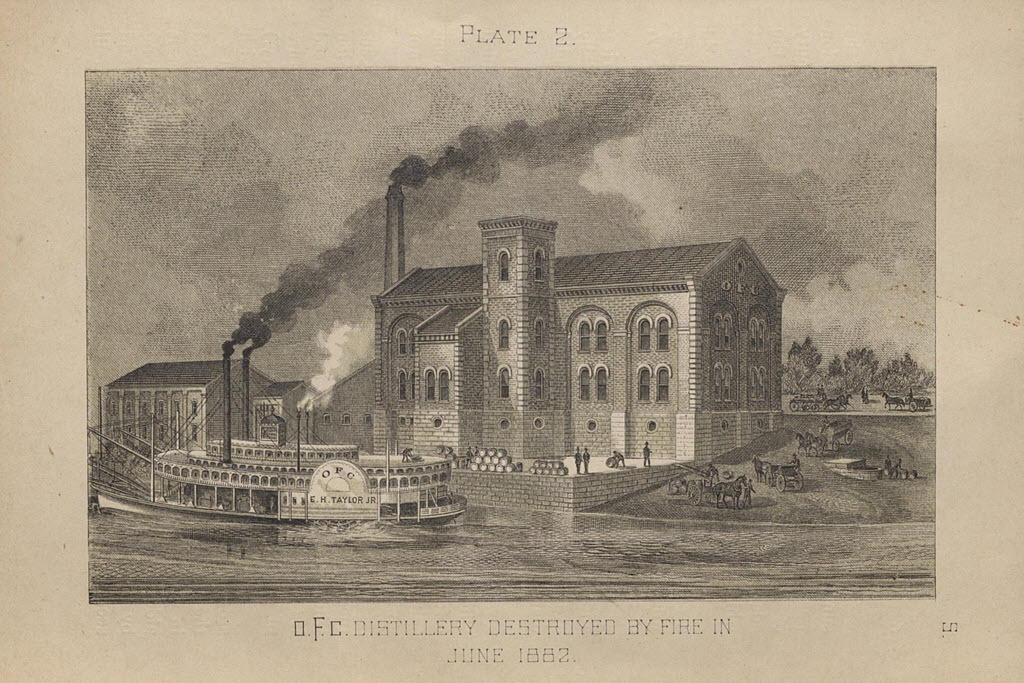
The O.F.C. Distillery, destroyed by fire in June 1882. Rebuilt on the same site, now Buffalo Trace.
Before 1984, bourbon brands blended barrels together for a consistent taste. Elmer T. Lee broke that pattern at what's now Buffalo Trace. He remembered Colonel Albert B. Blanton handpicking single barrels from Warehouse H to share with guests. Lee revived that practice and named the bourbon after him. Blanton's launched in 1984 as the first commercially sold single barrel bourbon. Every bottle comes from one barrel instead of a blend, so no two taste exactly alike.
Heaven Hill, one of the few houses that kept Bottled-in-Bond alive through the deregulated 1980s when most of the industry dropped it.

The Heaven Hill Bourbon Experience in Bardstown, built as a replica of the original 1935 distillery.
Jack Daniel's, whose real history runs through Nathan Green and is told properly in Juneteenth Special: The Builders You Never Heard Of rather than repeated here.
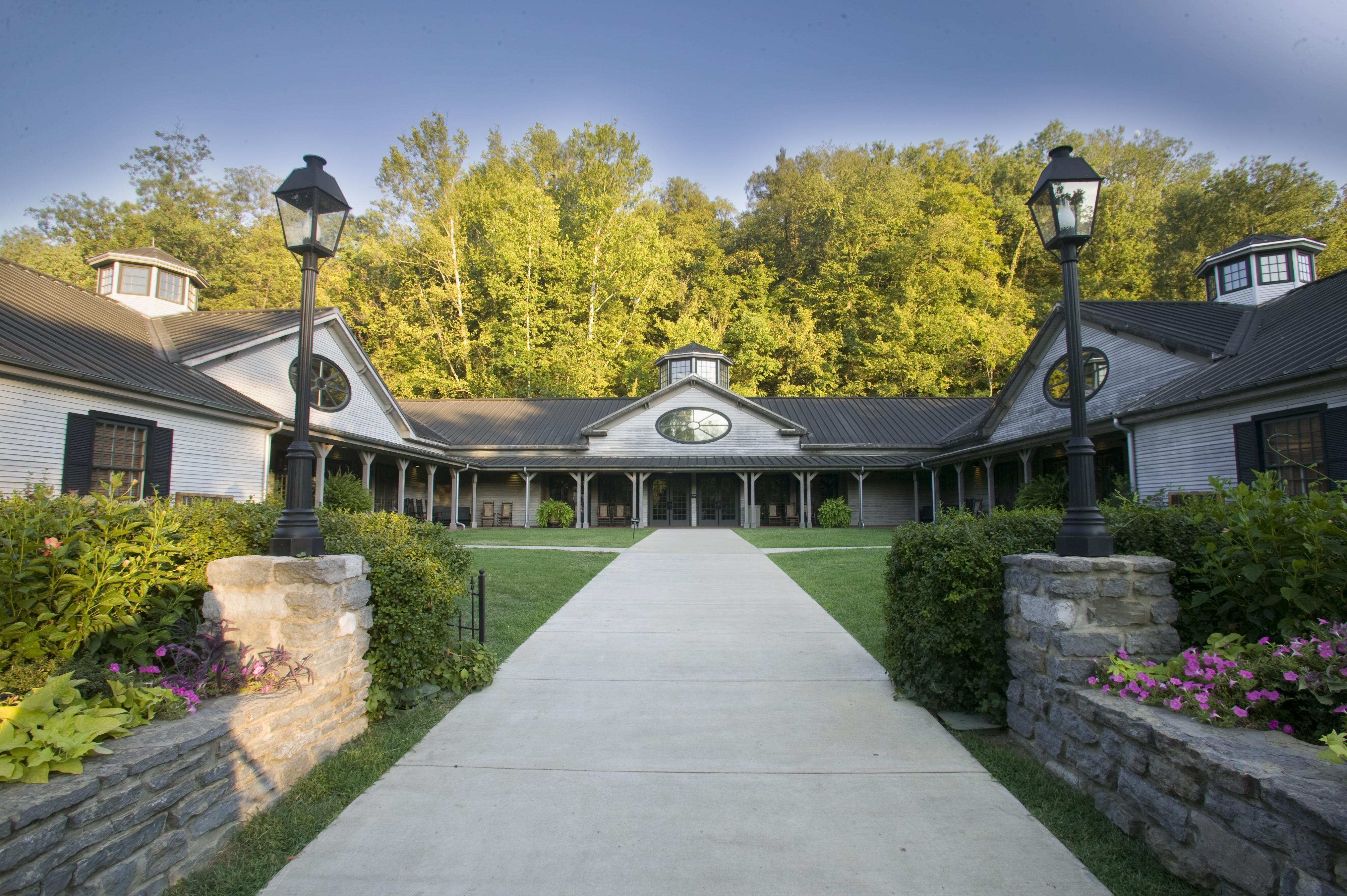
Jack Daniel's Visitor Center, Lynchburg, Tennessee.
Part 2 picks up with American perfume, an industry that's less than a century old, and the marketing machinery, books, theater, film, music, and platforms, that sells both spirits and perfume today.
Spirits are the older story here. Part 2 turns to perfume, an American industry that's only about eighty years old, and the marketing machinery that sells both.