Tobacco is the oldest cash crop in this whole series, older than rum, older than the country itself. America’s role in cigars was never really about inventing the leaf. It was about growing a piece of it, housing the people who rolled it, and then, with one signature, cutting the whole industry off from its own source.
America's 250th — A Five-Part Series
24. Tobacco Before Anything Else
Indigenous people across the Americas grew and smoked tobacco for centuries before any European ship arrived. English colonist John Rolfe planted a sweeter Trinidadian strain of it at Jamestown around 1612, after the colony had nearly starved to death trying to find something, anything, to sell back to England.
It worked. By 1617 Virginia was exporting 20,000 pounds of tobacco a year. That figure doubled the next year. Tobacco became Virginia’s currency in the most literal sense: colonial taxes, court fines, and government expenses were all paid in pounds of leaf. The crop exhausted soil fast and demanded constant labor, which is a direct line to why the Chesapeake became a plantation economy built on indentured servitude and then slavery, decades before rum’s version of the same story played out in New England.
None of that early Virginia leaf was cigar tobacco in the modern sense. It was pipe and chewing tobacco, grown for volume. The cigar-specific story starts somewhere else entirely: Cuba.
25. Ybor City, and the Cigars That Weren’t Quite Cuban
Cuban cigar manufacturing moved to American soil for the same reason a lot of industries relocate: tariffs and politics. Vicente Martinez Ybor ran a successful cigar factory in Havana, but Cuba’s war for independence and Spain’s tariffs on his own product made staying impossible. He shifted operations to Key West in the 1860s, then to a patch of undeveloped land outside Tampa in 1885, a company town that became known as Ybor City.
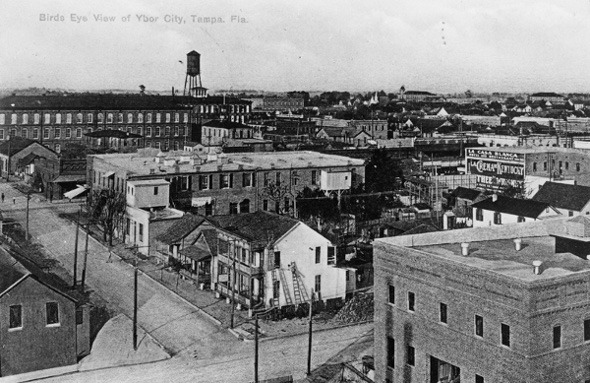
Ybor City, outside Tampa, around 1900, at the height of its cigar-manufacturing boom.
Thousands of Cuban, Spanish, and Italian immigrants followed the work. By 1910, more than two hundred factories in the Tampa area were rolling over a million cigars a day, entirely by hand, using leaf imported straight from Cuba. Tampa was, by any honest measure, a Cuban industry operating on American soil, not an American invention.
The legal name for what Tampa was making mattered too. Cigars rolled in the US from genuine Cuban leaf were sold as Clear Havanas, taxed as a domestic product purely because of where they were rolled, even though the tobacco inside and the flavor were entirely Cuban.
The most distinctive part of factory life, in Tampa and back in Havana itself, was the lector, a reader elected and paid by the workers to read aloud while they rolled. Lectors read newspapers, revolutionary tracts, and novels, all chosen by the workers, not the owners. Lectors reading radical labor material helped drive Ybor City’s major cigar strikes of 1920 and 1931, and Tampa’s factory owners banned the practice for good after the 1931 strike, replacing readers with radios. It was, in its own way, tiki’s cultural-borrowing question turned around: an imported Cuban tradition that shaped American labor history before American industry shut it down.
Havana’s own lector tradition produced a more famous footnote, and it belongs to Cuba, not Tampa. Rollers at Havana’s Particulares factory reportedly loved hearing Alexandre Dumas’s The Count of Monte Cristo read aloud. When Alonso Menendez bought that factory and launched a new brand in 1935, he named it after the novel: Montecristo. Two years later he bought Havana’s H. Upmann factory, founded in 1844 by a German banker named Hermann Dietrich Upmann, and moved Montecristo production there. Both names are still among the most recognized in cigars today, and neither one started as American. They are Cuban brands, split since 1960 between state-run production in Havana and exile-founded production in the Dominican Republic.
26. The One Leaf America Actually Grows
Cigar tobacco does have one genuinely American chapter, and it comes from an unlikely place: the Connecticut River Valley, a few hundred miles north of anywhere a cigar is usually associated with.
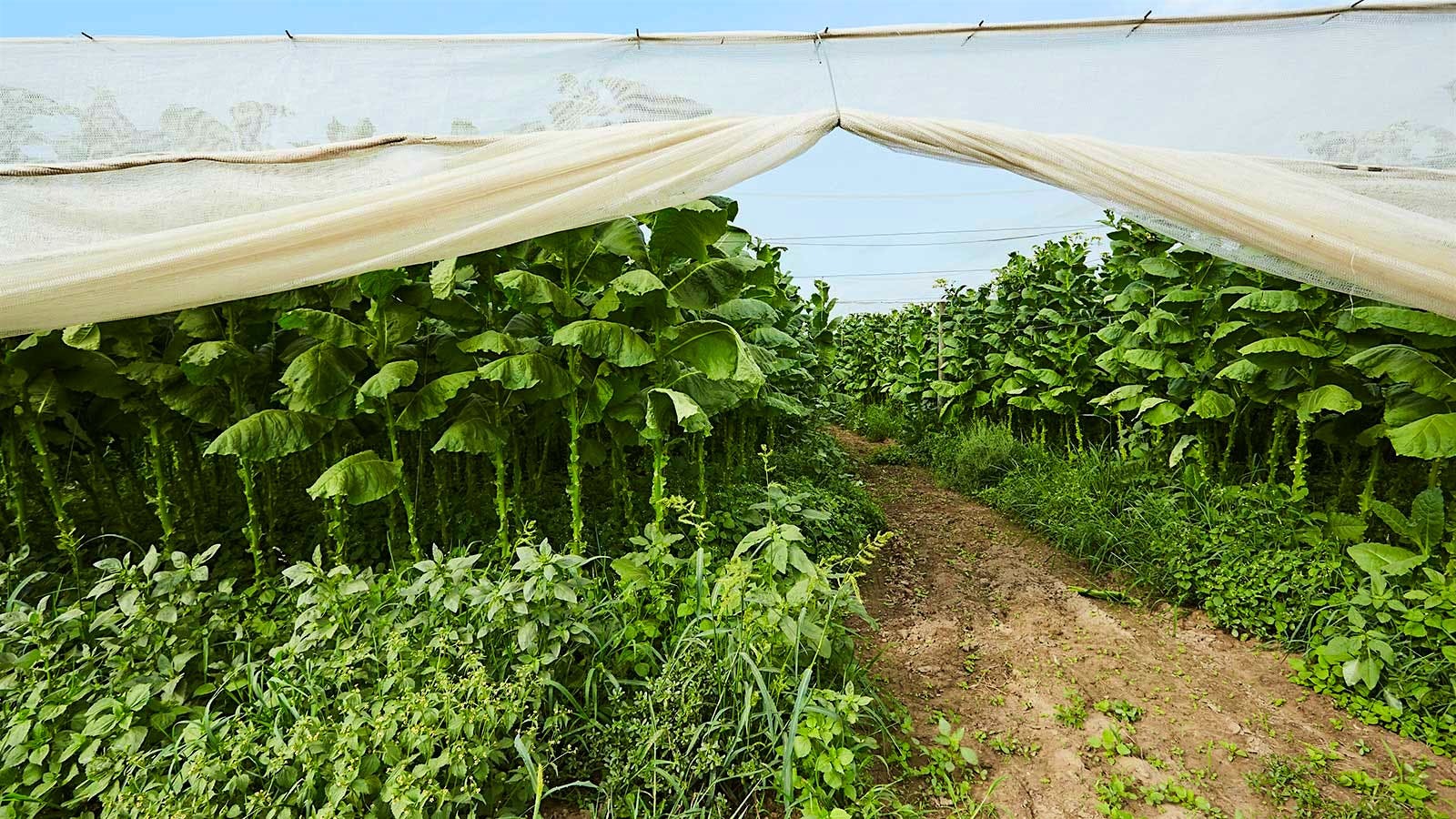
Connecticut shade tobacco growing under cheesecloth netting, mimicking Sumatra’s filtered light.
Farmers there had grown tobacco since the 1630s, originally for pipes. By the 1820s they’d shifted to cigar wrapper leaf, and by the early 1900s they were stretching cheesecloth tents over entire fields to grow tobacco in filtered shade, mimicking the growing conditions of Sumatra. The result, Connecticut Shade, became one of the most prized cigar wrappers in the world, mild and golden, wrapped around brands like Macanudo, Ashton, and the Dominican-made Montecristo line sold in the US today.
At its peak in the 1920s and 1930s, more than 20,000 acres of the Connecticut Valley were under cultivation. By 2025, true Connecticut Shade was down to 35 acres, all on a single farm in Massachusetts. Broadleaf, a related but different variety grown in full sun rather than under cloth, is a separate story: Connecticut and Massachusetts together still had roughly 3,000 acres of tobacco in cultivation as of the 2022 USDA Census of Agriculture, almost all of it broadleaf. Cheaper labor in Ecuador and Central America, using Connecticut seed but not Connecticut soil, took over most of the shade market specifically. The genuine article still exists, still commands a premium, and still can’t legally be grown anywhere else and called Connecticut Shade.
27. One Signature, One Industry, Overnight
On February 7, 1962, President Kennedy signed Proclamation 3447, banning all trade between the United States and Cuba, cigars included. According to his press secretary Pierre Salinger, writing about it thirty years later, Kennedy asked him the night before to quietly track down about a thousand of his favorite H. Upmann Petit Coronas. Salinger came back with twelve hundred. Only then did Kennedy sign the order.
That detail is one man’s account, not an official record. Better to flag that upfront than repeat it as settled fact. What’s not in dispute is what the embargo did next. Cuban-exile cigar makers who’d already fled after the 1959 revolution and 1960 nationalization, the same Menendez family behind Montecristo among them, rebuilt their brands from scratch in the Dominican Republic, Honduras, and Nicaragua. They carried their family names, their rolling techniques, and in some cases the same brand names, repurposed under new trademarks since Cuban ownership claims weren’t recognized under US law after nationalization.
That rebuilding is the entire premium cigar industry most Americans actually smoke today. Dominican and Nicaraguan tobacco, often finished in genuine or Ecuadorian-grown Connecticut wrapper, built on a foundation of displaced Cuban expertise. The embargo did not end the Cuban cigar. It just relocated the industry that grew up around it, permanently, to three other countries, while the original stayed frozen in place, still illegal to bring home, still mythologized because of it.
Cohiba shows what happens when the same name ends up on both sides of that split, and unlike Montecristo, this one is still being fought over. Cuba created Cohiba in 1966 as Fidel Castro’s personal cigar, supplied to him and top officials, and released it to the public in 1982. General Cigar registered the Cohiba trademark in the United States in 1978, years before Cuba ever sold the cigar commercially, and has sold a Dominican-made version here ever since. Cubatabaco sued to cancel that US trademark in 1997, and the case has swung back and forth in court for over 25 years. In May 2025, a federal district court ruled against General Cigar, upholding the cancellation of its federal registration. That doesn’t end the story on shelves, though. General Cigar’s common law trademark rights, built on decades of continuous sales, remain valid separately from the federal registration, and the company says its Cohiba will keep selling in the US as it has for nearly 50 years. Whatever happens on appeal, it is the clearest live example of exactly what this section is about: two companies, two countries, one name, and a legal fight the embargo made possible in the first place.
28. Miami, Where the Exile Industry Still Performs Itself
Tampa was the first American cigar city. Miami is the second, and it exists for an entirely different reason: the 1959 revolution, not 19th-century tariffs.
Simon Camacho opened Miami’s first cigar factory in 1961, two years after Castro took power and a year before the embargo. Three more exiles opened factories within months of each other in 1964, including Jose Orlando Padron, who rented a Little Havana storefront and rolled 200 cigars a day by hand after his family’s Cuban tobacco farms were confiscated. Ernesto Perez-Carrillo Sr., a former Cuban senator, followed in 1968 with El Credito Cigars, where the non-Cuban La Gloria Cubana brand was born.
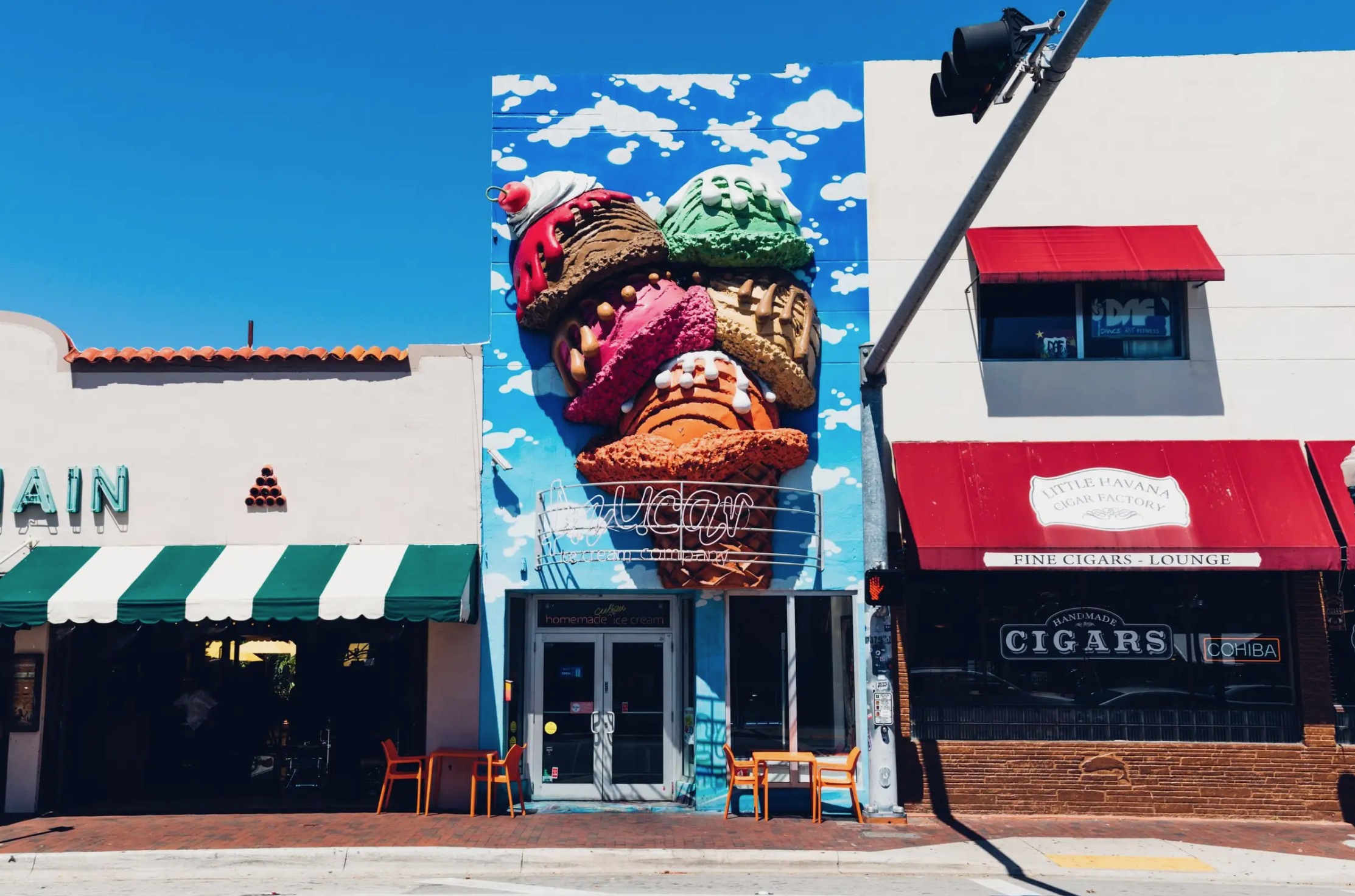
A storefront cigar roller on Calle Ocho, Little Havana, Miami.
Padron’s own story turned violent in 1978, after he traveled back to Cuba on a humanitarian visit that helped free thousands of political prisoners. A photo of him handing Castro a cigar reached Miami’s exile community, a boycott followed, and three bombs went off at his company headquarters. He kept the business running.
Almost none of that history changes the basic economics. Rolling a cigar in Miami costs roughly twenty times what it costs in Nicaragua, so nearly every major brand that started on Calle Ocho, Padron, La Gloria Cubana, Don Pepin Garcia’s Tatuaje, has since moved its real production offshore. What’s left in Little Havana today is smaller, closer to theater than industry: a strip of storefront fabricas where tourists watch Cuban-trained rollers work by hand, alongside cafecito windows and a game of dominoes in Maximo Gomez Park. It is the visible, tourist-facing remnant of an exile industry whose actual manufacturing has already moved on, much like Ybor City’s own relationship to Cuba a century earlier, just with the roles of visitor and source reversed.
The generation after the original 1960s exiles kept expanding who gets to be an American cigar maker at all. Rafael Nodal left Cuba as a teenager on the 1980 Mariel boatlift, spent four days at sea to reach Miami, and later built Aging Room into one of the highest-rated boutique brands in the country. Rocky Patel, an Indian-American who left a Hollywood entertainment law practice, and Steve Saka, who created the Liga Privada line before founding his own Dunbarton Tobacco & Trust, built major American cigar brands with no Cuban exile lineage behind them at all. By the 2000s, being an American cigar maker no longer meant being a Cuban exile specifically. It meant being any of the people the industry let in once the door was open.
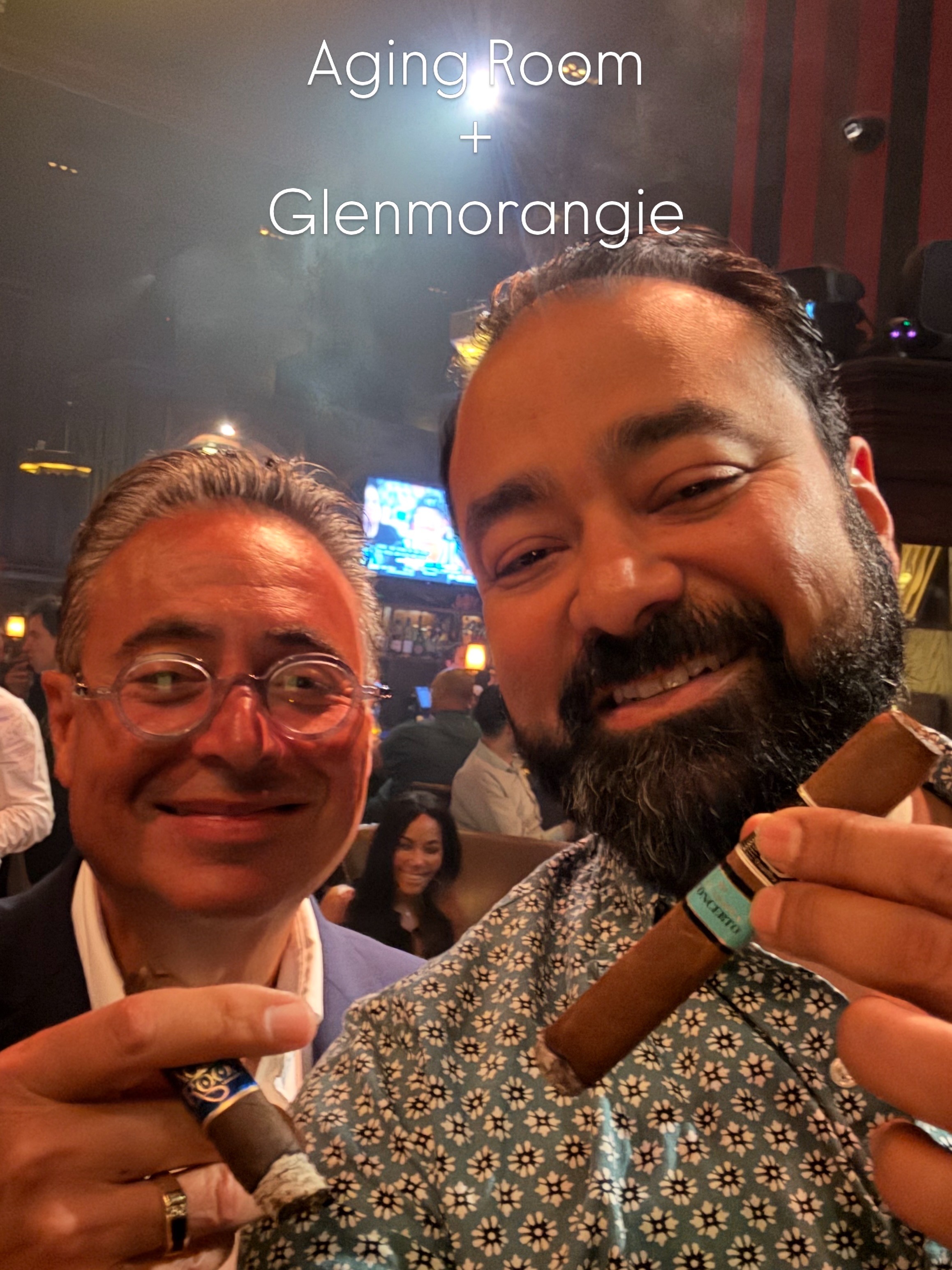
With Rafael Nodal at the Carnegie Club, at an Aging Room and Glenmorangie pairing.
Dates Worth Knowing
- 1612: John Rolfe plants the first commercially successful tobacco crop at Jamestown
- 1630s: Tobacco farming begins in the Connecticut River Valley
- 1820s: Connecticut Valley tobacco shifts toward cigar wrapper leaf
- 1869: Vicente Martinez Ybor opens a cigar factory in Key West, Florida
- 1885: Ybor relocates operations to what becomes Ybor City, outside Tampa
- 1900s: Connecticut farmers begin growing tobacco under cheesecloth shade
- 1920 and 1931: Major Ybor City cigar strikes, driven partly by lector-read material
- 1931: The lector tradition is banned in Ybor City factories after the strike
- 1935: Alonso Menendez launches Montecristo in Havana
- 1937: Menendez acquires the H. Upmann factory and moves Montecristo production there
- 1960: Cuba nationalizes the cigar industry; the Menendez family and others flee
- 1961: Simon Camacho opens Miami’s first cigar factory
- February 7, 1962: Kennedy signs the Cuban trade embargo, Proclamation 3447
- 1964: Jose Orlando Padron opens a Little Havana storefront that becomes Padron Cigars
- 1968: Ernesto Perez-Carrillo Sr. opens El Credito Cigars, birthplace of La Gloria Cubana
- 1978: Padron’s Miami headquarters is bombed after his humanitarian visit to Cuba
- 1978: General Cigar registers the Cohiba trademark in the US, four years before Cuba sells it commercially
- 1980: Rafael Nodal leaves Cuba as a teenager on the Mariel boatlift
- 1995: Rocky Patel founds what becomes Rocky Patel Premium Cigars
- 2015: Steve Saka founds Dunbarton Tobacco & Trust after creating Liga Privada at Drew Estate
- 2025: The US Trademark Trial and Appeal Board rules against General Cigar in the Cohiba trademark case
Houses and Brands Worth Knowing
Ybor City, Tampa, Florida, the historic center of American cigar manufacturing, now a National Historic Landmark District.
The Connecticut River Valley, the only place on earth that can legally call its tobacco Connecticut Shade, still supplying wrapper leaf to premium cigar brands worldwide.
Padron Cigars, founded from a Little Havana storefront in 1964, production long since moved to Nicaragua, company headquarters still in Miami.
El Credito Cigars, Calle Ocho, Miami, birthplace of the La Gloria Cubana brand in 1968, still rolling cigars on site for visitors today.
Cohiba (US version), an American trademark since 1978, made in the Dominican Republic and sold by General Cigar since decades before Cuba's own Cohiba ever reached the public.
Aging Room, founded by Rafael Nodal, a 1980 Mariel boatlift exile, now one of the most decorated boutique cigar brands in the country.
Rocky Patel Premium Cigars, Naples, Florida, founded by Indian-American entrepreneur Rakesh “Rocky” Patel after he left a Hollywood legal practice.
Dunbarton Tobacco & Trust, founded by Steve Saka, creator of Drew Estate’s Liga Privada line before starting his own company in 2015.
29. Where This Leaves Things
None of the spirits in this series started as American inventions. Whiskey came from Scots-Irish immigrant distillers. Rum came from Caribbean sugar plantations. Tequila is Mexican, protected as Mexican by law. Gin, vodka, and liqueurs each trace back to European roots brought over by immigrants too. Tobacco came from indigenous farmers, long before cigars existed as their own category. America took each one and built an industry or a marketing machine around it.
Perfume tells the same story from a different angle. America didn’t invent fragrance either, but Estée Lauder built an empire on it starting in 1946, and the marketing machine around it, books, theater, film, music, and now platforms, sells both spirits and perfume today at a scale that outpaces what America actually owns.
Tiki took that pattern furthest of all. It was a total fabrication built in a converted Hollywood storefront, and it now has a working museum of itself in Tokyo and a bar in Munich that’s been open since 1971. The rum blend behind it, invented by a man who had barely visited the Pacific, is still on drink menus in London, Berlin, and Hong Kong today. The cigar embargo on Cuba runs that same idea backward. One signed proclamation relocated an entire country’s cigar industry to three other countries within a few years. American companies now own the marketing and distribution rights to a spirit, tequila, they are legally barred from distilling on their own soil.
Spirits and perfume run on two different clocks. Spirits go back to before the country existed. Perfume goes back about eighty years. Both run on immigrant founders anyway: Laird, the Shapira brothers at Heaven Hill, Estée Lauder, Ralph Lauren.
The one group excluded from all of this was the one that grew tobacco here first. Native nations were barred by federal law from distilling on their own land for 184 years, a restriction that only lifted in 2018. Every other tradition in this piece got exported, borrowed, or sold back to the world in some form. That one was blocked at the source until a few years ago.
Here’s where I’d like to see that go next. Alcohol and tobacco have caused real, documented harm in Native communities, on land that was taken from those same communities in the first place. I’d like to see the companies built on that land, and on that history, put real money behind treating alcoholism and tobacco-related cancers in Indian Country, not as a marketing gesture but as an ongoing commitment. I’d also like to see more of what Talking Cedar and Copper Crow are already doing: distilleries built on actual Native ownership, using techniques and ingredients with real roots in Native communities, not just tribal land hosting someone else’s brand.
The faces selling all of this still skew narrow. Depp, Pitt, McConaughey, Dylan, that’s the roster of top-dollar endorsement deals this series found, and almost none of them are immigrants in a story built almost entirely on immigrant founders. Perfume has its own version of that same gap. Niche houses have built real audiences through social media since Barneys closed. They deserve real department store space for it, and real transparency in sourcing across niche, designer, and clone houses alike. Whiskey already has a model worth following. Small distilleries are leading on sustainable practices, local grain, spent mash reuse, less water waste. Bigger houses still treat it as a marketing angle instead of catching up. I want that same standard everywhere in this series, spirits, perfume, tobacco alike: sourcing and sustainability as the default, not a footnote, the same way Bottled-in-Bond made honesty the default a century ago.
America turns 250 this year. I feel more hope than worry about what happens next. The Lairds, Nathan Green, Estée Lauder, Donn Beach, José Orlando Padrón, Rafael Nodal, none of them set out to build an industry. They just kept working, and it added up over decades or centuries, depending on where you start counting. I think the next 250 years get built that way too, by people nobody’s watching yet. I’m glad to be around for the start of it.