Key Takeaways
- Negroni Week runs September 21-27, 2026, an Imbibe Magazine initiative since 2013 that has raised over $5 million for Slow Food through nearly 15,000 participating bars worldwide.
- The popular Count Camillo Negroni origin story is disputed by cocktail historians; what's solid is the drink's lineage from the 1860s Milano-Torino through the Americano.
- The Boulevardier (bourbon), White Negroni (Lillet Blanc and Suze), and Negroni Sbagliato (prosecco) all keep the same equal-parts structure while reworking one or two ingredients.
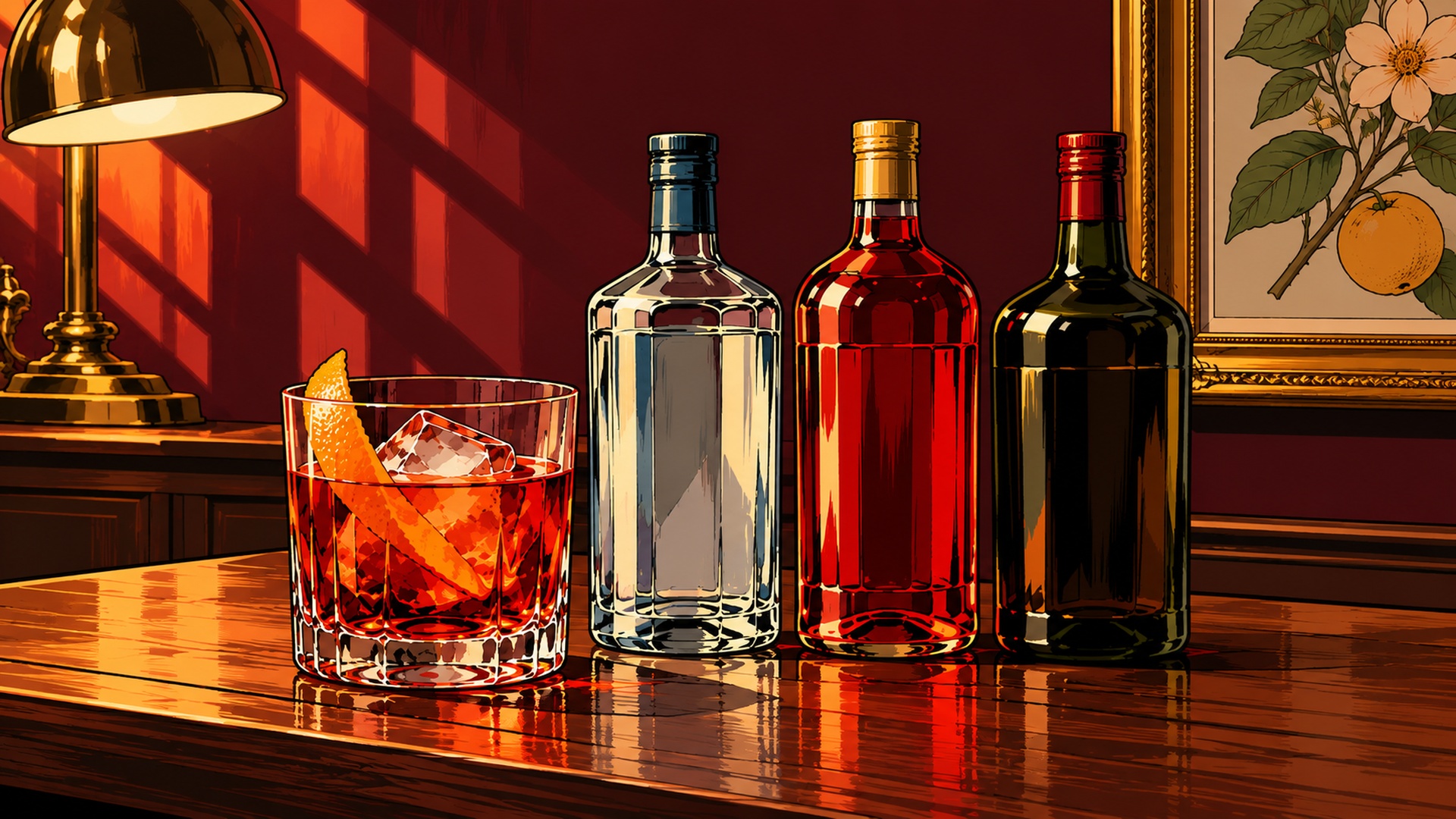
Negroni Week runs September 21 through 27 this year, put on by Imbibe Magazine since 2013. The mechanics haven't changed much in over a decade: a bar registers with a donation to Slow Food, then spends the week pouring Negronis and Negroni riffs, often layering in a share of the week's sales on top. It has grown from roughly 120 venues at the start to close to fifteen thousand bars across more than ninety countries last year, and it has raised over five million dollars since it began. The more interesting question is why an equal-parts drink this simple has stayed interesting for more than a century, and why bartenders keep pulling it apart and rebuilding it.
Equal parts gin, Campari, and sweet vermouth, stirred with ice, then either strained over fresh ice or built and stirred directly in a rocks glass, with orange peel expressed over the top. One large cube or a handful of standard ice cubes both work. That's the whole drink. Every component is right there at full strength, which means a bad bottle of vermouth or a gin that doesn't want to share the glass ruins the drink immediately. Simplicity is usually the hardest thing to execute well, and the Negroni is the clearest proof of that in any bar's well.
Three things wreck a Negroni. Vermouth is a fortified wine, not a spirit. Once opened, it starts fading within a few weeks even refrigerated, and a tired bottle turns the whole drink flat and dull no matter how good the gin is. Dilution matters more than people expect for a drink with no mixer to hide behind; with typical home-bar ice, 30 seconds or so is a useful starting point, but the right endpoint is temperature and dilution, not the stopwatch. And gin choice changes the drink more than most riffs do: a juniper-forward London dry holds its own against Campari, while a softer, citrus-heavy gin can disappear under it. None of that is exotic knowledge, but a Negroni built on a stale vermouth bottle and a ten-second stir isn't really the same drink as one built with attention to either.
The Story Everyone Tells, and the Problem With It
The popular version credits Count Camillo Negroni, who supposedly walked into Caffè Casoni in Florence around 1919 and asked bartender Fosco Scarselli to strengthen his usual Americano, an aperitif of Campari, sweet vermouth, and soda. Scarselli swapped the soda for gin and used an orange peel instead of lemon to mark the new drink apart from the one it came from.
It's a good story. Cocktail historian David Wondrich, one of the most careful researchers working in this field, looked into Camillo Negroni's actual biography and found his status as a count questionable, though his grandfather Luigi genuinely held the title. Colonel Hector Andres Negroni went further, arguing there's no Camillo Negroni at all in the documented Negroni family genealogy, which runs back to the eleventh century, and proposed an entirely different origin instead: a French general, Pascal Olivier, Comte de Negroni, building a vermouth-based drink at an officers' club in Lunéville decades earlier. That account has its own chronology problem, though: different tellings date it as early as 1857, before Campari existed at all, and as late as 1914, the year after Pascal Olivier himself died. Neither origin story has a contemporary source from 1919 confirming it. What's solid is the lineage the drink sits inside. The Milano-Torino, equal parts Campari and sweet vermouth, was already established by the 1860s. Add soda and it becomes an Americano. Swap the soda for gin and you have a Negroni, whoever actually made that swap first and whatever his real name was.
Even the equal-parts ratio itself took decades to lock in. A 1953 British bartenders' guide describes the Negroni as stirred equal parts with a lemon twist, not the orange garnish that's standard today. The International Bartenders Association didn't put out an official cocktail list until 1961 (developed the year before, fifty drinks in that first edition), and the Negroni was on it from the start, orange garnish included. The drink existed for roughly forty years before the IBA codified a standard version.
The Riffs on a Negroni
Swap the gin for bourbon and you get the Boulevardier. Credit for it usually goes to Erskine Gwynne, an American writer living in 1920s Paris, with the recipe reaching print in Harry MacElhone's 1927 book Barflies and Cocktails at equal parts bourbon, Campari, and sweet vermouth, the same ratio as a Negroni, with whiskey standing in for gin. The now-common 3:2:2 build came from a 2007 revival by cocktail historian Ted Haigh; the IBA adopted it as the official ratio in 2020, but it isn't the drink's original proportions. Either way it reads richer and rounder than a Negroni, the way bourbon's vanilla and caramel sit differently against Campari's bitterness than gin's botanicals do.
Swap the gin for sparkling wine and you get the Negroni Sbagliato, sbagliato meaning mistaken in Italian, created in 1972 by Mirko Stocchetto at Bar Basso in Milan. The familiar story goes that he grabbed the wrong bottle during a busy service, reaching for gin and coming up with sparkling wine instead, and the drink worked well enough that he kept making it on purpose from then on. It stayed a Milan specialty for decades until 2022, when actor Emma D'Arcy named it as a favorite drink in an interview, a clip that turned into enough of a moment online that prosecco-based Negronis started showing up on cocktail menus well outside Italy.
Keep the gin, but swap the vermouth and Campari for something French, and you get the White Negroni, built in the summer of 2001 by bartender Wayne Collins and Nick Blacknell, Plymouth Gin's brand director at the time, while the two were stuck in a small town outside a wine fair in Bordeaux with a limited bar and a craving for a Negroni anyway. Collins reached for Lillet Blanc in place of sweet vermouth, Blacknell suggested Suze for the Campari's bitterness, and Plymouth Gin stayed as the base. It sat mostly unnoticed outside a small circle of bartenders until Audrey Saunders started pouring it at New York's Pegu Club, working from Suze bottles Plymouth's own brand ambassador was reportedly bringing into the country before it was formally imported. Suze got a real US import deal in 2012, and the drink has been a fixture on cocktail menus since.
Why the Ratio Is the Actual Subject
Every one of these riffs keeps the same structural idea: something spirit-forward, something bitter, something that rounds the two out, in roughly equal measure. What changes is which bottle plays which role. Bourbon instead of gin changes the base without touching the balance. Prosecco instead of gin turns the whole drink lighter without abandoning the Campari backbone that makes it a Negroni at all. Lillet and Suze swap out the Italian bitter-and-vermouth pair for a French one and somehow still land somewhere recognizable. A three-ingredient drink turns out to be an unusually forgiving template, since every part sits in full view with nothing else to cover for it. Change a part, sometimes two, even nudge the ratio a little, and the drink still holds together, because what makes it a Negroni was never the exact math. It's the balance between something spirit-forward, something bitter, and something that rounds the two out.
Cheers.
Pull up a chair.
New writing on fragrance, spirits, and cigars goes up multiple times a week. Subscribe free on Substack for the Bite-Sized Brief, or pay a nominal fee to read the full article.

Sources
- Negroni Week's founding by Imbibe Magazine in 2013, the Slow Food charity partnership, its growth to nearly 15,000 venues in over 90 countries, and the 2026 dates (September 21-27): Negroni Week, "About"; Campari, "Negroni Week"
- The Count Camillo Negroni/Fosco Scarselli/Caffè Casoni origin story, David Wondrich's research, Colonel Hector Andres Negroni's counter-claim, the Pascal Olivier de Negroni theory and its own chronology problems, and the Milano-Torino/Americano lineage: Wikipedia, "Negroni"
- IBA's first official cocktail list, approved 1961 at the Gausdal Mountain Hotel in Norway, Negroni included from the start, and the IBA's current official Negroni recipe (equal 30ml parts, half-orange-slice garnish): IBA, "Cocktails"; IBA, "Negroni"; Wikipedia, "List of IBA official cocktails"
- Boulevardier's creation by Erskine Gwynne, its 1927 print debut in Harry MacElhone's Barflies and Cocktails, and the original 1:1:1 ratio: Wikipedia, "Boulevardier (cocktail)"; Difford's Guide. The 2007 Ted Haigh revival and current IBA 3:2:2 standard: IBA, "Boulevardier"
- Negroni Sbagliato's 1972 origin with bartender Mirko Stocchetto at Bar Basso, Milan, per his son Maurizio's own account: Coqtail; Coqtail (2025 interview)
- Emma D'Arcy's 2022 viral mention of the Negroni Sbagliato: NPR, "Why everyone is talking about Negroni sbagliato"
- The White Negroni's creation by Wayne Collins and Nick Blacknell in Bordeaux in 2001 and its US popularization via Audrey Saunders and Suze's 2012 US import launch: Punch, "How the White Negroni Became a Modern Classic"
A note on the image in this piece: the hero illustration is AI-generated.