Part 3 zooms out: how fragrance interacts with the body and memory, the scale of the global industry, and why sustainability is no longer optional for houses that want to source the ingredients they depend on.
Notes on Fragrance — Complete Series
8. Fragrance and the Human Body
Skin ChemistryWhy does the same perfume smell different on different people? The answer is skin chemistry.
Your skin’s pH, natural oils, body temperature, and microbiome all interact with fragrance molecules and alter how they develop. A citrus top note that disappears in minutes on one person can linger for an hour on another. An oud base that smells powerfully smoky on one skin smells warm and woody on another. This is why a friend’s recommendation, however well-intentioned, is only a starting point.
Diet also plays a role. High-fat diets can make fragrances project more intensely. Hydrated skin holds fragrance longer than dry skin. Applying unscented moisturizer before spraying creates a base that extends wear noticeably.
Scent and MemoryThen there is the scent-memory connection. The olfactory system connects directly to the hippocampus and amygdala, the brain’s memory and emotion centers. No other sense routes this way. This is why a smell can trigger a fully formed emotional memory in an instant, without conscious thought.
DS & Durga’s Radio Bombay does this to me every time. One spray and I am back in my grandmother’s home in Chennai, the smell of her sandalwood chest in the corner of the bedroom. I have not been in that room in decades. The fragrance puts me there in seconds. When I smell Ralph Lauren Polo Green, I think of my father. Chanel No. 5 will always remind me of my mother. These associations formed on their own, quietly, over years. I never chose them.
Some perfumers design with this intentionally. Dominique Ropion has spoken about building emotional anchors into fragrance compositions, deliberately structuring them to create the conditions for memory formation. That is the ambition at the highest level of the craft.
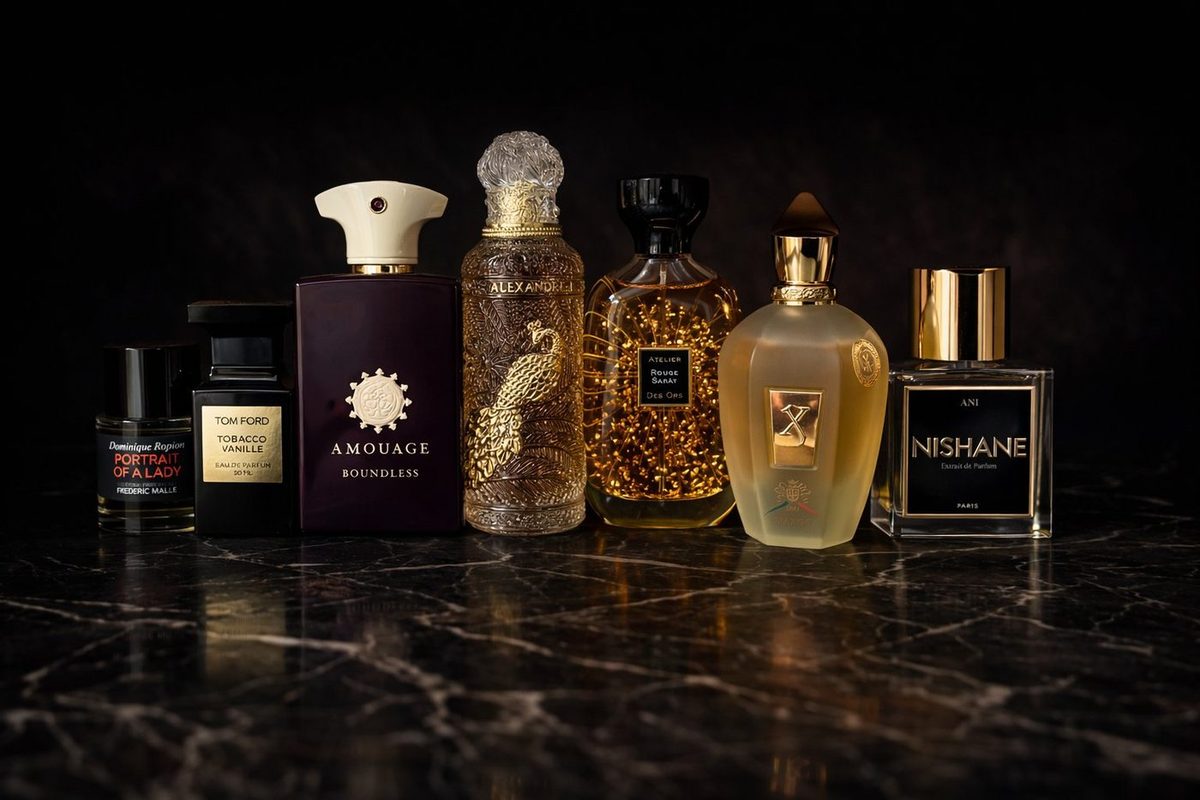
From left to right: Frédéric Malle Portrait of a Lady, Tom Ford Tobacco Vanille, Amouage Boundless, Alexandre J Imperial Peacock, Atelier Des Ors Rouge Saray, Xerjoff Naxos, Nishane Ani.
9. Fragrance and the Global Economy
The NumbersThe fragrance industry is large, growing, and structurally important to multiple sectors.
The global perfume market is valued at around $60 billion in 2025 and is projected to approach $100 billion by the mid-2030s. This figure covers personal fragrances only. It excludes scented household products, room fragrances, and personal care products with added scent, which would more than double the number.
Key PlayersThe dominant players are familiar: LVMH (which owns Dior, Givenchy, and Maison Francis Kurkdjian, among others), Chanel, Coty, Estée Lauder, L’Oréal, and Puig. Behind them, a tier of independent ingredient suppliers, Givaudan, dsm-firmenich (formerly Firmenich and DSM), IFF, and Symrise, essentially supply the raw materials and aroma chemicals that the entire industry depends on.
The fastest growth is happening in Asia-Pacific, particularly India and China, as disposable incomes rise and personal grooming becomes a higher priority. The Middle East remains the highest per-capita fragrance spending region in the world. North America leads in total market value.
Fragrance is also one of the most recession-resilient luxury categories. An $80 bottle of perfume is still an accessible indulgence for people who cannot afford a $5,000 handbag.
Must-Know FragrancesTwo fragrances worth knowing in terms of commercial scale: Creed Aventus and Dior Sauvage are routinely cited as among the best-selling niche and designer fragrances in the world respectively. Dior Sauvage has been reported to be one of the top-selling men’s fragrances globally for several years running. Creed Aventus commands a price point and following that most niche houses can only aspire to. Both are worth smelling regardless of whether you own them. They became what they are for a reason.
Frederic Malle is worth a separate mention here. His house, founded on the concept of giving named perfumers creative freedom, produces some of the most serious fragrances made today. Portrait of a Lady and Monsieur are two of the best things in my collection. The people behind the Frederic Malle counter are among the most knowledgeable in the business and worth getting to know.
10. Sustainability & the Future
The fragrance industry has a genuine sustainability problem, and the better houses are beginning to address it seriously.
Endangered IngredientsSome of fragrance’s most important naturals are under pressure. Mysore sandalwood is now heavily regulated due to decades of over-harvesting. Agarwood trees, the source of oud, take decades to mature and are increasingly scarce in the wild. Ambergris, the waxy substance from sperm whales that produces one of perfumery’s most prized fixatives, is now primarily replaced by synthetic ambroxan for ethical reasons. The industry’s reliance on slow-growing, rare, or animal-derived materials is a structural vulnerability.
Responsible SourcingSome houses are beginning to address this with real commitment. Chanel works directly with jasmine growers in Grasse to maintain supply chains that protect both quality and ecological balance. Givaudan and dsm-firmenich both publish sustainability reports detailing ingredient sourcing practices.
The most ambitious example in the industry right now is Amouage’s Wadi Dawkah project. Since 2022, Amouage has been the custodian of Wadi Dawkah, a UNESCO World Heritage Site in the Dhofar region of Oman, home to over 5,000 wild frankincense trees. In partnership with Oman’s Ministry of Heritage and Tourism, they have turned the site into what they describe as the first smart forest in the GCC, using geotagging and blockchain to trace every harvest from tree to bottle. A visitor centre and distillery, designed by Milan-based Giò Forma Studio, is under construction and expected to open in 2027.
Perfumers are invited to sponsor individual trees at the site. I have sponsored one myself.
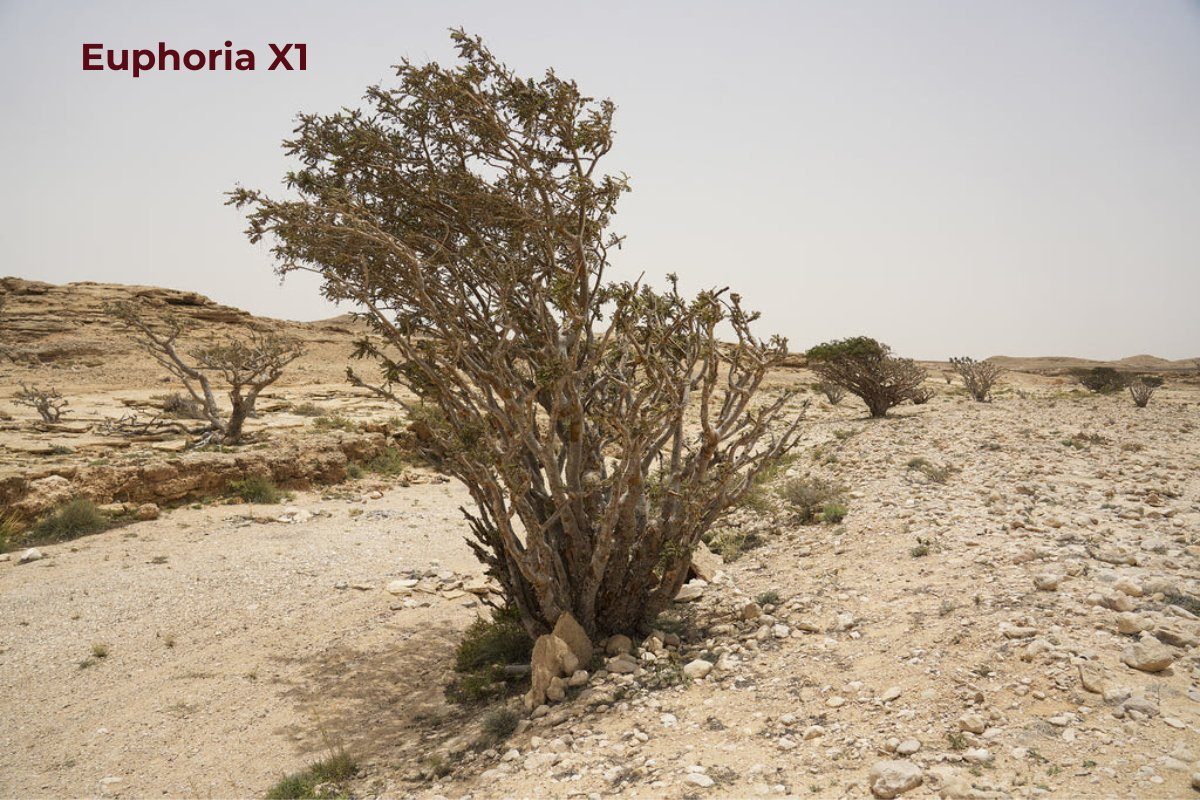
Euphoria X1 — my sponsored frankincense tree at Wadi Dawkah, Oman. One of over 5,000 Boswellia sacra trees at the UNESCO World Heritage Site, custodied by Amouage since 2022.
Similar programs exist elsewhere. Louis Vuitton sources ingredients through its Les Fontaines Parfumées atelier in Grasse with a focus on traceability. Givaudan has long-term farmer partnerships in key ingredient regions. These are still the exception, not the rule, but the pressure is growing.
The Packaging ProblemThis is where the industry has the most obvious room to improve, and the least excuse not to. A typical luxury fragrance bottle arrives inside a box, wrapped in tissue, cushioned with filler, sealed with a ribbon. The bottle itself is often glass that weighs more than the liquid it contains. Almost none of it needs to be this way.
Some houses are starting to offer refill programs. Chanel, Maison Margiela, and others now sell refill pouches for select fragrances. This is a meaningful step. But refills remain the exception rather than the rule.
There is a compelling model in adjacent industries worth adopting more widely. Card companies like Botanical PaperWorks embed wildflower seeds in their paper packaging. The packaging itself becomes something you plant rather than discard. Fragrance houses could easily use seed-embedded paper for outer boxes. Some smaller niche brands already do. The barrier is a willingness to prioritize it, not technology or cost.
Other practical approaches worth wider adoption: biodegradable filler materials, minimal single-material packaging that is easier to recycle, concentrates that reduce liquid volume and therefore shipping weight, and glass standardization that makes bottle reuse more practical.
The consumer side of this equation matters too. Buying fewer bottles of better quality, using what you own before adding more, choosing houses with transparent sourcing and refill programs. A collection of 850 bottles, I will freely admit, is not the most sustainable position. But it starts with knowing the problem exists.