The final part: where fragrance and spirits intersect, where the industry is going from here, and a complete glossary of terms used throughout this series.
Notes on Fragrance — Complete Series
11. Pairing Fragrance with Spirits
Why It WorksThis is where fragrance and the other half of this channel intersect. The parallel is closer than it might seem. Both fragrance and fine spirits are built around layered aromatic complexity. A whisky’s opening, its development on the palate, and its finish map remarkably well onto a fragrance’s top, heart, and base notes. Both reward patience and attention.
General Principles- Match intensity. A heavy, oud-forward fragrance belongs with an equally assertive whisky. A light, fresh EDT gets lost next to something powerful. Mismatches can also work if done deliberately: a medicinal, peaty Scotch can balance a sweet oriental in the same way a sour cuts through richness in cooking.
- Find the shared note. Smoky fragrance with peated Scotch. Vanilla-forward oriental with bourbon. Tobacco accord with aged rum. When both share a dominant aromatic character, they amplify each other rather than compete.
- Think about seasons. Heavy fragrances and heavy spirits are both cold-weather pleasures. In summer, a fresh aromatic EDT pairs more naturally with something lighter: a Japanese whisky, a light rum, a dry gin.
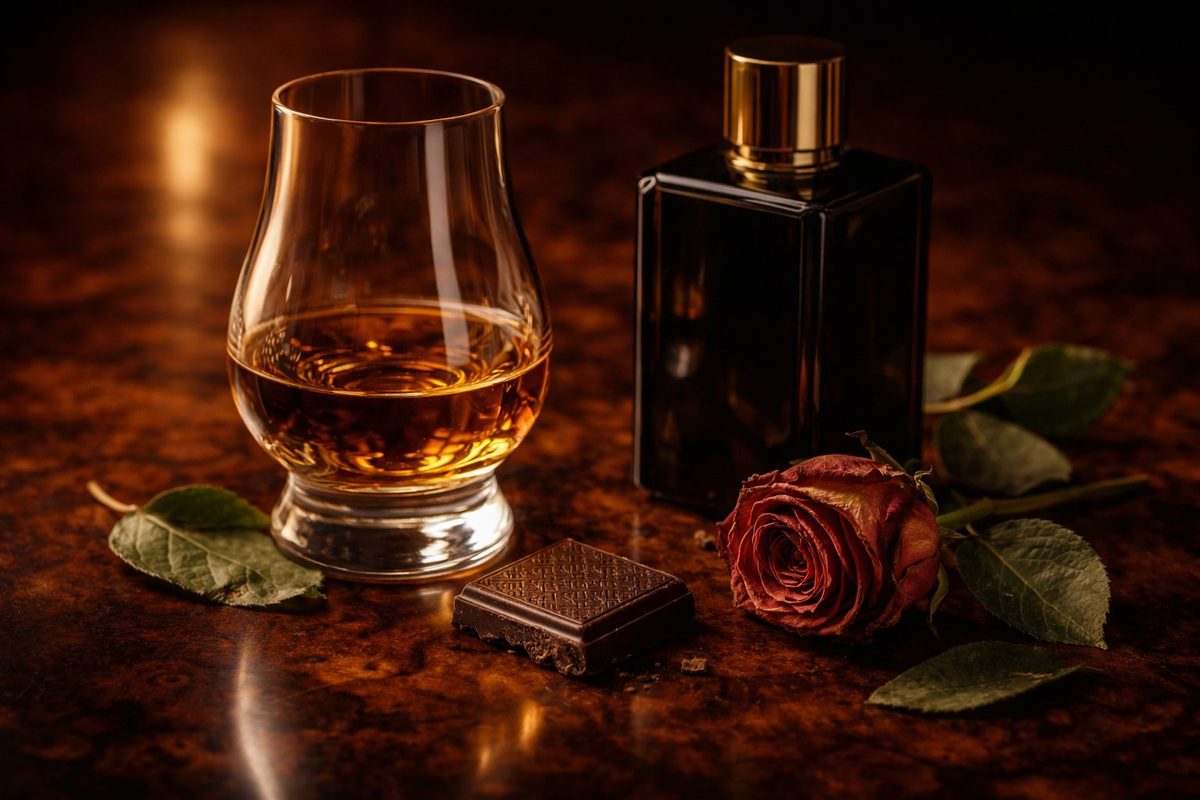 Pairings from My Collection
Tom Ford Tobacco Oud — whisky top note, tobacco, oud, incense. Pairs with Ardbeg Corryvreckan or Ardbeg Smoketrails. Both are peat-forward Islays with enough complexity to match the fragrance’s depth. The smoke in the bottle and the smoke in the glass reinforce each other.
Creed Centaurus — cinnamon, cardamom, bourbon vanilla, tonka. Pairs with Calumet 16 or Woodford Reserve Double Oaked. The vanilla and spice in the fragrance echo the oak-driven sweetness of American whiskey.
Orto Parisi Terroni — birch smoke, volcanic earth, guaiac wood. Pairs with Colonel E.H. Taylor Straight Rye Bottled in Bond or Rittenhouse Rye. Rye’s dry spice and the fragrance’s raw earthiness complement without competing. Both have edge.
Guerlain Habit Rouge — vanilla, rum raisin accord, warm amber. Pairs with Shibui Sherry Cask 18 Year or Aberlour A’bunadh. Sherry-influenced whiskies share the dried fruit and warm spice DNA of oriental fragrances. The pairing feels inevitable once you try it.
Hermès Voyage d’Hermès — cardamom, juniper, cedar. Pairs with Suntory Toki or Shibui 10 Virgin White Oak. Japanese whiskies tend toward elegance and restraint. So does Voyage. Neither dominates. They coexist with the kind of quiet dignity that makes an evening feel considered.
Xerjoff Naxos — honey, tobacco, lavender, tonka, oud. Pairs with FourSquare Sagacity or Ron Zacapa 23. Aged rums have a tropical sweetness and complexity that holds up to a rich oud fragrance. The honey note in Naxos and the molasses character of a good rum create a genuinely memorable pairing.
12. Where Fragrance Goes From Here
What ChangesThe fragrance world in 2026 is more interesting than it has been at any point in recent memory. Social media has created a genuinely global conversation about scent that did not exist fifteen years ago. TikTok’s #PerfumeTok, YouTube reviewers with millions of subscribers, Instagram accounts dedicated to niche collecting: these communities have brought new consumers into the category, elevated houses that previously had no marketing budget, and created demand for transparency about ingredients and sourcing.
The tension between accessibility and exclusivity will define the next decade. Clones will keep improving. Luxury houses will keep pushing prices higher and concentrations richer. The niche market will keep fragmenting into micro-niches. Sustainability will move from a talking point to a requirement as regulation tightens.
What Doesn’tWhat will not change is the fundamental thing. Scent connects to memory in a way nothing else does. A great fragrance, worn at the right moment, becomes part of who you are and how people remember you. That has been true since a priest in Mesopotamia burned frankincense on a temple altar four thousand years ago.
Choose carefully. Wear it with intention.
Appendix: Fragrance Glossary
A reference for the terms used throughout this series. Definitions are practical, not academic.
A highly concentrated aromatic extract obtained by solvent extraction from delicate plant materials like jasmine or rose. More complete and complex than an essential oil. More expensive, and more true to the original flower.
A blend of two or more fragrance materials that together create a single unified impression. A rose accord does not contain actual rose; it is a construction of multiple molecules that smells like rose. Most modern fragrances are built from accords rather than single raw materials.
A descriptor for notes that smell warm, skin-like, musky, or faintly animal. Historically derived from ambergris, civet, castoreum, and musk deer. Now almost entirely replicated synthetically. At low levels, animalic notes add depth and sensuality.
An oil-based perfume with roots in Indian and Middle Eastern tradition. Made by distilling botanicals into a base of sandalwood oil. Extremely concentrated and long-lasting. Many of the world’s oldest fragrances exist only as attars.
The final layer of a fragrance, emerging after the top and heart notes have faded. Woods, resins, musks, and ambers dominate here. Base notes provide longevity and anchor the entire composition. They are what linger on skin hours later.
A synthetic aroma chemical developed and patented exclusively by one fragrance supplier. Available only to perfumers who work with that supplier. Givaudan’s Akigalawood, IFF’s Clearwood, and Firmenich’s Ambrox are examples. Captive molecules give houses a signature that competitors cannot fully replicate.
A fragrance family built on the accord of oakmoss, labdanum, bergamot, and cistus. Earthy, mossy, and sophisticated. Named after Cyprus. François Coty defined the modern chypre in 1917. Heavily affected by IFRA restrictions on oakmoss since the 2000s.
A fragrance that closely replicates the character of an existing, usually more expensive original. Not a counterfeit: clones are openly marketed as inspired by their reference. Houses like Lattafa, Fragrance World, and Alexandria Fragrances specialize in this category.
The percentage of fragrance oil in a bottle relative to alcohol and water. Higher concentration generally means more intensity, longer longevity, and closer sillage. See EDC, EDT, EDP, Parfum, and Elixir.
The final stage of a fragrance’s development on skin, typically 30 minutes to an hour after application, when the top notes have fully evaporated and the base notes have settled. The dry down is often the truest expression of a fragrance and the most important phase to evaluate before buying.
2–4% fragrance concentration. Light, fresh, short-lived. Lasts 1–2 hours.
15–20% fragrance concentration. Rich, long-lasting. 5–8 hours. The most popular format among serious collectors.
5–15% fragrance concentration. The standard workday format. Moderate projection, 3–5 hours of wear.
A reformulated, ultra-concentrated version of an existing fragrance, positioned above Parfum in strength. Not simply a higher concentration of the original: typically a darker, richer reinterpretation. Dior Sauvage Elixir (2021) is widely credited with launching the modern Elixir trend.
20–40% fragrance concentration. Maximum strength. Intimate sillage. Long-lasting and expensive. Applied in small amounts.
An ingredient that slows the evaporation of other fragrance materials, extending longevity and anchoring the composition. Ambergris was historically the most prized natural fixative. Synthetic ambroxan now serves this purpose in most modern fragrances.
A new fragrance released by a house that is related to an existing one, sharing DNA but not identical. Sauvage EDP is a flanker of Sauvage EDT. Flankers allow brands to extend successful franchises without replacing the original.
A constructed fragrance accord and family built on lavender, coumarin, oakmoss, and bergamot. Invented in 1882. The backbone of classic masculine fragrance for over a century. The name means “fern” in French, despite fern having no meaningful scent.
A fragrance family built on edible-smelling notes: vanilla, caramel, chocolate, coffee, pastry. Angel by Thierry Mugler (1992) created the category. Polarizing but commercially dominant.
The core of a fragrance, emerging as top notes fade, typically 20–60 minutes after application. Florals, spices, and resins dominate this layer. Heart notes define the fragrance’s character and personality.
The International Fragrance Association. The industry body that sets usage guidelines and restrictions for fragrance ingredients based on safety and allergen research. IFRA restrictions have significantly limited or eliminated certain classic natural ingredients, including oakmoss and several musks, forcing reformulations of many historic fragrances.
How long a fragrance lasts on skin. Affected by concentration, skin type, application method, and the specific materials used. Resins, musks, and woods generally last longer than citrus and aquatic notes.
Fragrance produced by an independent or artisan house, typically in smaller quantities, with a focus on ingredient quality and creative vision over mass-market appeal. Amouage, Frederic Malle, Serge Lutens, and Creed are examples. The line between niche and luxury designer has blurred considerably.
The informal title for a master perfumer. Refers both to the physical organ and to the trained ability to identify, remember, and creatively combine thousands of aromatic materials. There are fewer noses in the world than there are astronauts.
A single aromatic component or impression within a fragrance. Notes are described in three layers: top (first impression, fades quickly), heart (the core character), and base (the lasting foundation). A fragrance may contain dozens of individual ingredients but be described by only three or four marketing notes.
A dark, resinous material produced by the agarwood tree when infected by a specific mold. One of the most expensive raw materials in the world. The word comes from the Arabic al-oud, meaning the wood. Central to Middle Eastern and Arabic perfumery for centuries. Now ubiquitous across niche and luxury Western fragrance.
How far a fragrance radiates from the skin into the surrounding space. High projection means others will smell you from a distance. Low projection means the fragrance stays close and personal. Neither is inherently better; it depends on context and intention.
A change to an existing fragrance’s formula, often driven by ingredient restrictions, cost pressures, or supplier changes. Reformulations are common and frequently controversial. Many classic fragrances smell different today than they did decades ago. Earlier vintages are often sought after by collectors as a result.
The trail a fragrance leaves in the air as you move through a space. From the French word for “wake” (as in the wake of a ship). A fragrance with strong sillage announces itself. One with low sillage stays close. Related to but distinct from projection: projection is about how far it radiates outward; sillage is about the trail left behind.
A fragrance built around a single flower note, intended to represent that flower as accurately as possible. A rose soliflore aims to smell like rose and little else. Increasingly rare in commercial perfumery, where complexity and blending are the norm.
Borrowed from wine. In fragrance, terroir refers to how the geographic origin of a natural ingredient affects its smell. Bulgarian rose smells different from Turkish rose. Haitian vetiver smells different from Javanese vetiver. Origin matters, and the best houses source accordingly.
The first impression of a fragrance, immediately apparent on application. Citrus, herbs, and light florals dominate this layer. Top notes evaporate quickly, typically within 15–30 minutes. They invite you in but do not define the fragrance. Never buy a bottle based on top notes alone.