Key Takeaways
- Islay is a legally protected whisky region under the Scotch Whisky Regulations 2009, and the protection is entirely geographic. There is no peat requirement attached to the name at all.
- I own whisky that proves both directions of that. Bunnahabhain and Bruichladdich are legitimately Islay and barely peated. Balvenie, Ledaig, and Talisker are meaningfully peated and nowhere near Islay.
- Around twenty peated bottles from my own shelf, eleven from one distillery alone, examples grouped by production choice rather than a full catalog or a ranking by taste, plus a Japanese distillery built to emulate Islay's climate and a scent that puts its own peat note on the label.
Islay whisky and peat get treated as synonyms, though they describe two different things. One is a place with a legal boundary drawn around it. The other is a production choice a distiller can make or skip, on Islay or anywhere else.
The Kiln, Not the Bog
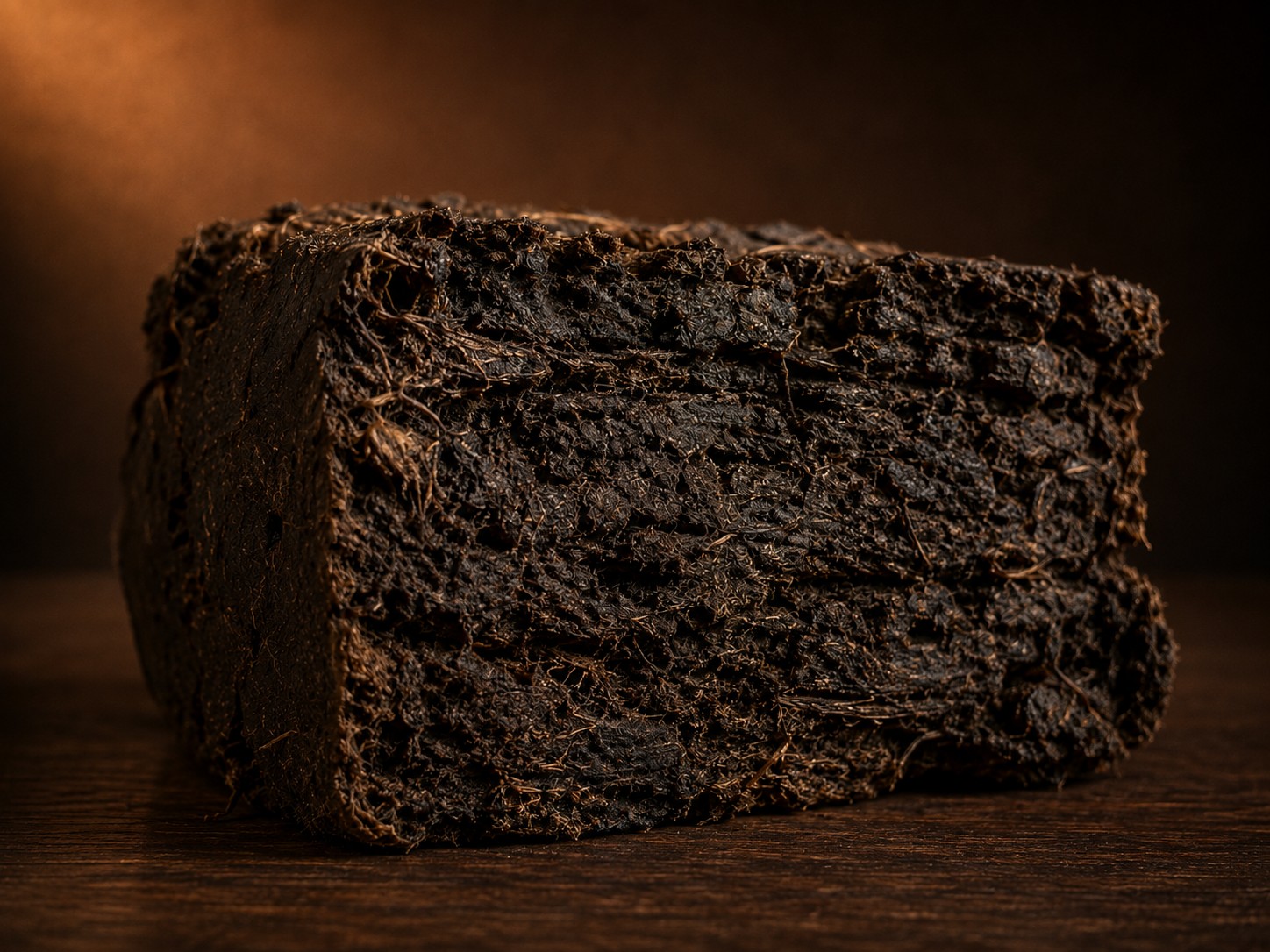
Where it starts. AI-generated; I don't have a real one in New York.
Peat is partially decayed plant matter, mostly moss, heather, and sedge, accumulated and compacted over thousands of years in a waterlogged bog under anoxic conditions that stop it from ever fully rotting. Cut into bricks and dried, it burns slow and smoky, which is exactly what a maltster wants.
Here is where the smoke actually goes. Barley gets malted, then dried in a kiln to stop it germinating. Some distilleries burn peat under that kiln instead of, or alongside, other fuel, and the smoke drifts up through a bed of barley spread across a perforated floor. The husk absorbs phenolic compounds out of the smoke as it passes through. That absorption is the entire mechanism. No peat touches the finished spirit. It only ever touches the grain, before fermentation has even started.
The malt's phenolic content is reported in parts per million, or PPM. The number describes the malt, not the bottle. Ardbeg's malt runs around 55 PPM, among the highest of the mainstream Islay distilleries. Laphroaig sits around 40 to 45. Lagavulin, malted at Port Ellen using peat cut from Islay's Castlehill bog, comes in around 35 to 37. Kilchoman runs two separate lines. Sanaig and the rest of the core range use commercially malted barley at 50 PPM, bought in. The 100% Islay releases use barley grown and floor-malted on the farm itself, peated closer to 20 PPM. Those are two distinct products, not one bottling blending the two.
PPM is an input spec, not a flavor score. It tells you how much phenol went into the malt before fermentation, distillation, and maturation all took their own bite out of the number, and even at the finished-spirit stage, chemical concentration and perceived smokiness don't track together in any clean way. Two whiskies can carry similar phenol counts and taste nothing alike. Every PPM figure in this piece is a production specification the distillery chose. Whether you taste it that way is a separate question.
What's on the malt bag isn't what ends up in your glass either. Fermentation, distillation, and the cuts a distiller makes all strip phenols out along the way, and by how much varies with every step in the process. Ardbeg's 55 PPM malt typically lands around 24 to 26 PPM in the new-make spirit. Lagavulin's 35 to 37 PPM malt drops to a new-make spirit figure of roughly 16 PPM. There's no dependable universal conversion to apply to a number on a label, only examples like these. Use the malt PPM for context about what a distillery chose to do, and trust your own glass for what it actually tastes like.
One myth worth correcting: peat-filtered water isn't the principal source of the smoke, even though it gets credited that way constantly. The phenols get into the whisky at the kiln, absorbed into the malt while it's still damp, well before fermentation or distillation touches anything. Water that's passed through peat can carry its own faint mineral character, but that's a different thing from carrying smoke. If a whisky tastes smoky, the smoke mostly came from the fire under the malt, not the stream, the "burn," feeding the mash tun.
Most distilleries buy peated malt from specialist maltsters rather than malting their own barley. The Scotch Whisky Association identifies nine UK facilities supplying peated malt to the industry. Only a handful of distilleries, including Kilchoman, Laphroaig, Bowmore, Highland Park, and Springbank, retain floor maltings of their own. Specifying a peating level and actually malting the barley yourself are two different jobs, and most distilleries only do the first one.
The words used to describe the result matter too. Smoky, medicinal, ashy, earthy, maritime, iodine-like: these terms are tasting associations, not chemical claims. Calling a whisky iodine-forward doesn't mean iodine is in the glass. It means the smell reminds a taster of a hospital cabinet, the same way calling something buttery doesn't mean butter is in it. The vocabulary is there to help you recognize a smell, and it makes no claim about what produced it.
A Region With No Flavor Requirement
The Scotch Whisky Regulations 2009 name five protected localities and regions: Highland, Lowland, Speyside, Campbeltown, and Islay. A distillery can only put one of those names on a label if the whisky was physically distilled inside that boundary. That's the entire test. Nothing in the regulation says a word about peat, smoke, or flavor of any kind. The protection is where the still sits, not what comes out of it.
Bunnahabhain and Bruichladdich sit inside that boundary as legitimately as Ardbeg does. Their standard malt runs close to zero PPM, roughly 2 for Bunnahabhain and 4 for Bruichladdich's own name, a rounding error next to Ardbeg's 55. Both distilleries also make heavily peated whisky under different labels, Bunnahabhain's Toiteach line and Bruichladdich's Port Charlotte and Octomore, which only sharpens the point. Peat is a choice a distillery makes bottle by bottle. Being on Islay was never the choice that mattered.
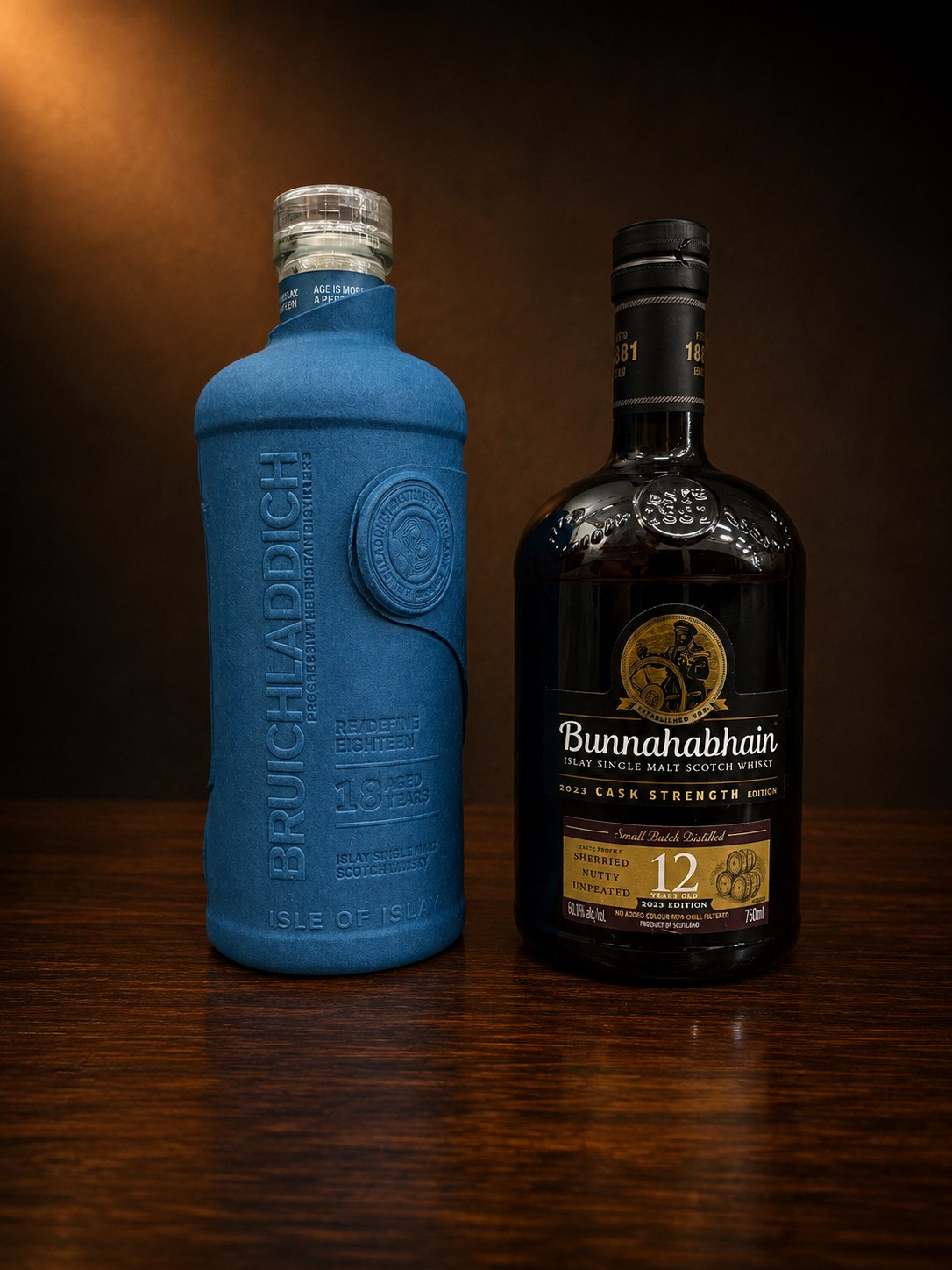
Both legally Islay. Neither one smoky.
Islay without deliberate peat
- Bunnahabhain Cask Strength 2021. Roughly 2 PPM. Sherried, rich, and nothing about it reads as smoky.
- Bunnahabhain 2014 Canasta Butt Cask Strength. Same near-zero peating, aged in a sherry butt that pushes it toward dried fruit and toffee instead.
- Bruichladdich 18. The distillery's own name at roughly 4 PPM, while its Port Charlotte range runs closer to 40 under a different label entirely.
All three are legally Islay Single Malt Scotch Whisky, printed on the label, distilled inside the same boundary as Ardbeg and Laphroaig.
Peat Doesn't Stay Home Either
The reverse holds too. Peat isn't an Islay exclusive. Peat use in whisky was once far more widespread across Scotland, and Islay became distinctive largely because its distilleries retained strongly peated styles after much of the rest of the industry moved toward coal, coke, and rail-delivered fuel. Plenty of peated whisky still comes from nowhere near the island.
Peated, and nowhere near Islay
- Balvenie 19 Year Old Week of Peat. Speyside, a region that's almost entirely unpeated by convention. Balvenie runs a small peat fire beside its main kiln, mixed with coke-fired heat, to keep the influence deliberately light. This release pushes further than their standard does.
- Ledaig 18. Tobermory's peated line, made on the Isle of Mull, a different island entirely.
- Talisker 10. Isle of Skye, medium-peated around 20 PPM, with a peppery, maritime character that reads differently from anything Islay makes despite a similar phenol level.
Highland Park, from Orkney, sits in the same medium-peat bracket using its own heather-heavy local peat, a different composition from Islay's coastal cut entirely.
The Islay Deep End
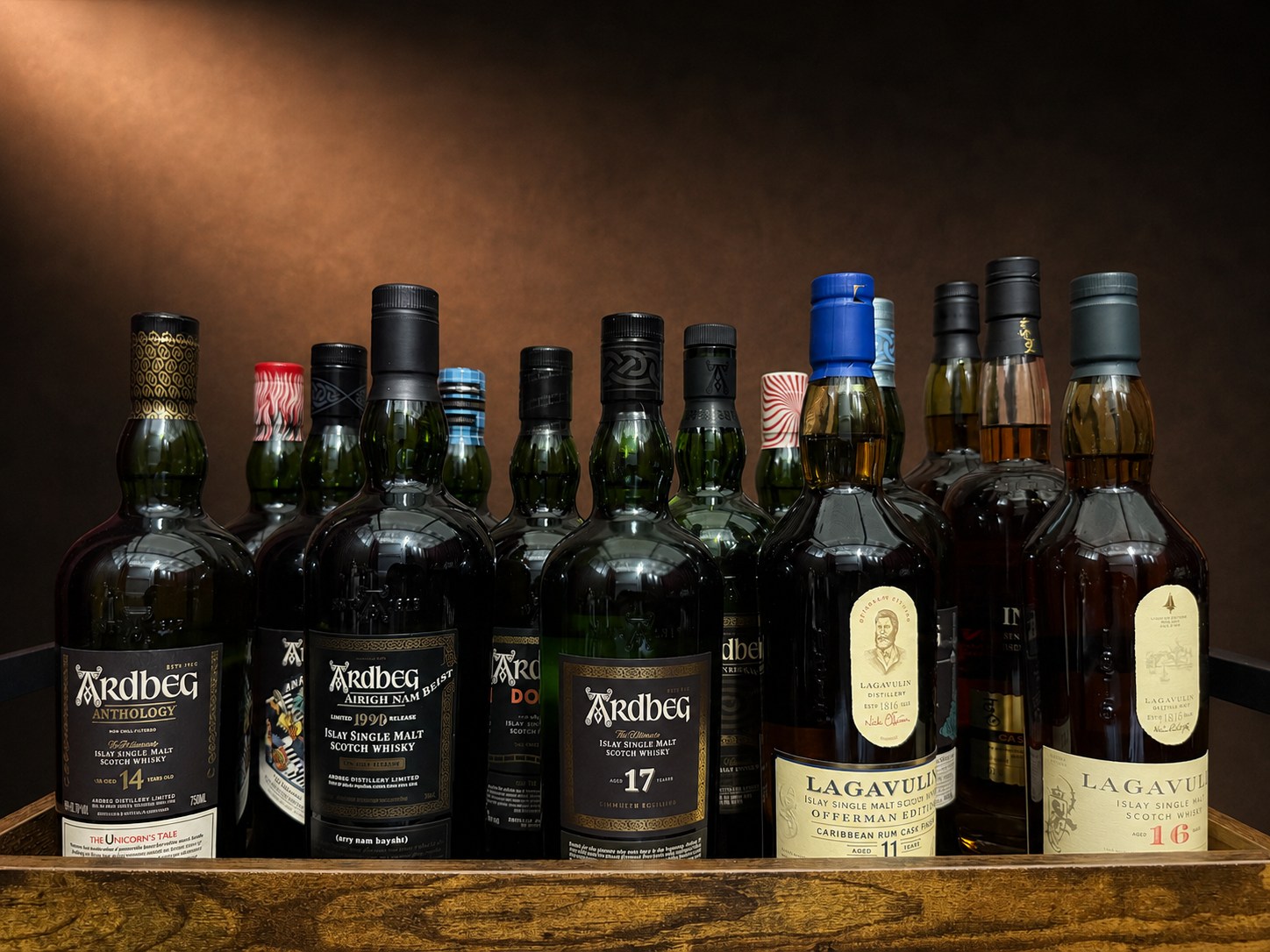
One island, several distilleries, all committed to the smoke.
Where Islay does lean into peat, it leans all the way in. Around twenty of my own bottles are made with deliberately peated malt, and eleven of them split between two houses, Ardbeg and Lagavulin, half a mile apart on the same stretch of coast.
Classic Islay peat
- Laphroaig 10. Around 40 to 45 PPM in the malt, medicinal and iodine-heavy, the bottle most people picture when they picture Islay.
- Kilchoman Sanaig. Built on the commercially malted, roughly 50 PPM stream, the same one used across most of Kilchoman's core range, not the estate's own floor-malted barley.
- Lagavulin 16. Roughly 35 to 37 PPM in the malt, falling to about 16 PPM in the new-make spirit. The benchmark most other Islay whisky gets measured against.
The Kannan
- 60ml (2oz) Buffalo Trace bourbon
- 7ml (¼oz) Laphroaig 10
- 1 demerara sugar cube
- 1 teaspoon club soda
- Apple- and cherry-wood smoke
- 2 Angostura cherries
- Ice
- Glass: Rocks glass
Muddle the demerara sugar with the club soda in the bottom of the glass. Add the bourbon and stir over ice. Add the Laphroaig, then smoke the glass with apple- and cherry-wood and garnish with the cherries. Old Fashioned bones, taken further. A quarter ounce of Laphroaig is all it takes, just enough to shift the character without taking over. The full story of how this one came together is in Part 2 of the digestifs and whisky evening.
The Ardbeg deep end
- Ardbeg Corryvreckan. A high-strength, non-chill-filtered bottling at 57.1 percent ABV, no age statement. Ardbeg doesn't label it cask strength; that term belongs to a separate bottling, the Ardbeg Ten Cask Strength. Whether Corryvreckan is the smokiest expression in the range is a sensory judgment, mine, not a lab measurement I can point to.
- Ardbeg Airigh Nam Beist 1990. An older, harder-to-find expression, bottled 16 to 18 years after distillation depending on the release year, six to eight years past what the core 10 gets, not the decades it sometimes gets credited with.
- Ardbeg Smoketrails. Part of a travel-retail series exploring how Ardbeg's peat character shifts under different cask finishes.
Airigh Nam Beist was discontinued once its 1990 stock ran out, and it now trades on the secondary market for well past what a standard 10 costs. Two more sit in the cabinet beyond these three: Ardbeg Anthology Unicorn's Tale, and Dolce, this year's Fèis Ìle open-day release, built around an Italian cinema theme for Ardbeg Day. Collecting one distillery this deep takes years of watching for releases, which is a different hobby from simply liking smoke.
Beyond Scotland
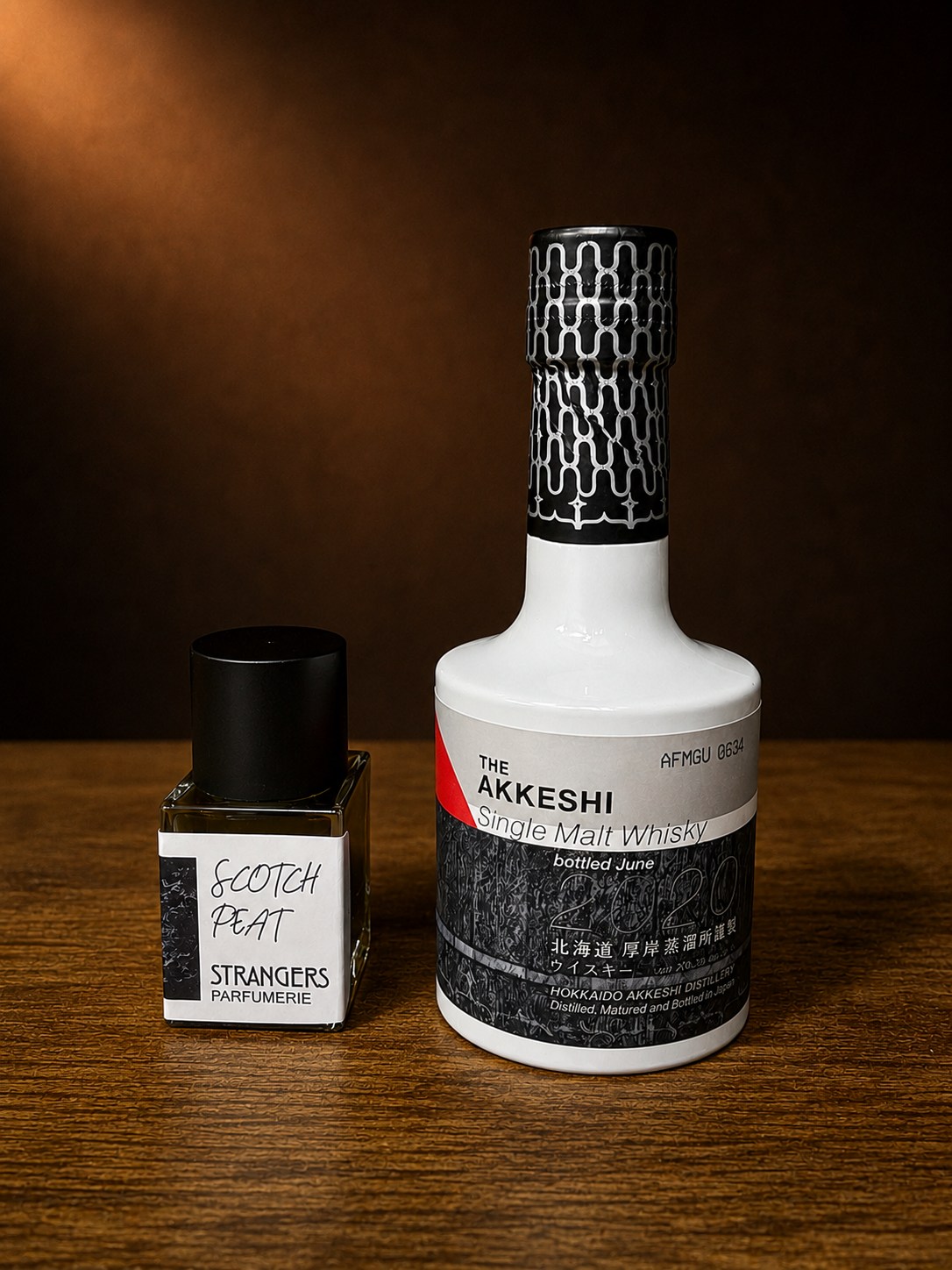
A Hokkaido whisky inspired by Islay beside a perfume inspired by Scotch peat.
Peat has no geographic protection; Scotch whisky does. Anyone with a bog and a kiln can do the same thing, and some of them do it well.
Kiln-peated, like Islay does it
- Akkeshi Sarorunkamuy. Hokkaido, Japan. The distillery describes itself as sited specifically to emulate Islay's cool, foggy, maritime climate, using water drawn through nearby peatland. Two whisky sites, 88 Bamboo and the retailer Uisuki, have both called it "the little Lagavulin."
- Amrut Fusion. Bangalore, India. Officially a single malt, which surprised me until I checked what the term actually requires. Single malt means malt whisky distilled at one distillery, not barley from one country, and Amrut distills and matures both its Indian and Scottish-sourced malt streams at its own Bangalore site.
- Kings County Peated Bourbon. Brooklyn, New York. American bourbon rules require majority corn, nothing about the remaining grain, so Kings County cuts theirs with Scottish peated malt. Not in my cabinet, but a real bottle worth knowing about.
All three derive their smoke from peated malt used before distillation, rather than a later cask finish. Amrut's split is 75 percent unpeated Indian six-row barley to 25 percent peated Scottish malt, and the result is legitimately single malt by the same single-distillery, all-malt principle Scotland uses, even though Scotch itself additionally requires production inside Scotland.
Where Amrut's peat actually comes from isn't published, and one reviewer's best guess lands on Highland rather than Islay, so this one doesn't get to borrow Islay's name the way Paul John does. It took a Double Gold at the 2025 San Francisco World Spirits Competition, part of a sweep that made Amrut the only Indian distillery to land three Double Golds and a Gold that year. Akkeshi and Amrut are both mine.
Smoke borrowed from a cask, not a kiln
- Balcones Prohibida. Waco, Texas. Not a whisky at all, a pot-still rum, rested at least 33 months in the distillery's own ex-peated Balcones single malt barrels. The base spirit never sat near a peat fire, the smoke comes secondhand from wood that once held peated whisky. Also not mine.
- Ron Relicario Peated Finish. A Dominican rum finished the same secondhand way, in ex-peated whisky casks from unnamed Speyside distilleries rather than Islay. A retailer reports a 2 PPM peat level, though the measurement basis isn't given and shouldn't be compared directly to the malt PPM figures used elsewhere in this piece. Also not mine, and unlike the Balcones, it's difficult to find in the U.S. Reviews split hard on it, iodine and antiseptic notes fighting the rum underneath rather than blending with it.
A different mechanism entirely from the group above, no kiln involved, just a barrel doing secondhand work. Neither is mine, and they make the same point from opposite directions: the Texas rum is more widely distributed in the United States, while the Dominican rum is the one you'd have to work for.
Related Smoke, Different Bottle
The compounds doing real work in a glass of Laphroaig include guaiacol and cresols, phenolic molecules that form when heat breaks down lignin, the structural material inside wood and plant matter. Peat smoke carries them into barley. Wood smoke carries them into meat and into whisky barrels during char. Birch tar and cade oil, two of perfumery's oldest smoky-leather materials, share some of that same phenolic chemistry. They aren't the same smoke, though. Each is a different complex mixture, made from different raw material under different conditions, and sharing a few compounds in common isn't the same as being interchangeable.
Birch tar comes from heating birch bark under oxygen-poor conditions until it breaks down into guaiacol, cresols, and catechol, the material behind Russian leather accords for over a century. Cade oil does a related thing to juniper wood, rounder and more resinous than birch tar, used at a fraction of a percent to anchor leather and smoky-incense compositions. Both are related to peat smoke by the same underlying mechanism, heat breaking down plant lignin into phenols, applied to different raw material with different results. Neither gets used raw in a fragrance you'd actually wear. IFRA prohibits crude birch tar and crude cade oil as fragrance ingredients because of their polycyclic aromatic hydrocarbon content, permitting only rectified oils that meet its specifications. Rectification reduces the restricted PAHs, and the finished fragrance must still fall within IFRA limits.
Guaiacol shows up in whisky twice, once from peat if the distillery uses it, and again from the char inside an oak barrel during aging, whether or not any peat was ever involved. Guaiacol is also a major industrial starting material for synthetic vanillin. In the dominant production route, it's first reacted with glyoxylic acid, then converted to vanillin through oxidative decarboxylation, a multistep relationship, not a simple molecular swap. That relationship is worth knowing, but it doesn't fully explain why a heavily peated whisky can carry a strange vanilla sweetness underneath the smoke. Peated whisky's phenolic profile runs well past guaiacol and cresols, dozens of related compounds contribute, and how the nose reads any of them together isn't something molecular structure alone predicts.
What Peat Costs
None of this is free. Peatlands are among the most effective carbon stores on the planet, holding around three billion tonnes of carbon in the UK alone. The IUCN designates roughly 80 percent of UK peatland as degraded, and degraded peatland releases an estimated 23 million tonnes of carbon dioxide a year. A degraded peatland can become a net source of emissions.
There's a scale argument the industry makes, and it's fair as far as it goes. Whisky accounts for under four percent of UK peat extraction; horticulture takes the overwhelming majority. But volume understates the damage. Peatland is more than 90 percent water, so cutting into a bog affects an area far wider than the cubic metres removed, the way puncturing something pressurized does more than remove what leaked out. A small share of extraction is not the same as a small footprint.
The SWA's 2023 estimate puts the industry's total peat use that year at 8,000 tonnes, producing roughly 64,000 tonnes of peated malt, and the association has committed its members to net-zero emissions by 2040. Some of the restoration work is already tied to bottles named further up this page. Diageo and the RSPB restored 280 hectares of Islay peatland in 2017 for Lagavulin's 200th anniversary. Highland Park's peat comes from Hobbister Moor on Orkney, a site Edrington and the RSPB run as a bird sanctuary alongside the extraction. Whether that adds up to enough is a longer argument than this piece has room for.
The industry published a Commitment to Responsible Peat Use in 2023, covering extraction standards, efficient use, and restoration. The Scottish government has separately pledged £250 million to restore 250,000 hectares of peatland by 2030. Whether that's enough is a longer argument than this piece has room for. That context belongs in the room before the next bottle gets bought on smoke alone.
A Scent for the Day
Created by perfumer Prin Lomros and launched in 2019, Strangers Parfumerie Scotch Peat is number 1127 in my collection.
Bloom Perfumery places peat and malted barley in the opening, cade, smoke, and whisky in the heart, and cedar, hay, moss, and tonka in the base. Cade supplies a related smoky-phenolic impression rather than literally recreating peat-kiln smoke.
Here's the detail that sold me on it for this piece over anything else in the cabinet. When I logged this bottle in my own database, two of its defining notes, malted barley and peat itself, had no clean category to sit in and got excluded from the tracked fields. In a perfume called Scotch Peat, the note supplying half the name couldn't be recorded cleanly in my spreadsheet. What's on the label and what's actually trackable aren't always the same thing.
What to Do With Any of This
Stop assuming the region tells you the flavor. It tells you where the still sits, nothing more, and Bunnahabhain proves that as cleanly as any whisky can. Look for whether the malt was deliberately peated, use PPM only as production context, then trust the glass in front of you, not the word Islay on its own.
Pour something made with deliberately peated malt tonight, and pour something without it right after. Same island, same legal protection, same right to the name. What's different is a choice somebody made at the kiln, long before either bottle had a label.
The Journal goes beyond the bottle.
One thoughtful piece each week on fragrance, spirits, cigars, and the stories behind them.

Sources
- General PPM explanation and phenol figures for Ardbeg, Laphroaig, Lagavulin, and other Islay distilleries: Drinkhacker and Whisky and Wisdom.
- Kilchoman's two separate peating streams, Sanaig at 50 PPM on commercial malt versus the 100% Islay range at roughly 20 PPM on estate floor-malted barley: Kilchoman's own distillery page.
- PPM's status as an input specification rather than a reliable predictor of perceived smokiness: American Chemical Society sensory and chemical study.
- Ardbeg Corryvreckan's official specification, NAS, 57.1 percent ABV, non-chill-filtered, and its absence of the cask strength label: Ardbeg's current product page.
- Airigh Nam Beist's actual release age, 16 to 18 years depending on bottling year: Whisky.com.
- Guaiacol's multistep industrial conversion to vanillin via glyoxylic acid and oxidative decarboxylation: Chemistry-Europe review.
- Peated whisky's broader phenolic odorant profile beyond guaiacol and cresols: ScienceDirect.
- IFRA restrictions on crude cade oil and crude birch tar due to polycyclic aromatic hydrocarbon content: IFRA cade oil standard and IFRA birch tar standard.
- The peaty-water myth and confirmation that only kiln smoke, not distillery water, carries phenols into the whisky: Whisky.com.
- The nine UK facilities producing peated malt for the industry, and third-party maltsters supplying most producers: Scotch Whisky Association.
- The 2023 industry-wide peat use estimate, the net-zero by 2040 commitment, and the Commitment to Responsible Peat Use: Scotch Whisky Association and Berry Bros. and Rudd.
- UK peatland carbon storage, the IUCN's 80 percent degradation designation, the 23 million tonnes of annual CO2 release, whisky's sub-four-percent share of UK peat extraction, the 90-percent-water point from the IUCN's Clifton Bain, and the Lagavulin and Highland Park restoration partnerships with the RSPB: Whisky Magazine.
- The Scottish government's £250 million peatland restoration pledge: Scottish National Adaptation Plan.
- Lagavulin's malting at Port Ellen using Islay's Castlehill peat bog, and the drop in phenol content between malt and finished spirit for both Ardbeg and Lagavulin: Whisky Advocate and Whiskipedia.
- Talisker and Highland Park's medium peat classification: The Whisky Club.
- Balvenie's small adjacent peat fire mixed with coke-fired heat for a deliberately light peat influence: Whisky News.
- The Scotch Whisky Regulations 2009 and the five protected localities and regions: UK Legislation.
- Bunnahabhain and Bruichladdich's near-zero standard peating levels against their separate heavily peated lines: Drinkhacker and Whisky Advocate.
- Akkeshi Distillery's siting to emulate Islay's climate and its use of water drawn through nearby peatland: Akkeshi Distillery's own site. Its "little Lagavulin" reputation: 88 Bamboo and Uisuki.
- Kings County Peated Bourbon's grain bill and use of Scottish peated malt: Kings County Distillery.
- Amrut Fusion's official single malt classification, its 75/25 Indian and peated Scottish barley composition, and its unconfirmed peat region: Amrut's own product page and Whiskey In My Wedding Ring.
- Amrut's three Double Golds and one Gold at the 2025 San Francisco World Spirits Competition, including Amrut Fusion's Double Gold: Hotelier India.
- Balcones Prohibida's ex-peated single malt barrel finish and 33-month minimum aging: Wine and Whiskey Globe.
- Ron Relicario Peated Finish's divided reception, 2 PPM level, and Speyside cask origin: The Lone Caner and Excellence Rhum.
- Guaiacol and cresols as the shared phenolic compounds in whisky peat smoke, birch tar, and cade oil, and their formation through the breakdown of lignin: Fragrenza and Première Peau.
- Cade oil's production, composition, and use in leather and smoky-incense perfumery: Première Peau.
- Scotch Peat's perfumer and 2019 launch date, along with the untracked peat and malted barley notes, are pulled directly from my own collection database. Its note pyramid is quoted directly from Bloom Perfumery's own listing.
- Peating figures reflect published testing and industry reporting as of this writing and can shift with new releases or reformulation.
A note on the images in this piece: the hero illustration and the peat brick near the top are both AI-generated. The Bunnahabhain and Bruichladdich pairing, the Ardbeg lineup, and the Akkeshi and Scotch Peat pairing are real photographs of the actual bottles.