Key Takeaways
- Thermal breakdown of plant material is the shared mechanism behind a braai, peated whisky, cigar smoke, and smoky perfumery, producing overlapping families of phenolic compounds including guaiacol, syringol, cresols, and catechols.
- Guaiacol, syringol, and their relatives together give wood smoke its character, and hardwoods like camelthorn produce more of the syringyl-derived ones than conifers do.
- Tobacco pyrolysis research identifies two temperature bands, below and above roughly 350°C, each yielding a different phenol mix; a burning cigar's coal-to-leaf gradient likely crosses both in a single draw.

Heritage Day was September 24 in South Africa, which is when this piece was supposed to go up. Since 2005, a parallel National Braai Day campaign started by Jan Scannell has encouraged South Africans to mark Heritage Day around a fire. He left a career in financial services to spend a year promoting it, drove a forty-day tour of heritage sites braaiing along the way, and set a world record in 2010 for the longest continuous braai, 28.5 hours. In 2007, Archbishop Desmond Tutu became its patron, calling a braai one of the few things genuinely shared across South Africa's regions and communities. The pitch was simple: pick something everyone already does around a fire, and let that be the common ground.
A braai is not a cookout with a different accent. The wood matters. Kameeldoring, camelthorn in English, is one prized option, particularly where it's available, valued for dense, long-lasting coals and a distinctive wood smoke, though depending on geography, braaiers reach just as often for rooikrans, sekelbos, mopane, or black wattle. And the method matters more than the wood: coals arranged into zones, direct heat for what needs to cook fast, indirect for what needs time, embers preferred over open flame because flame chars unevenly. The South African description of the whole thing comes down to one word: patience. You respect the fire.
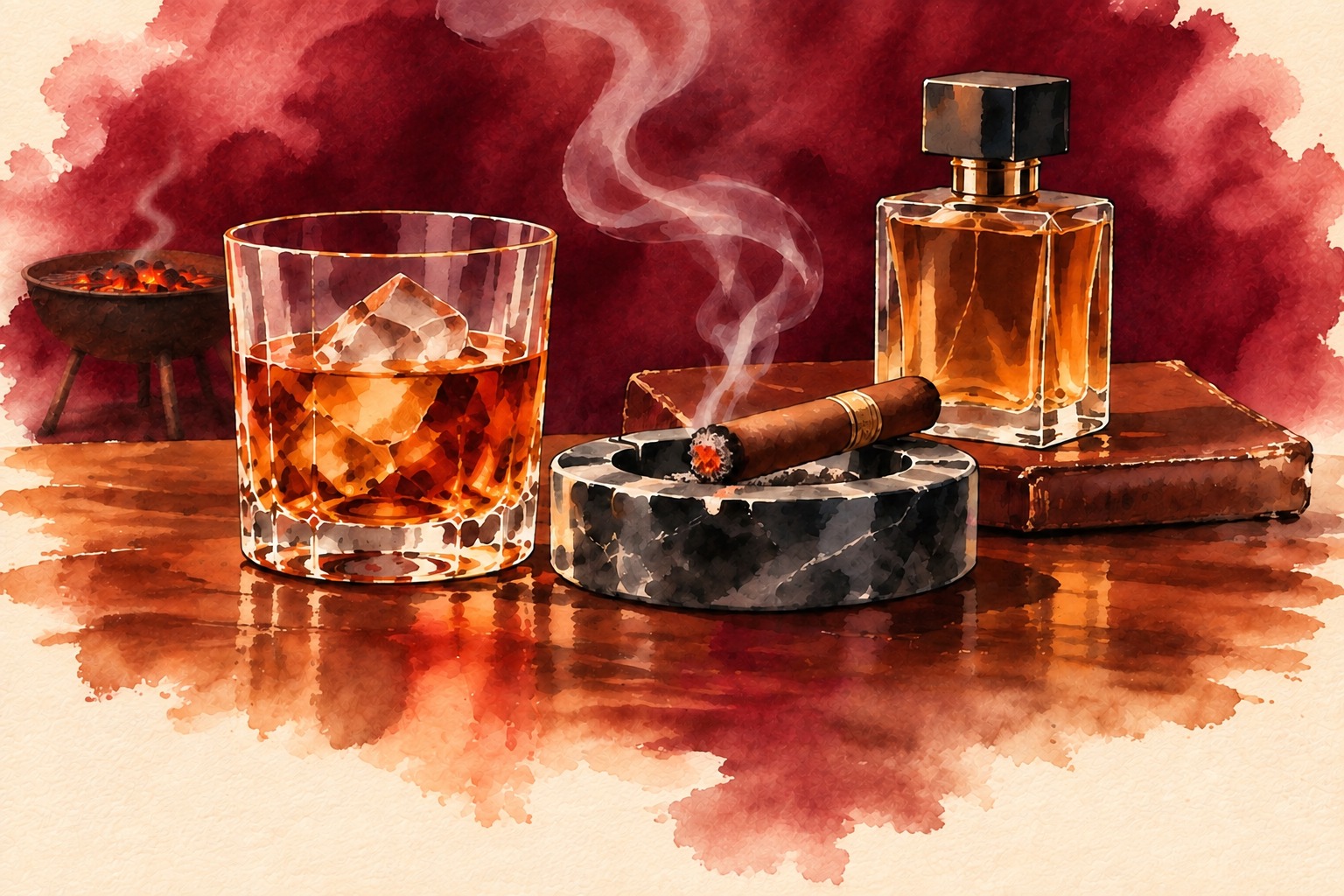
I don't braai. But I own a shelf of things that got their character the same way a braai does, by sitting downwind of burning plant matter and absorbing what came off it. A peated Islay whisky. A cigar. A handful of fragrances built around cade oil or birch tar. All four, the braai included, run on the same underlying chemistry: thermal breakdown of plant material, lignin chief among the sources, throwing off a specific family of phenolic compounds. What differs is the plant, the temperature, and how long the smoke sits in contact with what it's flavoring. That's the whole difference between a glass of Ardbeg, a cigar, a bottle of Chanel's Cuir de Russie (French for “Russian leather,” a smoky leather fragrance), and dinner on a Tuesday.
Want the full story?
Read the Full Article →Pull up a chair.
New writing on fragrance, spirits, and cigars goes up multiple times a week. Subscribe free on Substack to read every post's opening for free, then go paid to keep reading past the divider.