Key Takeaways
- How big the room is and how close you will stand decide these picks more than the notes do. The anthropologist Edward Hall measured those distances in the 1960s, and his four bands map onto fragrance better than any season chart.
- Six occasions, nine bottles, one deliberate blank. The interview and the wedding are opposite problems, and a bottle that solves one will sink the other.
- The funeral answer is nothing. Not out of respect, and not because fragrance is rude. Because smell is the strongest hook memory has, and that day is going to get filed whether anyone means to file it or not.
The usual question is which fragrance suits a wedding. That question skips the part that decides it. A wedding is a large room holding a hundred competing smells, and you will spend most of the night standing more than ten feet from anyone who is not your date. An interview is a small office with a desk between you and someone who cannot get up and leave. Same bottle, opposite results.
So the six picks below are not organised by note family or by season. They are organised by room size and standing distance, which is the thing that actually varies across these occasions. Get that right and the notes mostly take care of themselves.
The Rule
Edward Hall was an anthropologist who spent the 1960s measuring how far apart people stand from each other. He set the results out in The Hidden Dimension in 1966, and the four bands he named have been in every communications textbook since. Intimate distance runs from contact out to about eighteen inches. Personal distance covers roughly a foot and a half to four feet, which is friends and family. Social distance runs four to twelve feet, which is acquaintances and colleagues. Public distance starts around twelve feet and goes out from there.
Hall was careful about what he meant by those numbers. He did not offer them as strict rules that translate precisely to behaviour, but as a way to gauge how distance changes communication, and how much that varies between cultures and settings. Applying them to fragrance is my move, not his. He never wrote a word about perfume.
Applied, the rule is short. Pick the bottle whose trail runs out at the edge of the zone you will actually occupy. If you spend an evening at four feet and your scent is built to carry twelve, everyone in the room is getting a dose they did not ask for. If you spend an evening at twelve feet wearing something built to be found at eighteen inches, nobody smells anything and you have wasted the bottle. That is the whole method. Every pick below is that one calculation.
The Interview
The smallest room on this list, and the one where you have the least control. A desk, two chairs, maybe eight feet across at the widest. You are sitting in personal distance for forty minutes and the other person cannot excuse themselves. Whatever you wear, they are getting all of it, for the entire time, at close range, in a room that probably has no window that opens.
So the answer is a fragrance built around restraint, not a specific dilution. Houbigant Fougère Royale, an eau de parfum. Paul Parquet composed the original in 1882, and it's widely credited as the first fougère, the family that would go on to define barbershop counters for the next century. It was also one of the first fragrances built on a synthetic material: Parquet isolated coumarin from the tonka bean and used it to build a smell that doesn't exist in nature. He's said to have described the goal as inventing the scent ferns would have, if ferns had a scent at all. Bergamot, Mediterranean herbs, lavender and chamomile up top. Rondeletia, geranium, rose de mai, cinnamon and carnation through the middle. Amber, oakmoss, patchouli, tonka bean and clary sage underneath.
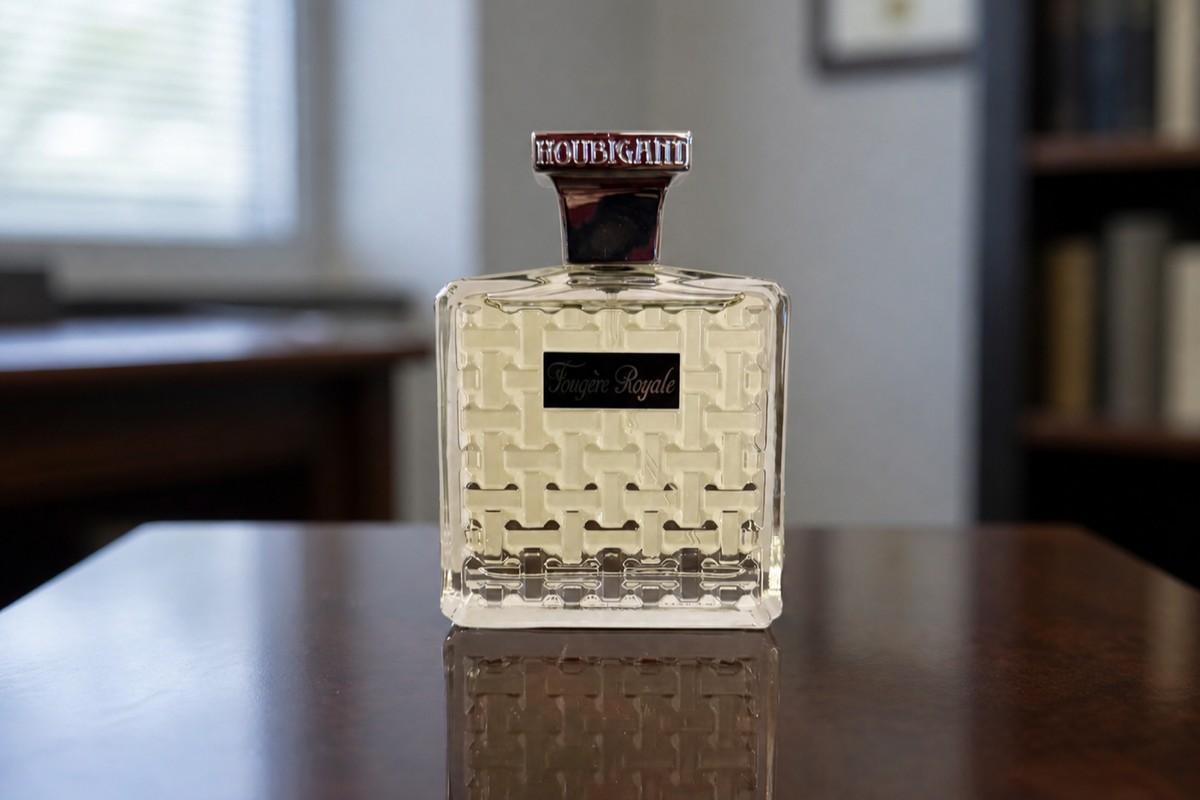
Houbigant Fougère Royale, 2010 relaunch.
Houbigant discontinued and revived Fougère Royale more than once across the twentieth century. The bottle in my collection is the 2010 relaunch, composed by Rodrigo Flores-Roux with Roja Dove directing, and Flores-Roux has said plainly that this version doesn't try to recreate the 1882 original. It leans more floral and less powdery than the fragrance Parquet built.
A fougère reads as soap before it reads as a fragrance. The genre made its name as a barbershop scent, plain and unpretentious, and the effect on a stranger across a desk is closer to clean than to composed. Reviews of this exact eau de parfum describe average projection and four to six hours of longevity, short by the standards of most of what's in this piece. Two sprays, chest only, under the shirt. That puts the cloth between the scent and the room.
Meeting the Parents
A living room, sofas at angles, four to twelve feet most of the evening. That is social distance, the widest band you can still hold a normal conversation across. The complication is that you will also cross into personal distance twice, once on the handshake or the hug at the door and once on the way out, and those two moments are the ones people remember.
So this needs a bottle that reads correctly at both ranges. Creed Green Irish Tweed. Peppermint, verbena, lemon, bergamot and galbanum at the top. Geranium, lavender and violet in the heart. Sandalwood, cedarwood, ambroxan and oakmoss at the base. Creed does not print a year or a perfumer on its own page, but the fragrance is generally dated to 1985 and Pierre Bourdon has said he composed it.
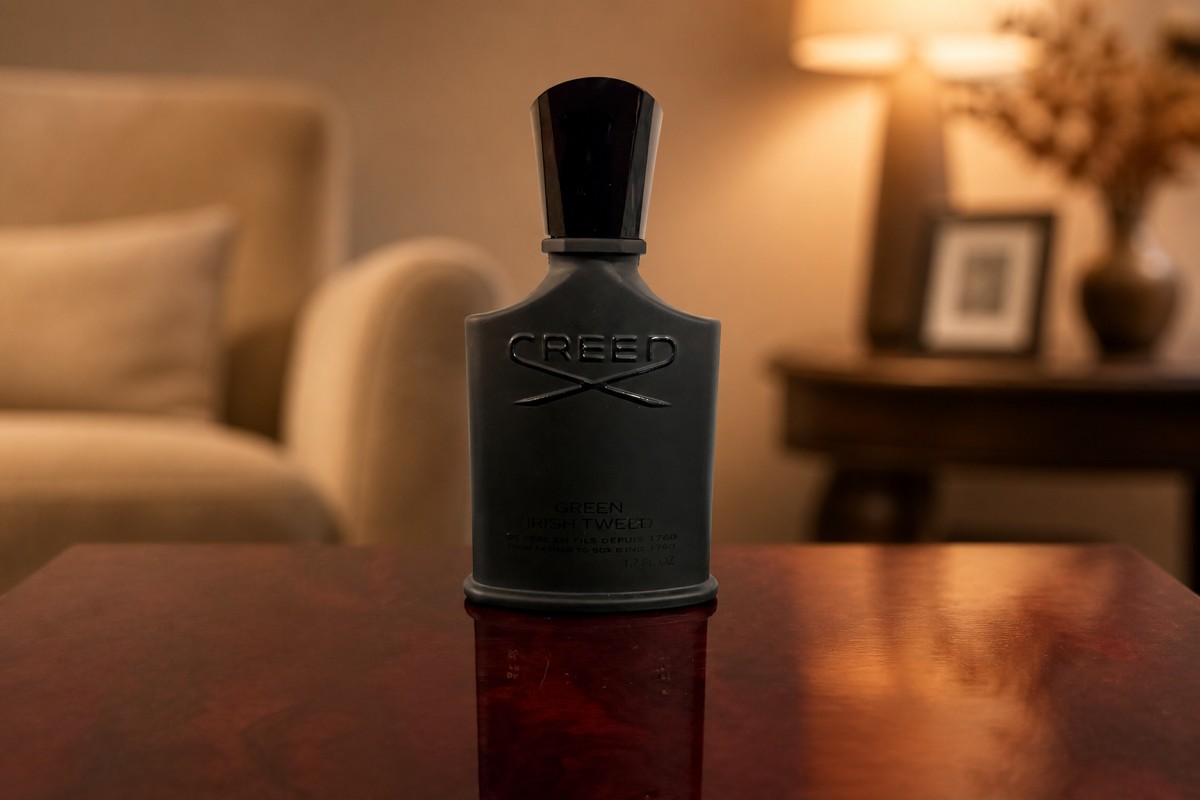
Creed Green Irish Tweed.
There is a story attached that gets told backwards constantly, so here it is the right way round. Bourdon made Green Irish Tweed for Creed in 1985. Three years later he made Davidoff Cool Water, in 1988, on closely related lines. The older one is the Creed. If someone in the room says Creed copied Cool Water, the dates say otherwise, and it was the same perfumer either way.
The other option is Chanel Bleu de Chanel, an eau de toilette. Jacques Polge composed it in 2010, Chanel's first men's fragrance since Allure Homme Sport in 2004 and the house's first new men's flagship since Égoïste in 1990. Grapefruit, lemon, mint and pink pepper at the top. Ginger, nutmeg, jasmine and Iso E Super through the heart. Incense, cedar, vetiver, sandalwood, patchouli, labdanum and white musk underneath. It's also the fragrance enthusiasts complain about most for being too safe, and that complaint is exactly why it belongs on this list. Nobody has ever been put off by Bleu de Chanel. Collectors mean that as an insult. A room meeting you for the first time means it as the whole point.
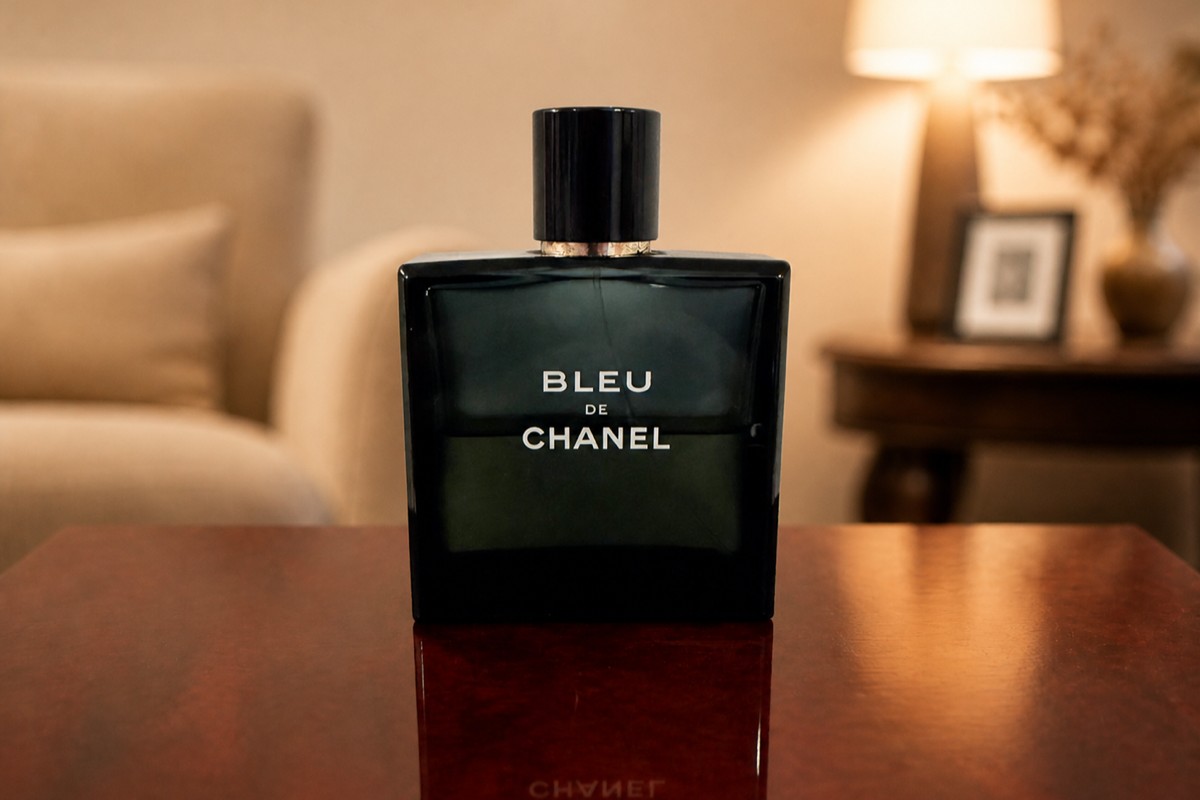
Chanel Bleu de Chanel.
What either one does at a parents' house is unglamorous and exactly right. Both smell clean and put-together without telling a story about you, and nobody in the room has to form an opinion. Three sprays, chest and one on the back of the neck for the hug, whichever bottle you reach for.
The First Date
The closest standing distance on this list. Dinner across a small table is personal distance, and anything that happens after is intimate distance, eighteen inches and in. At that range projection is not just unnecessary, it works against you. A scent that fills a room from four feet away is loud at six inches.
Dior Homme Original. Lavender, sage and bergamot at the top. Iris, amber, cacao and cardamom through the heart. Patchouli, leather and Tahitian vetiver underneath. It launched in 2005 built around iris paired with leather and cocoa, a pairing nobody else in menswear was using at that concentration, and it stayed on shelves under the plain Dior Homme name until February 2020. That month Dior released an entirely different composition and moved the 2005 formula to the name it carries now, Dior Homme Original, so nobody confused the two. It is an eau de toilette, and it wears close to the skin without ever needing to prove it is there.
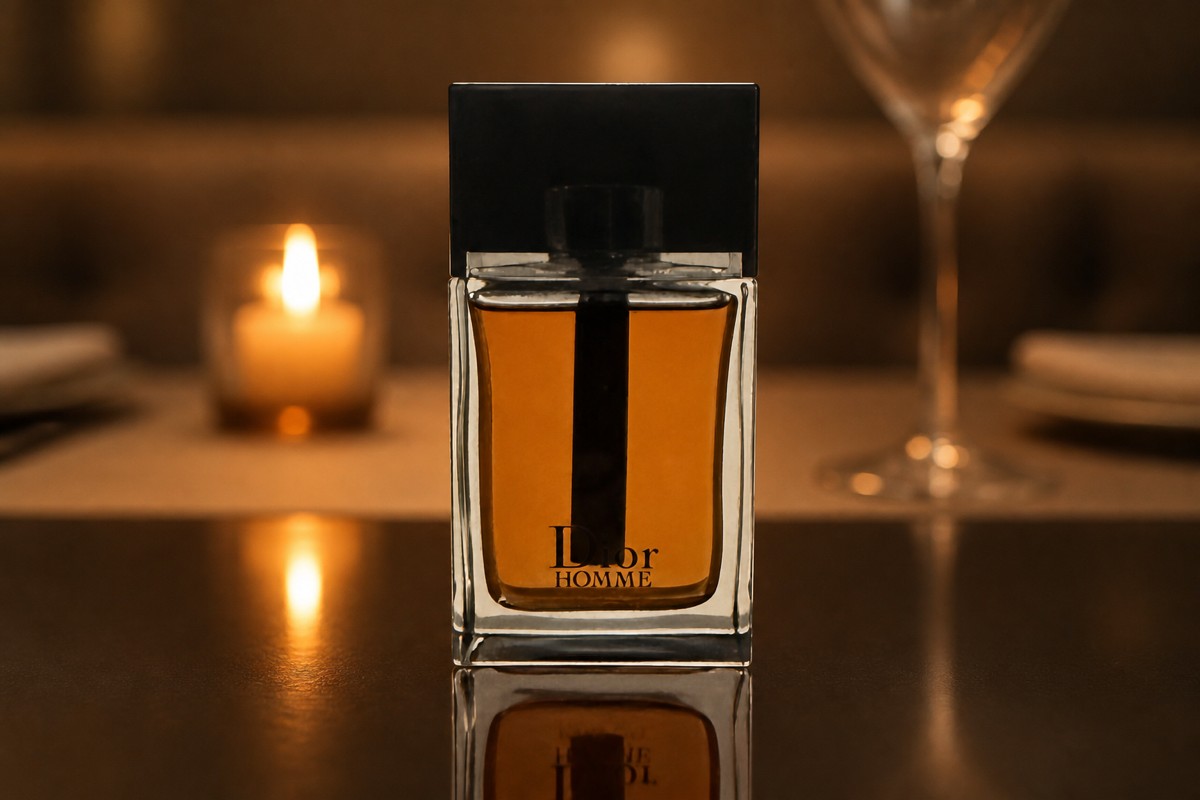
Dior Homme Original.
If the classic route is not the mood, Initio Side Effect is the bolder version of the same range. Rum and tobacco up top, cinnamon and saffron close behind, settling into sandalwood, leather and hedione. It launched in 2016 as part of Initio's Carnal Blends collection and it has real projection on most skin, more than the Dior does. Wear it here with the same discipline as the Dior, at the same low spray count. The bottle can carry farther. The application shouldn't.
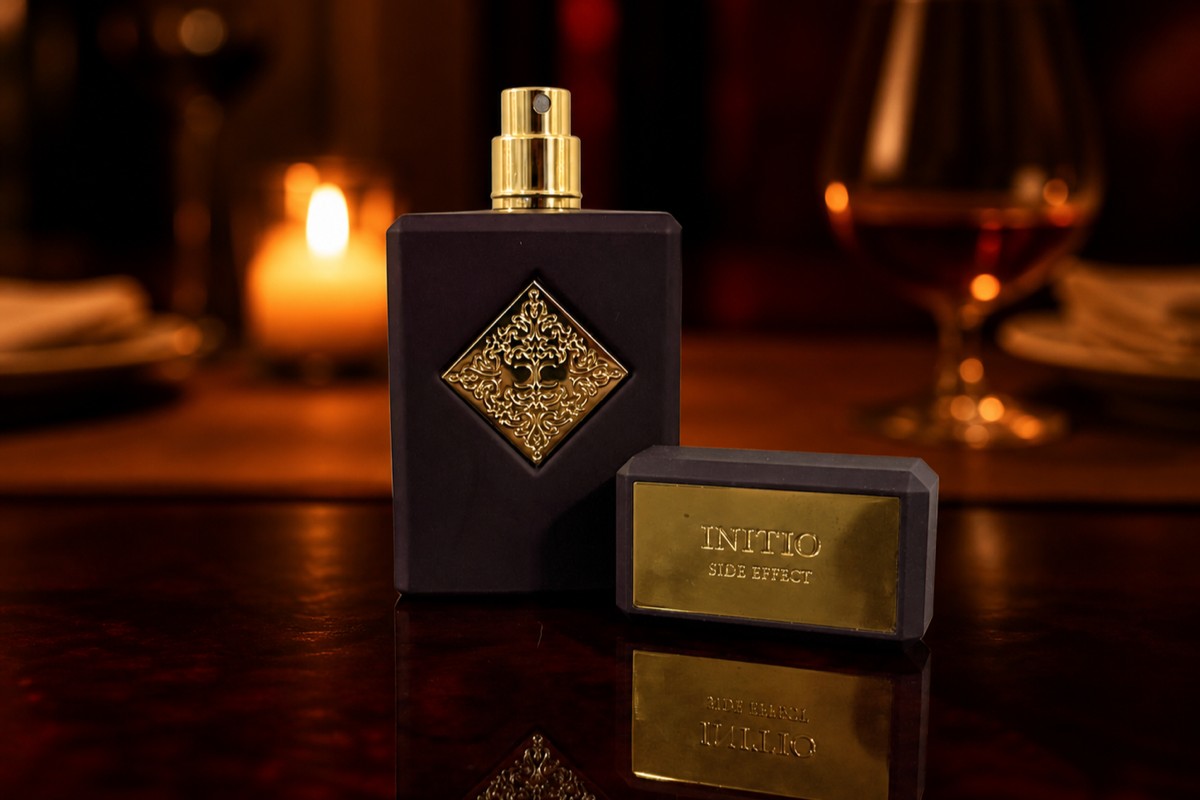
Initio Side Effect.
Two sprays, chest only, whichever bottle you pick. Nothing on the neck, nothing on the wrists, nothing in the hair. At this range the application matters more than which of the two you reach for.
I wore Dior Homme on my first date with my now-partner, five years ago. I went light on the sprays. I'm glad I did. She is sensitive to scent, and if I had come in strong she probably would not have agreed to a second date. She has come around on perfume since, and these days she loves a good rose and oud combination. But the lesson from that first date has stayed the same regardless of the bottle: apply less than you think you need.
The Wedding
The opposite of the interview in every dimension. A large room, high ceilings, several hundred people, all of them wearing something. Most of your evening runs at social and public distance, twelve feet and beyond, with a few minutes of close contact scattered through it. You are also going to be there for six hours, half of them warm.
This is the one occasion on the list where a big bottle is the correct answer, not an indulgence. Amouage Jubilation XXV. Amouage was founded in Muscat in 1983 at the request of Sultan Qaboos, and the house publishes its own specifications in a way almost nobody else does. Jubilation XXV is an eau de parfum at twenty-three percent oil concentration, aged eight weeks, five of maceration and three of maturation. Labdanum, coriander, orange, davana, frankincense and blackberry at the top. Honey, bay, cinnamon, orchid, rose, clove, celery seed and guaiac wood in the heart. Patchouli, opoponax, myrrh, cedar, musk, moss, ambergris, oud and immortelle at the base.
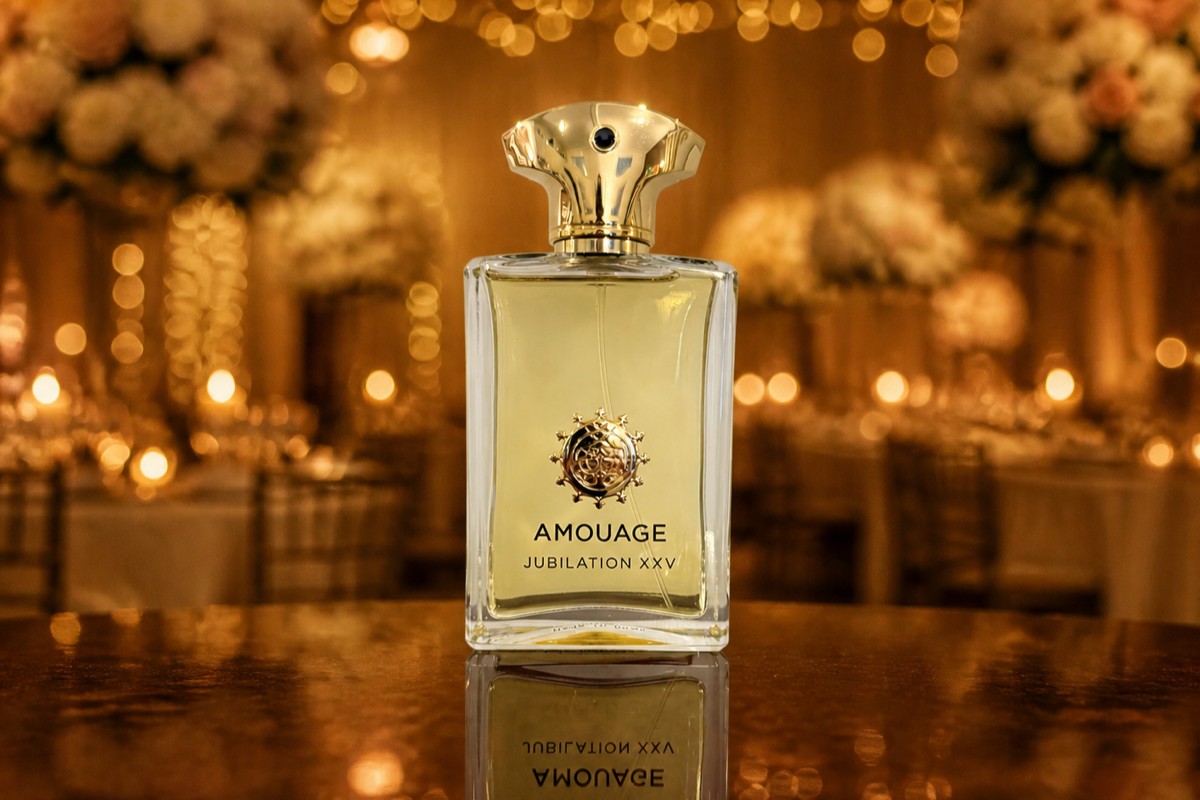
Amouage Jubilation XXV.
That reads like an ingredient list for something overwhelming, and worn wrong it is. Worn right, at three sprays on the chest and none above the collar, it is the only bottle here that still says something at twelve feet after four hours. In my experience that kind of persistence tracks with the published oil concentration, twenty-three percent here, though the concentration number alone doesn't guarantee it. Formula and skin matter too. Three sprays is where I've found it holds without turning into a wall.
A correction, in passing: the XXV gets explained everywhere as the house's twenty-fifth anniversary, usually alongside a 2007 launch date, and those two facts do not fit together. A house founded in 1983 has its twenty-fifth anniversary in 2008. Amouage's own page states neither the year nor the anniversary, so I am not going to assert either.
The other option is Amouage Reflection 45, and it is not a stronger version of Jubilation, whatever the shared house makes it look like. It is a 2021 reinterpretation of the house's 2007 Reflection Man at a 45 percent extrait concentration, built around iris and jasmine instead of incense and fruit. Lavender, juniper and cardamom up top. Iris, jasmine, neroli and tonka bean through the heart. Sandalwood, myrrh and vetiver at the base. The extrait strength is a fair part of why it earns a place on this list. In my experience it holds its shape for most of a six-hour day without a reapplication in the middle of the reception, which is the same problem Jubilation solves from the other direction. Two sprays here, not three. Extrait strength doesn't need the third.
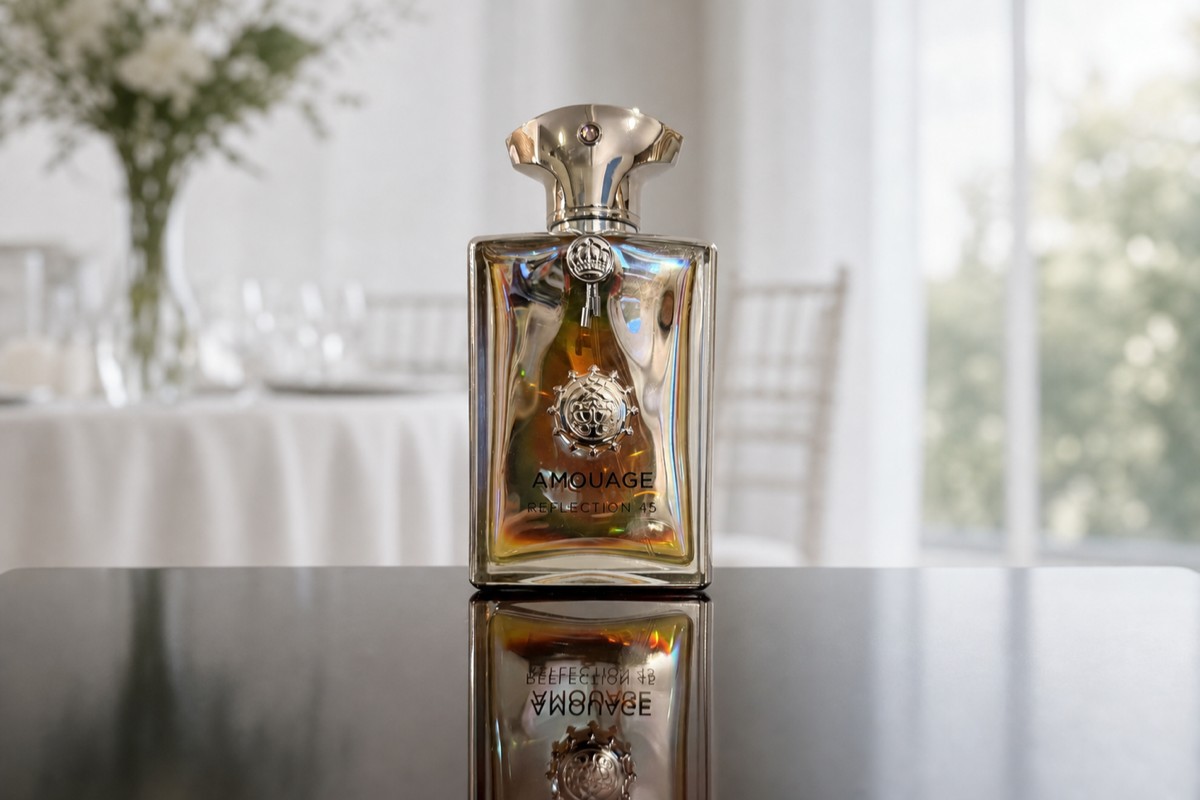
Amouage Reflection 45.
The Reunion
A loud bar or a hotel function room, and unlike the wedding you will not stand still. Reunions are twenty short conversations at four feet, and you will move between them all night. That means your scent gets introduced twenty separate times, which is a different problem from filling one room for six hours.
Argos Triumph of Bacchus. Argos is an independent American house that names its releases after figures out of Greco-Roman mythology, and this one is built around Bacchus, the god of wine and of freeing people from self-consciousness through it. Rum, white peach, green apple and saffron at the top. Patchouli, jasmine, vetiver and tonka bean through the heart. Tobacco, amber, Mysore sandalwood and vanilla underneath. Perfumer Christian Petrovich, credited on the brand's own product page and consistently elsewhere.
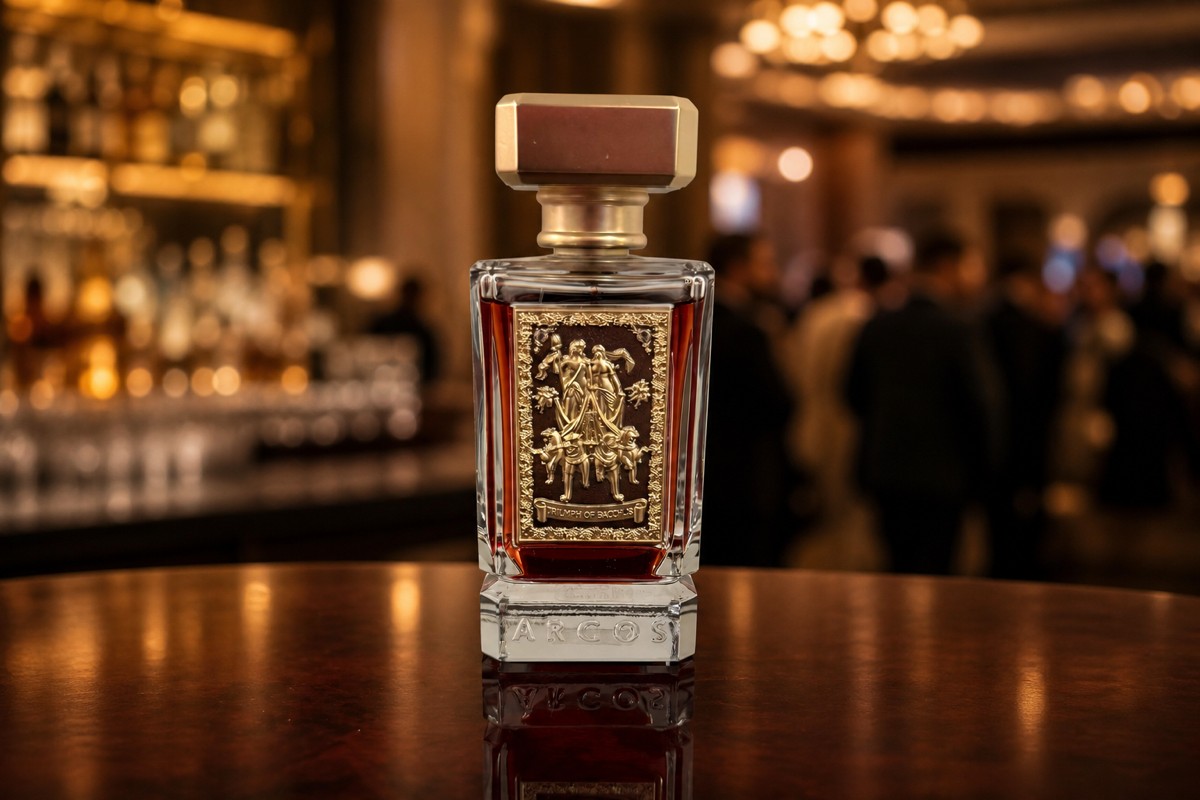
Argos Triumph of Bacchus.
The other option is Bon Parfumeur 502 Iris Cartagena, an extrait de parfum. Perfumer Clément Marx built it in 2024 around a founder's trip to Cartagena, Colombia, a late dinner under the stars with coffee, rum and chocolate on the table. Cocoa, rum, petitgrain and mandarin up top. Iris, sandalwood, vanilla and cedar through the middle. Papyrus, coffee, vetiver and sugar cane underneath. It's boozy and gourmand in the same register as the Argos, warm enough to carry through a loud room, with the iris keeping it from reading as dessert.
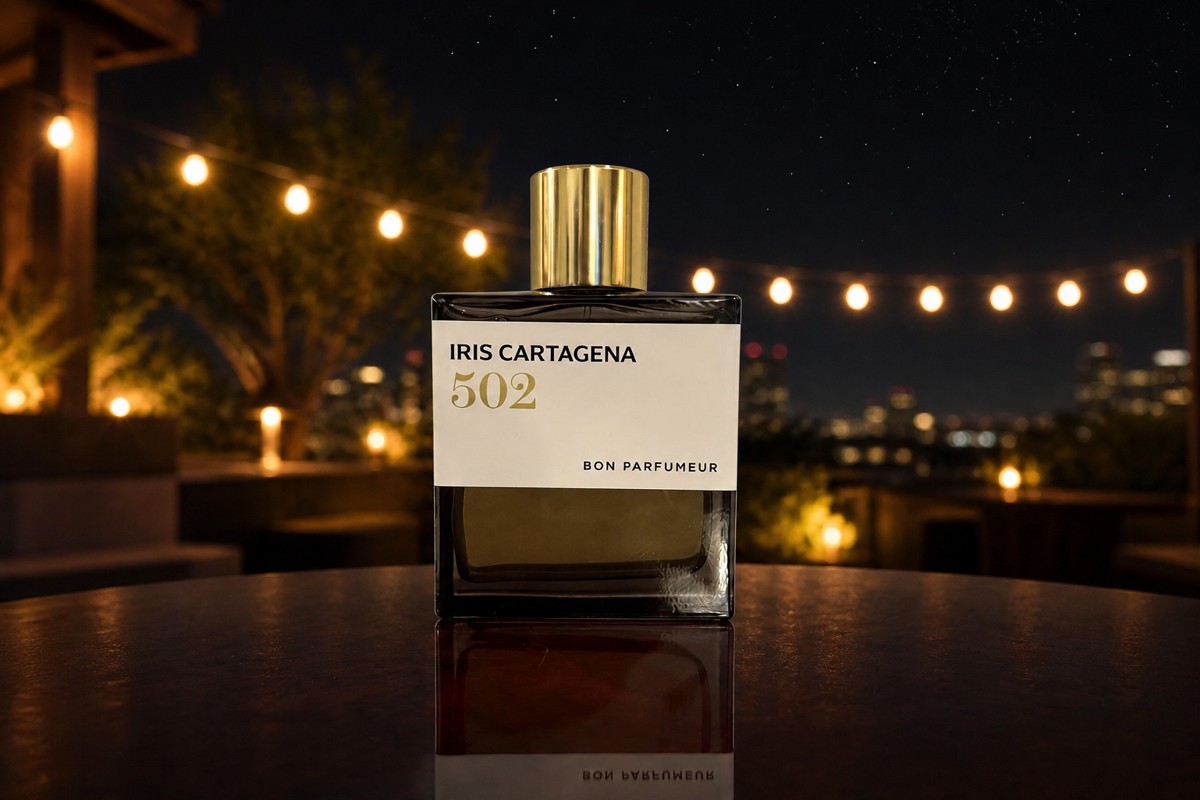
Bon Parfumeur Iris Cartagena.
Boozy and warm is the whole reason either one is here. Both are built to project, and a reunion is the one occasion on this list where that is exactly what you want. You are moving through the room all night, not holding one conversation for six hours, so your scent has to reintroduce itself over and over instead of filling a space once and holding it. Three sprays for the Argos, chest and one on the jacket. Two for the Iris Cartagena, extrait strength doesn't need the third. The jacket spray lasts longer than skin and survives the room's warmth.
The Funeral
Wear nothing.

The one deliberate blank on this list.
Not because fragrance is disrespectful, and not because there is a rule about it. I went looking for a funeral-etiquette authority that says this and could not find one, so treat what follows as an argument, not a citation.
The argument is about memory. Smell has a shorter path to the parts of the brain that handle emotion and memory than any other sense. The primary olfactory cortex includes the amygdala, which handles emotional memory, and the hippocampus, which handles associative learning, and odour reaches them without the thalamic routing that vision and hearing go through first. Rachel Herz, reviewing the field in 2016, found that odour-evoked memories are rarer, thought about less often, and drawn from earlier in life than memories triggered any other way, and that they arrive with more emotion attached than memories triggered by any other cue. Johan Willander and Maria Larsson tested ninety-three older adults in 2006 and found that memories cued by smell clustered in the first decade of life, while memories cued by words or pictures peaked in the teens and twenties, and that the odour memories came with a stronger sense of being taken back in time.
Put that next to a funeral. Everyone in that room is going to remember the day involuntarily, for years, triggered by things they did not choose. If you wear something distinctive, you have put yourself in that trigger set for people who are not thinking about you at all and did not agree to it. Someone will smell cardamom in an elevator in 2034 and be back in that room. That is a large thing to hand to a person who is grieving, and there is no version of it you get to take back.
There is a smaller, more practical reason underneath. Anne Steinemann surveyed the US population in 2016 and found that 23.6 percent of people reported health problems from being near someone wearing a fragranced product, self-reported and not a clinical measurement. A funeral is a packed room where you cannot know which mourners are in that quarter, and it is the single occasion where you have no standing to make them find out. Institutions already treat this as a real issue in shared indoor space. The Canadian Centre for Occupational Health and Safety publishes model scent-free workplace policy language listing headaches, nausea, shortness of breath and difficulty concentrating among the effects, though that guidance covers workplaces and not funerals, and I am not going to stretch it further than it goes.
Shower. Unscented deodorant. Clean clothes that have not been sitting in a wardrobe next to something loud. That is the whole answer, and it is the only entry on this list where doing less is doing the job.
The Six, Side by Side
| Occasion | The room | Where you stand | The bottle | Sprays |
|---|---|---|---|---|
| Interview | Small office, no exit | Personal, 1.5 to 4 ft | Houbigant Fougère Royale (EDP) | 2, chest, under the shirt |
| The parents | Living room, sofas | Social, 4 to 12 ft, with two hugs | Creed Green Irish Tweed (EDP), or Bleu de Chanel (EDT) | 3, chest and nape |
| First date | Small table, then closer | Personal into intimate, under 18 in | Dior Homme Original (EDT), or Initio Side Effect (EDP) | 2, chest only |
| Wedding | Large hall, six hours, hundreds of people | Public, 12 ft and out | Amouage Jubilation XXV (EDP, 23% oil), or Reflection 45 (extrait, 45% oil) | 3 for Jubilation, 2 for Reflection 45 |
| Reunion | Loud bar, constant movement | Social, 4 ft, twenty times over | Argos Triumph of Bacchus (EDP), or Bon Parfumeur Iris Cartagena (extrait) | 3 for Argos, 2 for Iris Cartagena |
| Funeral | Packed room, no way out | All of them, all night | Nothing | 0 |
Five of the six are a calculation about distance. The sixth is a calculation about memory, and it runs the other way: know when your scent shouldn't leave you at all.
Pull up a chair.
New writing on fragrance, spirits, and cigars goes up multiple times a week. Subscribe free on Substack for the Bite-Sized Brief, or pay a nominal fee to read the full article.

Sources
- Edward Hall's four proxemic zones and their measurements, from The Hidden Dimension, Doubleday, 1966: confirmed at the same figures used here, intimate to eighteen inches, personal 1.5 to 4 feet, social 4 to 12 feet, public beyond that, in Oxford Reference's entry on interpersonal zones and independently in "Types of Nonverbal Communication," Communication in the Real World, University of Minnesota Libraries Publishing. The two sources differ on attribution: the Minnesota textbook credits the framework to Hall's 1968 paper in Current Anthropology instead of the 1966 book. Both are current in the literature. A chapter excerpt from Em Griffin's A First Look at Communication Theory, which quotes Hall's book directly with a page citation, gives the social and public boundary as 10 feet, not 12, so that specific number isn't settled even among sources that quote the book firsthand. I am using 12 feet because it is the figure that recurs across the most secondary sources, not because the discrepancy is resolved. I have written intimate distance as a single band running to about eighteen inches instead of subdividing it, because Wikipedia's close-phase figure, "less than one inch (0.01 to 0.02 m)," is internally inconsistent and contradicts its own six-inch far phase, and neither Oxford Reference nor the Minnesota textbook subdivides intimate space either.
- Hall's own caveat that the measurements were not meant as strict guidelines but as a system for gauging how distance affects communication across cultures and settings: Nina Brown, "Edward T. Hall, Proxemic Theory, 1966," CSISS Classics, University of California, an academic overview of Hall's background and the cultural variation built into the framework. The book itself is borrow-only at the Internet Archive and its interior text was not read directly for this piece. Applying any of it to fragrance is mine, not Hall's.
- Houbigant Fougère Royale composed by Paul Parquet in 1882, credited as the first fougère and as one of the first fragrances built on a synthetic material, coumarin isolated from tonka bean: Bloom Perfumery's house history and Fragrantica's history piece, both drawing on Houbigant's own account. The Osmothèque's own review, reported by Persolaise, suggests the actual release may have been 1883 as a soap with the bottled perfume following in 1884, and that the fragrance wasn't widely popular until the 1910s. I am using 1882 because it is the year the house and most retailers use, not because the earlier date is settled. Roja Dove directing and Rodrigo Flores-Roux composing the 2010 relaunch, and Flores-Roux's own statement that this version does not resemble the 1882 original: Persolaise's review of the 2010 edition. The note pyramid: a Basenotes thread quoting Houbigant's own official press materials at launch. Average projection and four-to-six-hour longevity specifically for the eau de parfum: a Parfumo review of that concentration, distinct from the extrait.
- Green Irish Tweed's concentration and note list: Creed's own product page, which prints neither a year nor a perfumer. The 1985 date, the Bourdon credit, and Green Irish Tweed's status as the earlier of the two fragrances: journalist Gabe Oppenheim's book The Ghost Perfumer, built on Oppenheim's own interviews with Bourdon, reported in Basenotes' review of and interview around the book. This is journalism, not a statement from Creed, which has never confirmed the attribution and credits no outside perfumers on any of its fragrances.
- Davidoff Cool Water introduced in 1988, a plain date that is not in dispute: general trade record. Its composition on accord work related to Green Irish Tweed, and Bourdon's own account of the relationship between the two fragrances: the Oppenheim reporting above. Cool Water is Davidoff, licensed to Coty, and has no connection to Chanel, which is a common mix-up.
- Bleu de Chanel composed by Jacques Polge, launched September 13, 2010, as Chanel's first men's fragrance since Allure Homme Sport in 2004 and its first new men's masterbrand since Égoïste in 1990: Wikipedia, cross-checked against an Osmètheca profile of Polge's Chanel career. The eau de toilette's note list: Fragrantica, for the original 2010 concentration specifically, distinct from the 2014 eau de parfum and 2018 parfum, which use different note lists and different perfumers for the later editions.
- Dior Homme's 2005 launch and its note list of lavender, sage, bergamot, iris, amber, cacao, cardamom, patchouli, leather and Tahitian vetiver, and the February 2020 relaunch under which the 2005 formula was renamed Dior Homme Original while an entirely new composition took the plain Dior Homme name: Fragrantica's coverage of the 2020 launch and Persolaise's review from the same month. Francois Demachy's credit for the 2020 composition is confirmed across multiple sources; the perfumer behind the 2005 original is reported inconsistently and is not named here.
- Initio Side Effect's 2016 launch, its place in the Carnal Blends collection, and its note list of rum, tobacco, cinnamon, saffron, sandalwood and hedione: the brand's own product page and Fragrantica. Neither page names a perfumer, so none is asserted here.
- Amouage founded in Oman in 1983 at the request of Sultan Qaboos bin Said, by Prince Sayyid Hamad bin Hamoud Al Busaidi: the house's own story page. Jubilation XXV Man as an eau de parfum at 23% oil concentration, aged eight weeks across five of maceration and three of maturation, and its full note list: Amouage's own product page. That page gives no launch year, names no perfumer, and says nothing about what XXV commemorates. The widely repeated pairing of a 2007 launch with a twenty-fifth anniversary cannot both be right against a 1983 founding, and neither half is asserted here.
- Reflection 45's 2021 launch as a 45% oil extrait reinterpretation of the house's 2007 Reflection Man, and its full note list: Amouage's own product page. Fragrantica and several retailers credit the composition to Lucas Sieuzac; that credit could not be confirmed against a house source and is presented here as reported, not verified.
- Argos Triumph of Bacchus's note list, its mythological framing around Bacchus, and Christian Petrovich's perfumer credit: Argos Fragrances' own product page, with the credit repeated on Fragrantica. Fragrantica dates the launch to 2019; Argos's own page gives no year.
- Bon Parfumeur 502 Iris Cartagena's 2024 launch, its note list, and Clément Marx's perfumer credit: the brand's own product page and Fragrantica, which agree on the note list for the extrait. The Cartagena, Colombia inspiration and the founder's personal trip behind it: Bloom Perfumery, which names Ludovic Bonneton as the founder the story belongs to.
- Odour reaching the amygdala and hippocampus without the thalamic routing other senses go through, and odour-evoked memories being rarer, thought about less often, drawn from earlier in life and more emotional than memories cued any other way: Rachel S. Herz, "The Role of Odor-Evoked Memory in Psychological and Physiological Health," Brain Sciences 6(3), 2016, article 22, open access. This is a review article, not a single experiment.
- Odour-cued autobiographical memories clustering in the first decade of life while verbal and visual cues peak at eleven to twenty, and odour memories carrying a stronger sense of being brought back in time, from a study of ninety-three older adults: Johan Willander and Maria Larsson, "Smell your way back to childhood: Autobiographical odor memory," Psychonomic Bulletin & Review 13(2), 2006, pages 240 to 244, Springer.
- 23.6 percent of people reporting health problems from proximity to someone wearing a fragranced product, and 34.7 percent reporting adverse effects from fragranced products generally: Anne Steinemann, "Fragranced consumer products: exposures and effects from emissions," Air Quality, Atmosphere & Health 9(8), 2016, pages 861 to 866, Springer. This is a self-reported population survey, not a clinical measurement.
- Model scent-free policy language and the health effects it lists, including headaches, nausea, shortness of breath and difficulty concentrating: "Scent-Free Policy for the Workplace," Canadian Centre for Occupational Health and Safety, Government of Canada. This guidance covers workplaces only. It is cited here as evidence that institutions treat fragrance as a real issue in shared indoor space, not as a rule that applies to funerals, and the same page cautions that scent policies should not be limited to perfume.
- No funeral-etiquette authority prescribing fragrance-free attendance was found, and none is cited. That section is an argument built on the memory research above and on its own reasoning, and it should be read that way. Spray counts, placements and every recommendation in this piece are my own opinion and carry no citation.
A note on the images in this piece: the hero illustration and the Bite-Sized journal thumbnail are AI-generated, one in a comic style and one in watercolor. The nine bottle photos are real, shot from my own collection, with the backgrounds replaced by AI to suggest each occasion. The funeral section gets a black frame instead of a bottle, since that's the point.