Key Takeaways
- The first American bartending manual, Jerry Thomas's 1862 guide, laid out the sour format in four numbered recipes. Not one of them is a whiskey sour, and not one uses egg.
- Four of these eight trace to Milk & Honey or its orbit, though one was created for a bar in Chicago.
- One fragrance anchors four builds. The other four each needed a different bottle.
Have a Sour Day — A Two-Part Series
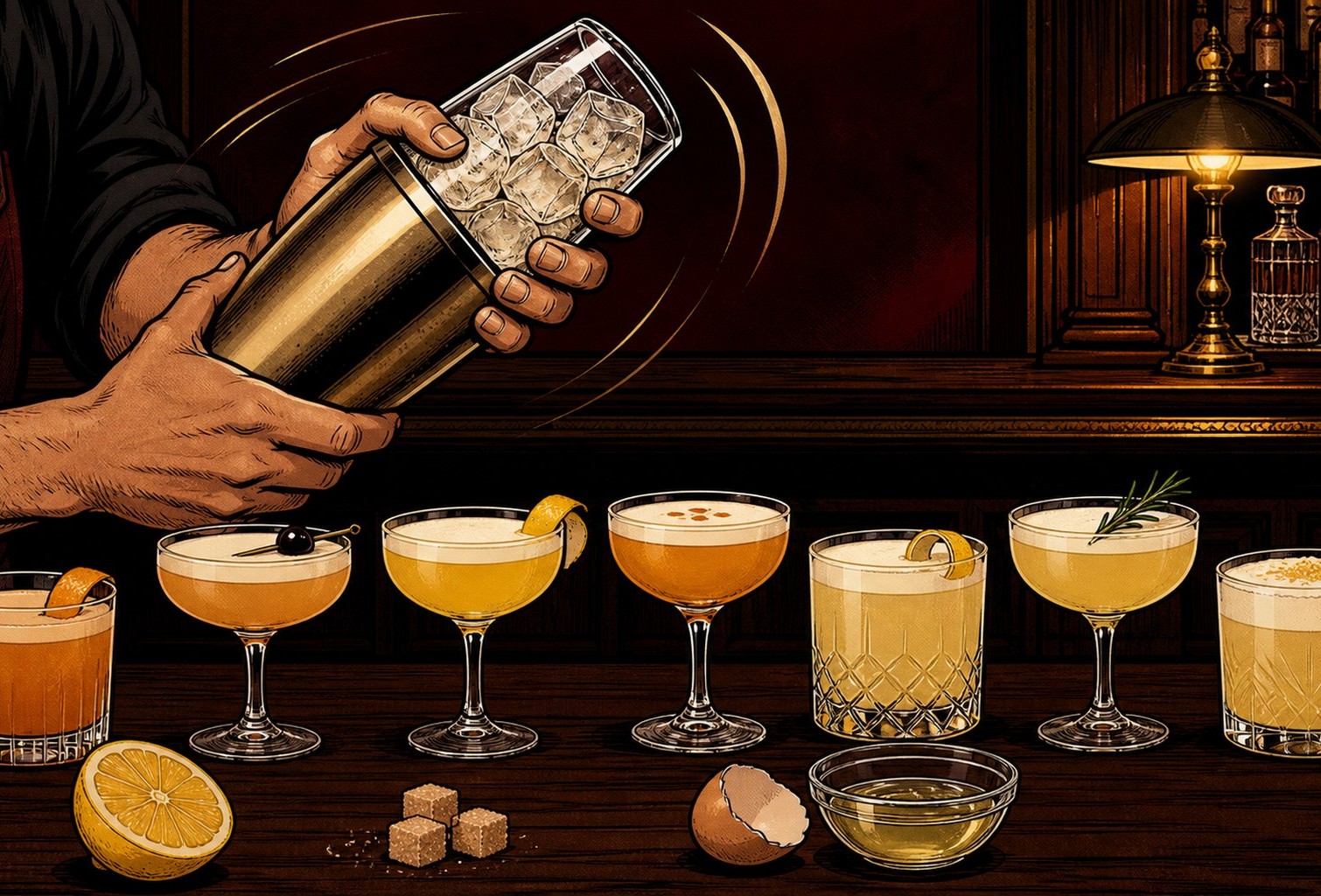
August 25th is National Whiskey Sour Day. It's an unofficial holiday, the kind bars use as an excuse for a discount, but the drink earns the attention on its own terms. It looks simple. Bartenders have been arguing over the proportions since the 1800s and still have not settled it.
Where the Sour Family Comes From
The whiskey sour belongs to an older family called sours: a base spirit, an acid, and a sweetener. Jerry Thomas laid the format out in his 1862 guide under a heading called Fixes and Sours. The section runs four numbered recipes, two Fixes and two Sours: a Brandy Fix, a Gin Fix, a Brandy Sour, and a Gin Sour. Two footnotes add a Santa Cruz Fix and a Santa Cruz Sour, rum standing in for the brandy and the gin, and a last line tells you to put the lemon skin in the glass.
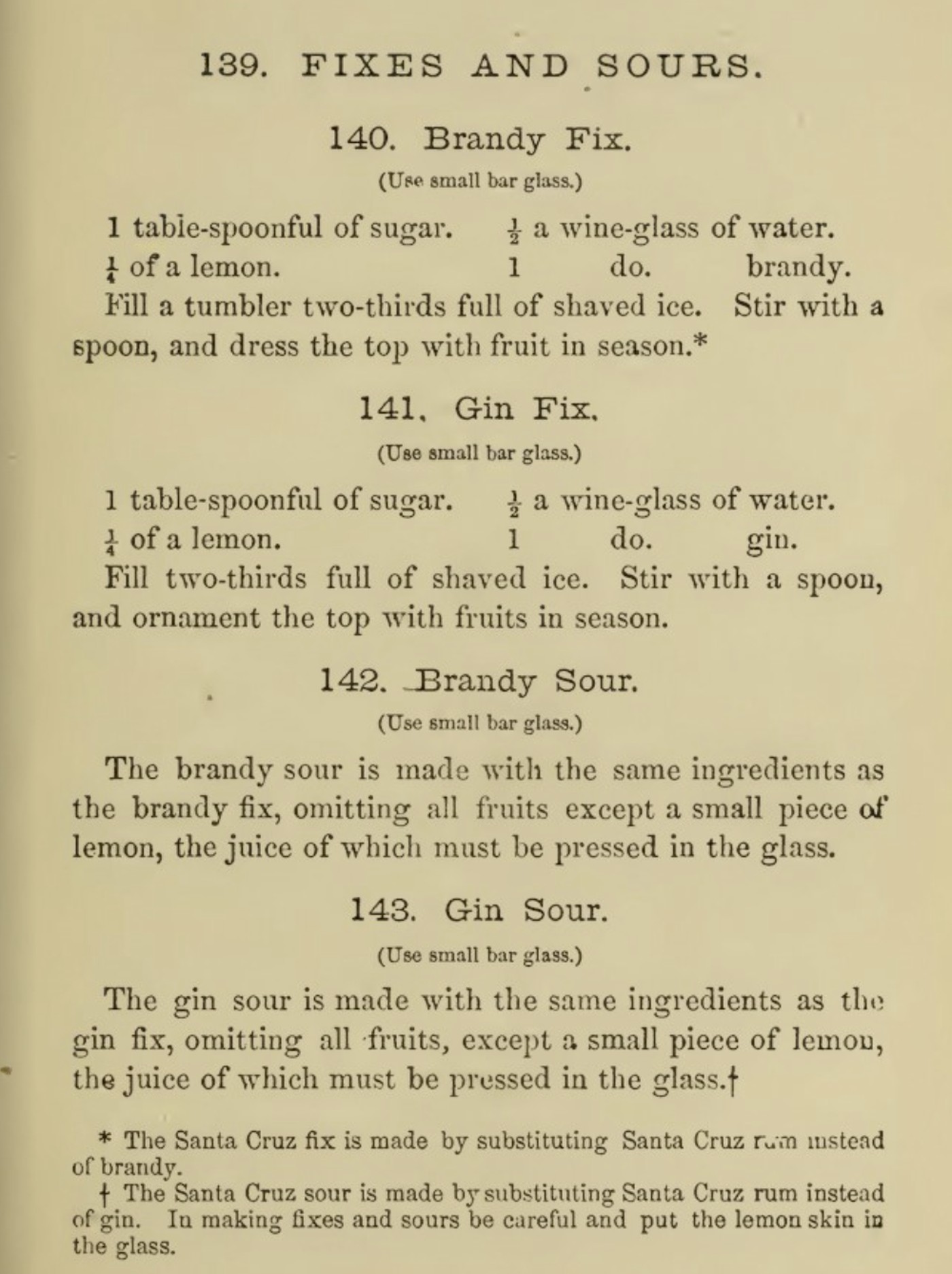
There's no whiskey sour in it. That isn't for lack of whiskey. The book carries eleven other whiskey drinks, punches and a julep and a smash and a cocktail and a crusta and a sling and a skin. The sour just wasn't one of them yet. Seven years later it was. Haney's Steward & Barkeeper's Manual printed a Bourbon Sour in 1869: a wine-glass and a half of bourbon, a full wine-glass of water, a tablespoon of sugar, half a lemon squeezed in, the rim of the glass rubbed with it, and a slice of fresh lemon dropped in after. Still wetter than the modern build, seven years on.
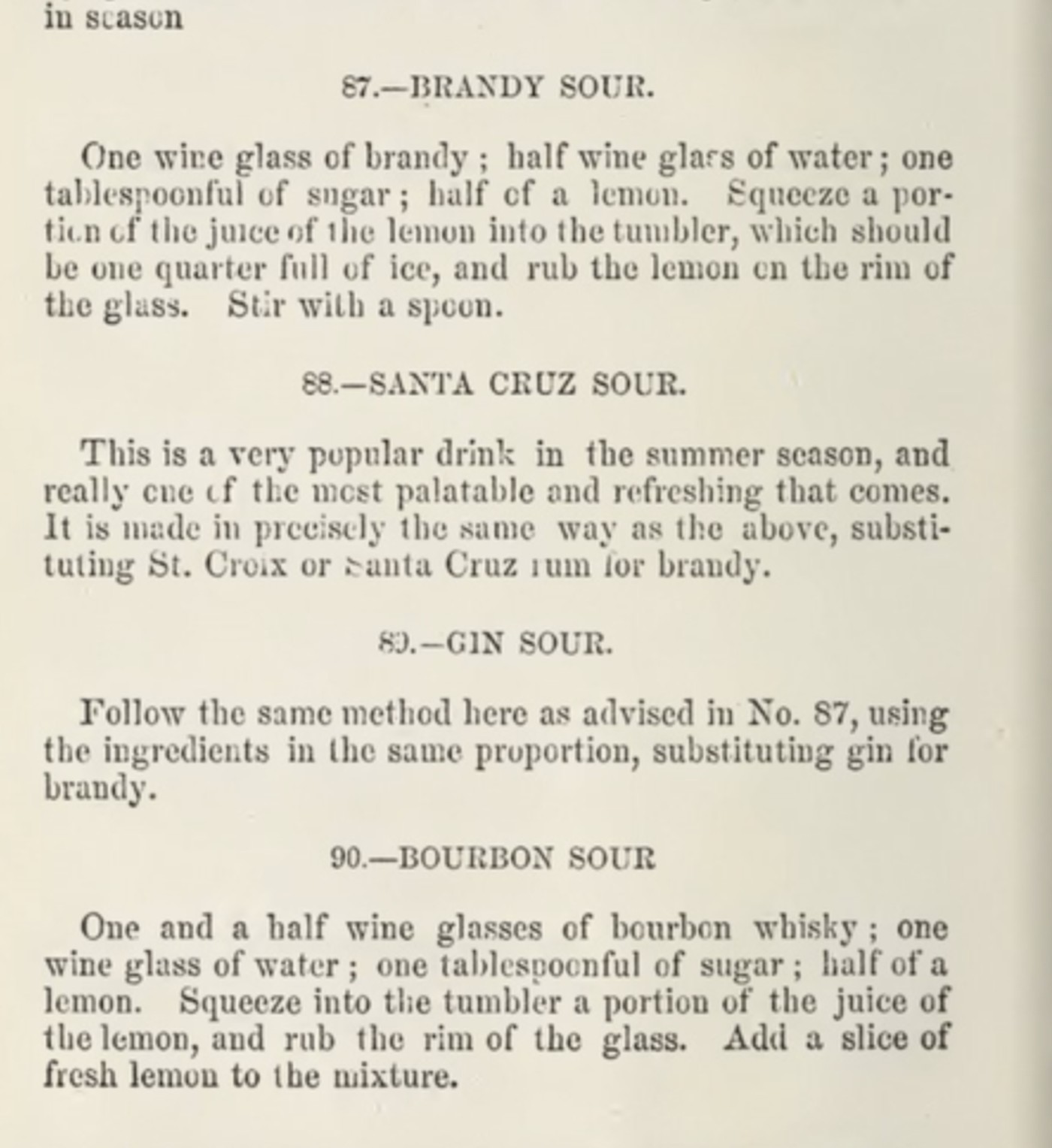
The earliest newspaper mention I could find comes a few months after that, on January 4, 1870, in the Waukesha Plain Dealer in Wisconsin, a passing line about a man ordering one, written as though readers already knew what it was.
There's a competing origin worth knowing because it doesn't hold up. A 1962 Universidad Nacional de Cuyo publication, citing the newspaper El Comercio, credits the drink to Elliott Stubb, a steward off the sailing ship Sunshine who put in at the port of Iquique and mixed whisky with sugar, ice, and the local Limón de Pica. Iquique was Peruvian at the time and only became Chilean in 1883, under the Treaty of Ancón. The story is set in 1872, three years after Haney printed a recipe and two years after a Wisconsin paper printed the name as something readers would recognize. Stubb turns up in pisco sour origin lore too, which is its own contested territory.
Thomas's sour is also wetter than the modern one. His Brandy Sour is the Brandy Fix with the fruit stripped out: a tablespoon of sugar, a quarter lemon, a wine-glass of brandy, and half a wine-glass of water, built on shaved ice. The modern build dropped the measured water. The dilution stayed, since syrup carries water and a hard shake against ice adds a good deal more. His parting instruction on the section is to put the lemon skin in the glass.
The Sour at Sea
The pattern is older than the bar manuals, though the line isn't as direct as it usually gets told. In 1740 Vice-Admiral Edward Vernon of the Royal Navy ordered his sailors' daily half-pint rum ration cut with a quart of water and issued in two servings, so nobody could hoard it and drink it all at once. His order suggested that men who wanted to could buy sugar and limes out of their own pay to make the result palatable.
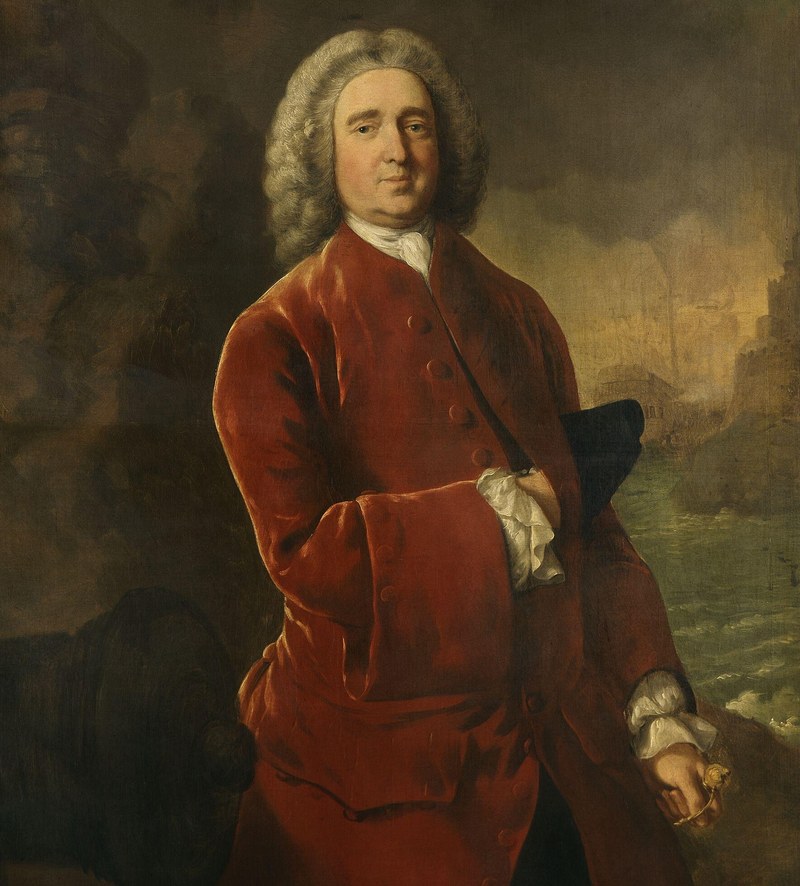
That's the part usually flattened. The sugar and citrus weren't issued and weren't required. They were an optional purchase. Vernon wore a cloak of grogram, a coarse silk-and-mohair cloth, and was already nicknamed Old Grog, so the sailors named the watered rum after him, and not as a compliment.
Call grog a precursor rather than a parent. Spirit, water, citrus, sugar, in the right shape a century early. The scurvy framing deserves its own caveat: the Royal Navy didn't adopt citrus as policy until 1795, fifty-five years later, and some historians read Vernon's instruction as being about making the ration drinkable and not about medicine. The lime is where the British got stuck with "limey" either way.
One more piece of lineage. The whiskey sour may not be the first sour in print at all. A gin sour reportedly appears on an 1856 menu from Mart Ackerman's Saloon in Toronto, held by the New York Public Library, which would put it thirteen years ahead of Haney.
The Scent
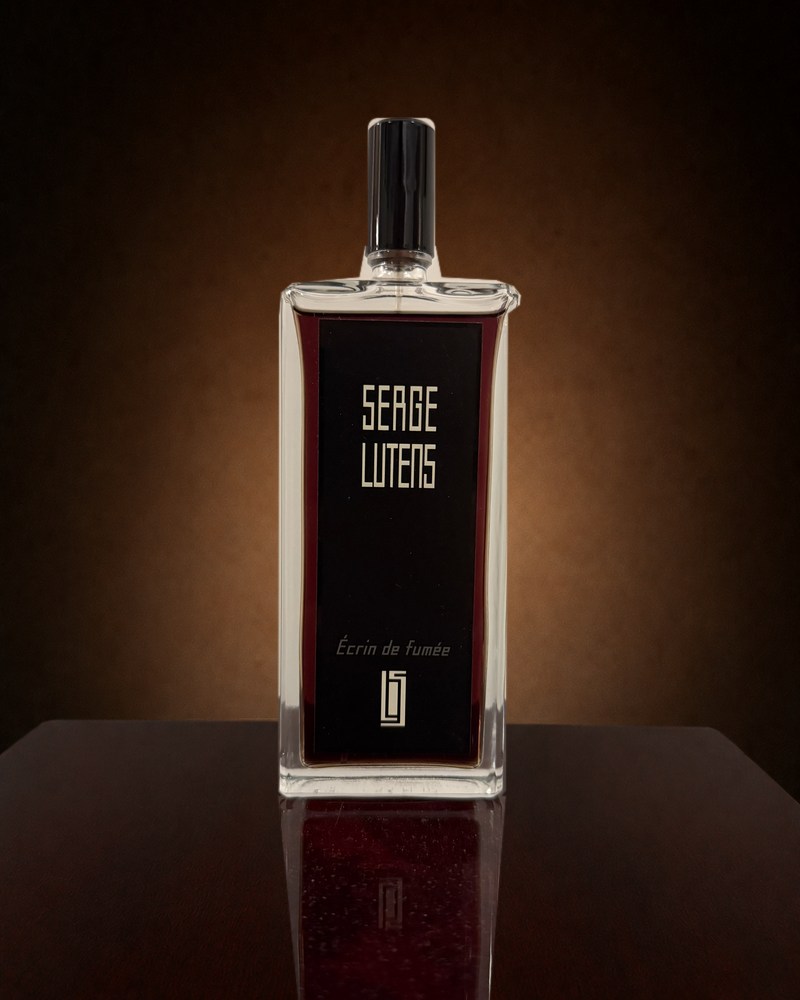
Serge Lutens Ecrin de Fumee, perfume 24 in the collection. Cacao, rum, smoke, tobacco, and woody notes, described by the house as an accord, with no clean top-middle-base split.
It anchors four of the eight drinks here, the ones still built on the whiskey-lemon-sweetener core with nothing loud competing: the Classic, the Boston, the New York, and the Gold Rush. The rum note does what the whiskey does in the glass, the base everything else sits on. The cacao brings a rounded sweetness that stands in for syrup better than a literal sugar note would. There's smoke in it, but the boozy ambient kind that comes off rum and tobacco, not the medicinal phenolic character of a peated Scotch.
The other four step outside that core far enough that forcing this bottle onto them stopped making sense. A different base spirit, a mint-driven build, no added syrup, or a different fruit entirely. Each gets its own pairing, noted where the drink is built.
When the Egg Arrived
Egg in a drink is old, and so is separating it. Thomas's 1862 book is full of both. One flip takes the whites of two eggs and the yolks of four, beaten apart and recombined. A mulled wine is subtitled "with the whites of eggs" and calls for twelve of them whipped to a froth. His egg nog has you beat the whites separately and float them on top, which is a foam cap under another name.
None of it goes into the four Fixes and Sours. The technique was sitting in the same volume and nobody had put it in a sour yet.
That changed within about twenty years. Patsy McDonough's 1883 Bar-Keeper's Guide has a Frosted Sour built with bourbon and the white of an egg, which appears to be the first. It still carries the half wine-glass of water, and the rim gets wet with lemon juice and dipped in powdered sugar.
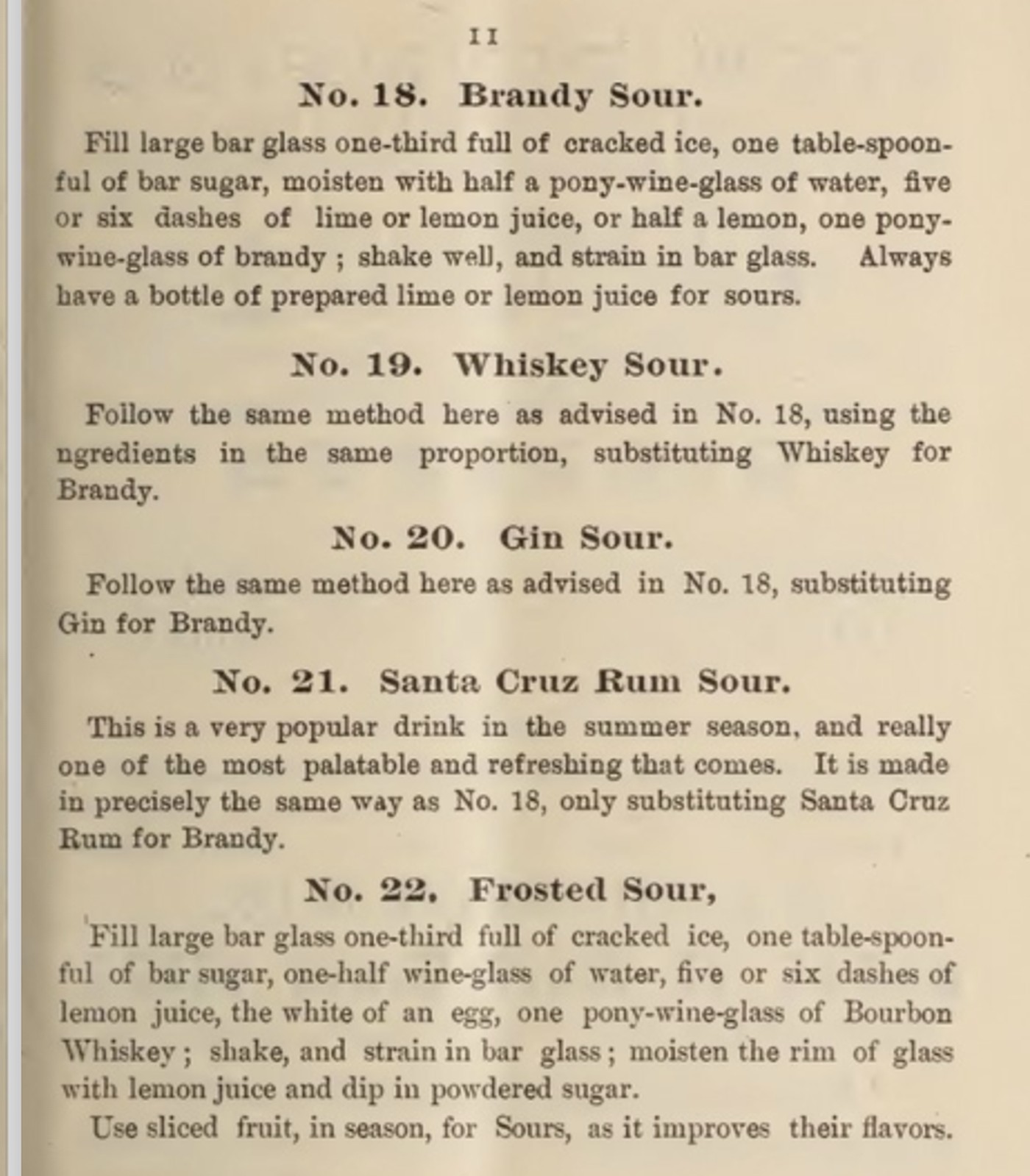
William Schmidt's 1892 Flowing Bowl prints the white of an egg as a straight ingredient in the Delicious Sour, no hedging. By 1922 Robert Vermeire could write in Cocktails: How to Mix Them that a few drops of white of egg improve all sours, and he stated it as settled advice. The fizz family picked it up over the same stretch, with the posthumous 1887 edition of Thomas's guide naming a Golden Fizz for the yolk version and Henry C. Ramos building the Ramos Gin Fizz on egg white in New Orleans in 1888.
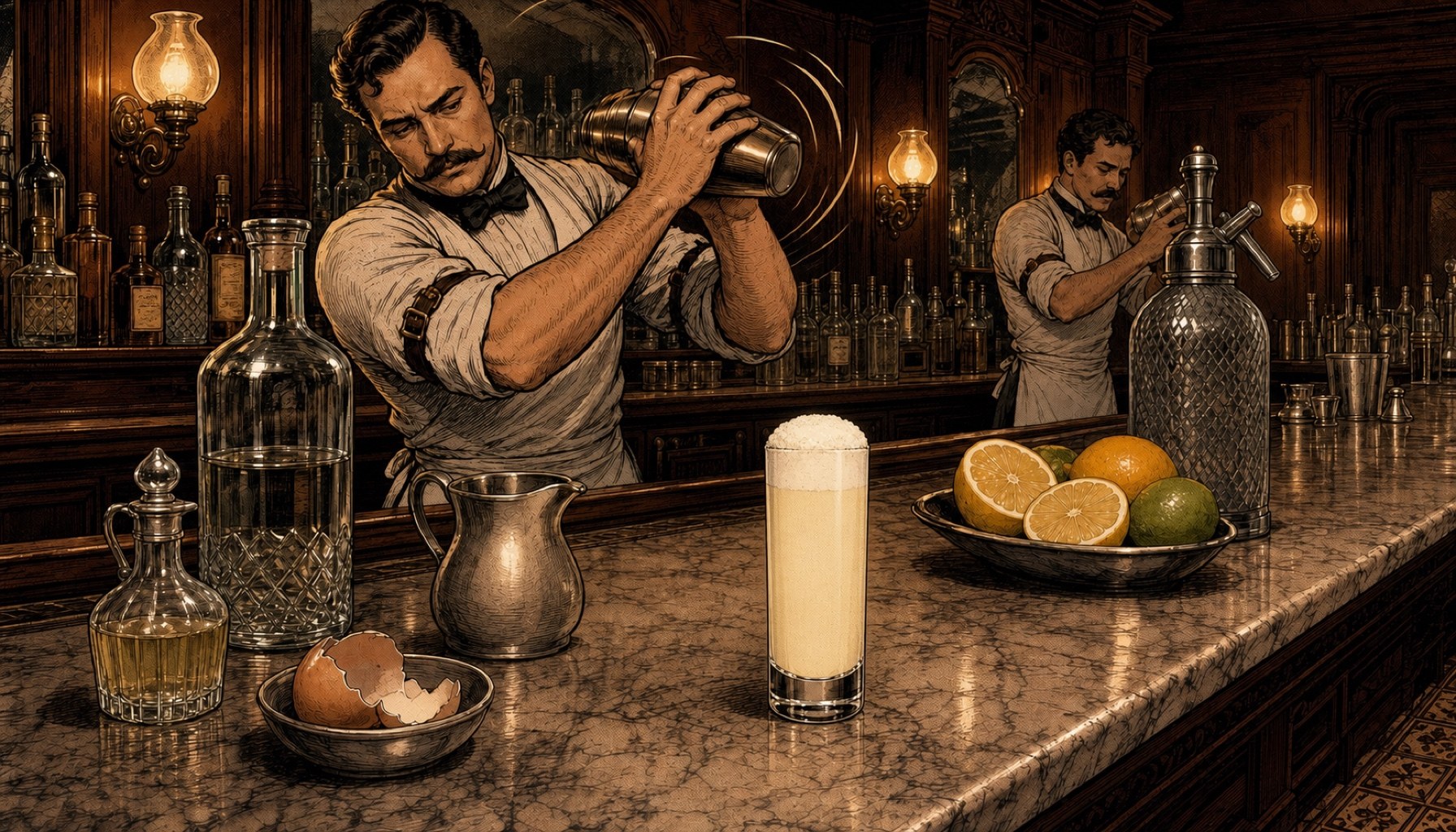
So the egg is later than the drink but not by much, and the Boston Sour is on firmer ground than I first thought. What the egg white does is mostly textural: a foam cap that softens perceived acidity and takes some tannic bite off an oakier whiskey. It isn't flavorless, it affects aroma and mouthfeel, but nobody drinks a sour for the taste of the egg.
On raw egg: use pasteurized whites if you're serving anyone pregnant, elderly, very young, or immunocompromised. Alcohol and citrus do not reliably make raw egg safe, whatever the internet says. Pasteurized whites whip nearly as well and remove the question.
About the Carton
Pasteurized whites come in a carton, and the carton has a reputation it only half deserves. America's Test Kitchen found they pour looser than fresh whites and take more than twice as long to whip to stiff peaks. That is a meringue problem. A sour asks for a fraction of that foam, so most of the penalty never shows up in a shaker. Difford's ran the direct comparison, carton against fresh in a whiskey sour with a reverse dry shake, and could not separate the two on foam or on taste.
The variable is the brand. Pasteurization aggregates egg-white protein, and a 2024 study in Food Chemistry traced the drop in foaming capacity to exactly that. How much any given carton loses depends on how it was processed. A 2026 paper in Poultry Science measured four major proteins across ten commercial cartons and found little overall change in composition, though it tested chemistry rather than foam. US regulations let producers add whipping aids to make up the difference and require them named on the front of the carton, so you can read which kind you are buying before you get to the register. Skip anything listing sugar or starch.
Pour 1 oz (30 ml) per egg white and dry shake harder than you would with a fresh one. The correction is the same one aquafaba needs, for the same reason.
The Vegan Version
Two builds below use egg white. The Boston Sour requires it, that's the entire distinction between it and the Classic. The Big Apple Sour treats it as optional. Both work with chickpea water.
Aquafaba is the liquid in a can of chickpeas. It foams because of a mix of proteins, soluble carbohydrates, and saponins working together, not any single component, and results vary a fair amount between brands depending on how concentrated the liquid is. If yours comes out thin, reduce it gently on the stove and let it cool.
The discovery is recent and has two names on it. In December 2014 Joël Roessel, a French opera tenor working through vegetable foams systematically, got liquid from red kidney beans and hearts of palm to whip, though his version needed starch and gum to hold. In February 2015 Goose Wohlt found the version that worked: chickpea liquid alone, no additives, as a direct egg white replacement using ordinary meringue technique. He built the name from the Latin aqua and faba, water and bean, and the community that formed around the discovery adopted it that March.
1 oz (30 ml), or two tablespoons, replaces one egg white. Dry shake harder than you would with egg, a full 15 seconds. The foam is comparable to egg white and often holds a little better, with none of the faint sulfur note raw egg can leave. Plenty of bartenders reach for it whether or not anyone at the table is vegan.
What I Pour
Every whiskey build below is written for Rittenhouse Rye Bottled in Bond, the standard bar rye for sours and the one I reach for. Bourbon works throughout if you want it rounder and sweeter. Rye keeps more spine against the lemon. Two recipes here, the Gold Rush and the Paper Plane, are canonically bourbon drinks, and I've written those as their creators built them.
If you don't have the Rittenhouse, Buffalo Trace, Woodford Reserve, and Four Roses all hold up. Four Roses is a Kentucky distillery despite what the name suggests to a New Yorker, and its higher-rye recipes land closest to what the Rittenhouse does.
For the Penicillin, blended Scotch is traditional but not compulsory. Johnnie Walker Black is the easy answer, Double Black the better one if you have it, since the extra peat means the float has less to do. Balvenie DoubleWood 12 takes it somewhere else, a single malt with enough sherry-cask weight to stand up to the ginger. Then move the smoke around: instead of a quarter ounce floated on top, build it with 1½ oz Johnnie Walker Black and ½ oz Ardbeg Wee Beastie so peat runs through the whole drink. Wee Beastie is five years old and bottled at 47.4%, young and sharp enough to hold its edge under lemon where an older, rounder Ardbeg would disappear.
There's an accident in the two bottles I use most. Rittenhouse is bottled in bond. So is the Laird's apple brandy in the last drink. Bottled in Bond is a federal standard from March 1897 and it's specific: one distilling season, January to June or July to December, one distiller, one distillery, at least four years in a federally bonded warehouse under government supervision, bottled at exactly 100 proof, nothing added but water, and the label has to name the distillery. It came with a tax incentive to get distillers to opt in, and it landed nine years before the Pure Food and Drug Act.
The Syrups
Seven of the eight use a syrup. Only three need something you can't buy at a normal grocery store. None of them is difficult, though the cinnamon wants an hour of steeping and the ginger wants juicing. Syrup concentration matters more than people expect: ¾ oz of 1:1 simple and ¾ oz of 3:1 honey syrup are not interchangeable, and swapping one for the other will throw the balance.
Make These First
- Simple syrup (1:1)
- 1 cup white sugar, 1 cup hot water. Stir until fully dissolved, cool before using. Makes about 1½ cups. Keeps about a month refrigerated.
- Honey syrup (3:1)
- ¾ cup honey, ¼ cup hot water. Stir until it pours freely. Makes about 1 cup. Keeps about a month refrigerated. Used in the Gold Rush.
- Ginger syrup
- Juice enough fresh ginger, skin on, to get ½ cup. Strain it, weigh it, and stir in granulated sugar at three quarters of that weight until dissolved. No heat: warming it flattens the raw bite that makes the drink work. An immersion blender is faster than a spoon. Makes about ¾ cup. Use within three days and freeze the rest in ⅜ oz portions. Used in the Penicillin.
- Honey-ginger syrup, the shortcut
- If you have no juicer: make the 3:1 honey syrup, steep ¼ cup of thinly sliced fresh ginger in it hot for an hour, then strain. One syrup instead of two. It is milder and sweeter than the split above, so treat it as a home adaptation and not the original. Keeps about a week refrigerated, longer than the raw ginger syrup because the ginger is cooked.
- Cinnamon syrup
- Make 1 cup of 1:1 simple syrup, drop in three broken cinnamon sticks while it's hot, steep at least an hour or overnight for more depth, then strain. Makes about 1½ cups. Keeps about two weeks refrigerated. Used in the Big Apple Sour.
Eight Worth Making
House proportions here run 2 oz spirit, ¾ oz lemon, ¾ oz syrup, which is a touch drier and more spirit-forward than the older books. Adjust the lemon by a few drops either way depending on how sharp your fruit is that week.
1. Classic Whiskey Sour
The bar-default version. No egg, straight over ice, garnished simply. Every other drink on this list is arguing with it.
Classic Whiskey Sour
- 2 oz (60 ml) Rittenhouse Rye Bottled in Bond, or bourbon
- ¾ oz (22.5 ml) fresh lemon juice
- ¾ oz (22.5 ml) simple syrup (1:1)
- 2 dashes Angostura bitters, optional, my preference not the canon
- Glass: Rocks, over ice
Shake all ingredients hard with ice until cold. Strain into a rocks glass over fresh ice. Garnish with an orange half-wheel and a cherry.
2. Boston Sour
The same build, except the egg white is required. Plenty of bars use "Boston Sour" and "whiskey sour" interchangeably and just ask whether you want egg in it. The name itself has no documented origin I could find, no inventor and no founding bar, so treat it as a convention rather than a pedigree. The drink underneath it is well documented; the label isn't.
Boston Sour
- 2 oz (60 ml) Rittenhouse Rye Bottled in Bond, or bourbon
- ¾ oz (22.5 ml) fresh lemon juice
- ¾ oz (22.5 ml) simple syrup (1:1)
- 1 egg white, or 1 oz (30 ml) aquafaba
- Glass: Rocks or coupe
Combine everything in a shaker without ice. Dry shake hard for 15 seconds to build the foam. Add ice, shake again until cold. Strain over fresh ice or up. Garnish with an orange half-wheel and a cherry.
3. Whiskey Smash
The other drink here with an 1862 pedigree, though not in the form you'd be served today. Thomas's Whiskey Smash, number 96, is a half tablespoon of sugar, a tablespoon of water, a wine-glass of whiskey, two sprigs of mint, and shaved ice. No lemon at all. It's a short julep. Dale DeGroff revived it in the 1990s by muddling lemon wedges into it, and that citrus is what turned a julep into a sour. The version below uses juice instead of wedges, which is cleaner but gives up the peel oils DeGroff's muddling releases. Use three or four lemon wedges instead if you want his.
Scent exception: Ralph Lauren Polo, the original 1978 green bottle, perfume 803. Juniper, basil, artemisia, caraway, and coriander up top, pine needles and leather through the heart, tobacco, oakmoss, patchouli, and cedar underneath. There's no mint in it, and that's the point. Thomas's smash had no lemon; Polo has no mint. Both are the older, greener version of something later modernized with citrus, the smash by DeGroff and Polo by way of the 2021 Cologne Intense, which added grapefruit and spearmint and stripped out the oakmoss and leather.
This is the one pairing here I didn't reason my way into. My father wore the original Polo. I keep a bottle of it now, with the 2021 Intense next to it on the same shelf. The newer one is cleaner, easier to wear, better behaved in a room full of people. The old one smells like him.
Whiskey Smash
- 2 oz (60 ml) Rittenhouse Rye Bottled in Bond, or bourbon
- ¾ oz (22.5 ml) fresh lemon juice, or 3 to 4 lemon wedges to muddle
- ¾ oz (22.5 ml) simple syrup (1:1)
- 8 to 10 fresh mint leaves, plus a sprig to garnish
- Glass: Rocks, over crushed ice
Press the mint gently in the shaker with the lemon and syrup. Don't shred it. If using wedges, muddle them here so the peel oils come out. Add whiskey and ice, shake hard, double strain over crushed ice. Garnish with a mint sprig, slapped once against your palm first.
4. New York Sour
The classic build with a red wine float poured over the back of a spoon. It shows up in Chicago around 1883 and was called a Chicago Sour and a Continental Sour before the New York name stuck, which is documented in Boston by 1885. Because the wine sits on top, the first sip is wine-led and tannic. It integrates as you go, and the sour underneath asserts itself by the end. Any dry, food-friendly red works. Malbec is the easy default.
New York Sour
- 2 oz (60 ml) Rittenhouse Rye Bottled in Bond, or bourbon
- ¾ oz (22.5 ml) fresh lemon juice
- ¾ oz (22.5 ml) simple syrup (1:1)
- ½ oz (15 ml) dry red wine, Malbec or similar
- 2 dashes Angostura bitters, optional, my preference not the canon
- Glass: Rocks, over ice
Shake whiskey, lemon, and syrup hard with ice. Strain over fresh ice. Float the wine on top by pouring it slowly over the back of a spoon. Garnish with a lemon twist.
5. Gold Rush
Bourbon, lemon, and honey syrup instead of simple. It came about around 2000 when T.J. Siegal, a regular sitting at the bar at New York's Milk & Honey, asked for his usual whiskey sour made with the honey syrup already sitting out instead of simple syrup. He wasn't working the stick; he was a customer with a good idea. It's been a modern-classic staple since. The original runs 2 oz bourbon, 1 oz lemon, ¾ oz rich honey syrup, which is tarter than the house proportions I use elsewhere. I've given the original below.
Gold Rush
- 2 oz (60 ml) bourbon
- 1 oz (30 ml) fresh lemon juice
- ¾ oz (22.5 ml) honey syrup (3:1)
- Glass: Rocks, over one large cube
Shake all ingredients hard with ice. Strain into a rocks glass over one large cube. No garnish, in keeping with the original.
6. Penicillin
Scotch instead of American whiskey, which stretches the definition, but it's built on the same bones. Sam Ross created it at Milk & Honey in 2005 as a riff on the Gold Rush: blended Scotch instead of bourbon, the sweetener split between honey syrup and the bar's ginger syrup, and a float of smoky Islay single malt so the smoke hits before anything else. Most published versions combine the two into one honey-ginger syrup, which is easier, keeps longer, and lands sweeter. The split is how Ross describes building it.
Scent exception: Montale Oud Tobacco. Citrus, cumin, and sumac up top, oud, incense, and orange blossom through the middle, oud, tobacco, and tonka underneath. Ecrin de Fumee's smoke is boozy and ambient. This drink has an actual peated float on it and needs something medicinal to match.
Penicillin
- 2 oz (60 ml) blended Scotch
- ¾ oz (22.5 ml) fresh lemon juice
- ⅜ oz (11 ml) honey syrup (3:1)
- ⅜ oz (11 ml) ginger syrup
- ¼ oz (7.5 ml) smoky Islay single malt, to float
- Glass: Rocks, over ice
Shake Scotch, lemon, and both syrups hard with ice. Strain into a rocks glass over fresh ice. Float the Islay malt on top over the back of a spoon. Garnish with candied ginger.
7. Paper Plane
Equal parts bourbon, Aperol, Amaro Nonino, and lemon. There's no added syrup, but the drink isn't unsweetened: both Aperol and Nonino are liqueurs, and U.S. regulations require a liqueur to carry at least 2.5% sugar by weight. They supply the sweetness and the bitterness at once. Toby Maloney asked Sam Ross for a summer drink for Chicago's The Violet Hour, and in 2007 or 2008, depending on the source, Ross sent back a bourbon-forward riff on the Last Word.
Scent exception: Xerjoff Richwood. Tangerine, bergamot, and grapefruit up top, damask rose and black currant through the middle, sandalwood, patchouli, labdanum, vanilla, and musk underneath. The grapefruit carries the bitter-bright register the Aperol carries in the glass, and the black currant has a liqueur-adjacent tartness close to what the Nonino is doing.
Paper Plane
- ¾ oz (22.5 ml) bourbon
- ¾ oz (22.5 ml) Aperol
- ¾ oz (22.5 ml) Amaro Nonino
- ¾ oz (22.5 ml) fresh lemon juice
- Glass: Chilled coupe, up
Shake all ingredients hard with ice until well chilled. Strain up into a chilled coupe. No garnish.
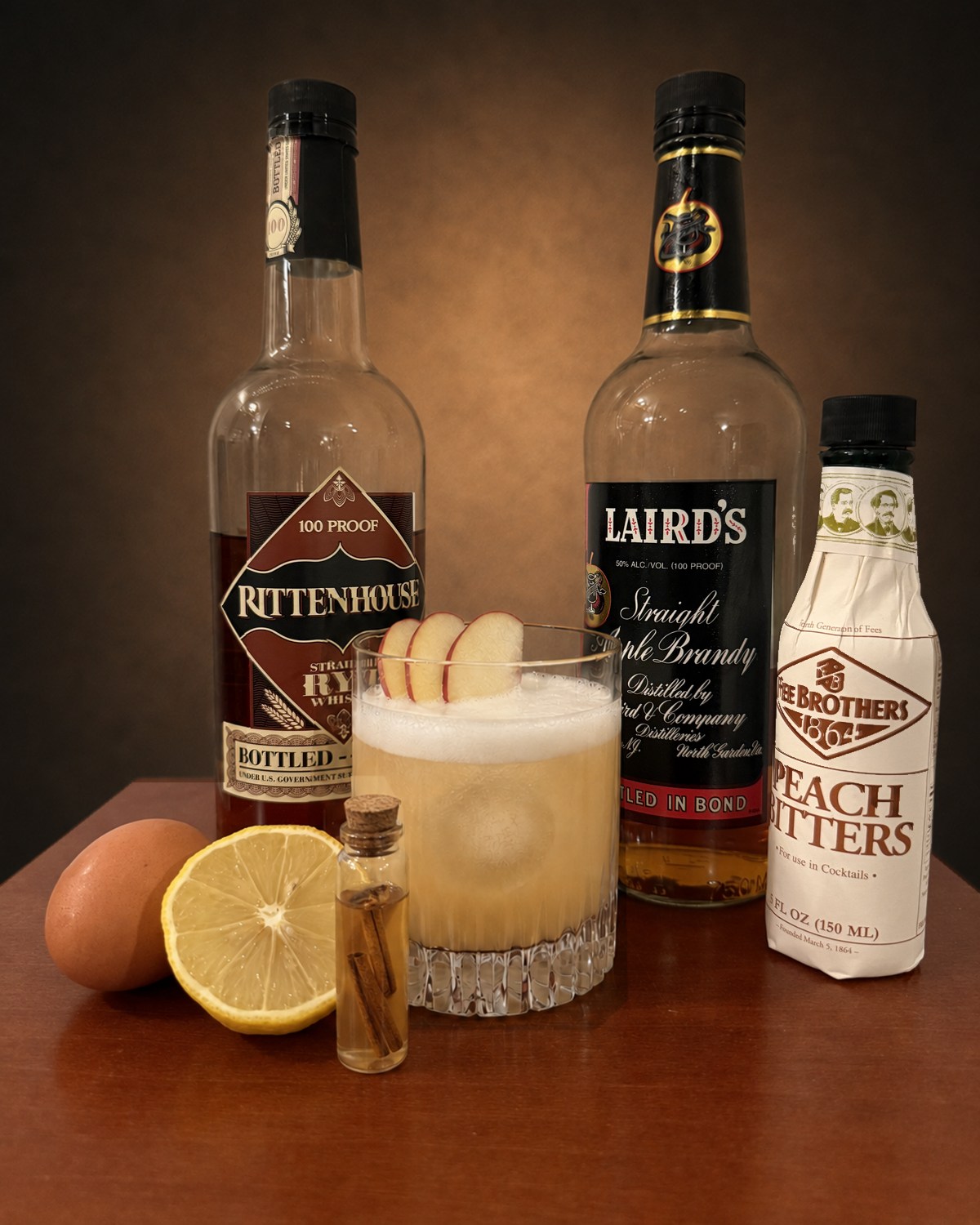
8. The Big Apple Sour
I built this one, but I can't claim I invented it. Sam Ross got there first with the Harvest Sour: rye split evenly with applejack, lemon, simple syrup, egg white, Angostura. Saveur's version of his recipe even names Laird's and Rittenhouse specifically, which is what was already on my shelf. That makes Ross responsible for three of the eight drinks here, counting the Penicillin and the Paper Plane. The Gold Rush belongs to Siegal.
What's mine is the two swaps. Cinnamon syrup instead of plain, and Fee Brothers peach bitters instead of Angostura. The peach is the part that matters. It pulls the apple brandy toward stone fruit and puts the drink in late summer instead of the Thanksgiving register the Harvest Sour lands in.
The New York angle is deliberate. Hudson Whiskey out of Gardiner works here if you want the whiskey half distilled in-state. Laird & Company has been in New Jersey since 1780, though every drop has been distilled at their North Garden, Virginia facility since 1976, so the Jersey part is the company and not the still. A good Calvados substitutes for the Laird's, softer and less apple-forward.
Scent exception: Xerjoff Alexandria II. Rosewood, lavender, apple, and cinnamon up top, rose, cedar, and lily of the valley through the middle, oud, sandalwood, amber, vanilla, and musk underneath. The most literal pairing here, apple brandy against an actual apple top note, and the oud in the base is why it sits in Xerjoff's Oud Stars collection.
The Big Apple Sour
- 1 oz (30 ml) Rittenhouse Rye Bottled in Bond, or Hudson Whiskey for a New York-made whiskey component
- 1 oz (30 ml) Laird's Bottled in Bond apple brandy
- ¾ oz (22.5 ml) fresh lemon juice
- ¾ oz (22.5 ml) cinnamon syrup
- 2 dashes Fee Brothers peach bitters
- 1 egg white, or 1 oz (30 ml) aquafaba, optional
- Glass: Rocks, over ice
Combine everything in a shaker without ice. If using egg white or aquafaba, dry shake hard for 15 seconds first. Add ice, shake again until cold. Strain into a rocks glass over fresh ice. Garnish with a thin fanned apple slice.
One format, eight drinks, and the only equipment you can't improvise is a shaker. That's the case for making one on its own day instead of ordering it.
Pull up a chair.
New writing on fragrance, spirits, and cigars goes up multiple times a week. Subscribe free on Substack for the Bite-Sized Brief, or pay a nominal fee to read the full article.

Sources
- The 1862 Fixes and Sours section, two Fixes and two Sours at numbers 140 through 143, the absence of any whiskey sour, the water in the original build, the lemon-skin instruction, the eleven other whiskey drinks, the Whiskey Smash at number 96 with no citrus, and the separated egg whites in the mulled wine, flip, and egg nog: read directly from Jerry Thomas, Bar-Tender's Guide, 1862. Scanned original.
- The 1869 Bourbon Sour and its exact build: read from Haney's Steward & Barkeeper's Manual, 1869, digitized by EUVS. Haney numbers recipes consecutively rather than by page, so the Bourbon Sour is cited both as recipe No. 90 and as page 28 depending on the source. Identified as an early whiskey sour by Paul Clarke in The Oxford Companion to Spirits and Cocktails. The January 4, 1870 Waukesha Plain Dealer as the earliest newspaper mention: Kevin Kos, citing David Wondrich.
- The Frosted Sour, its bourbon and egg white, the half wine-glass of water, and the sugared rim: read directly from Patsy McDonough, Bar-Keeper's Guide and Gentlemen's Sideboard Companion, 1883, page 11, digitized by EUVS. Schmidt's Delicious Sour and its egg white, from The Flowing Bowl, 1892, copyright 1891: digitized by EUVS, transcribed at Difford's Guide. Difford's dates the first egg-white sour to Schmidt; McDonough beats it by nine years.
- Vermeire's 1922 line that a few drops of white of egg improve all sours: Difford's Guide.
- The Golden Fizz in the posthumous 1887 edition of Thomas's guide, published two years after his death, and the Ramos Gin Fizz in 1888: Thirst Magazine.
- Raw egg safety and the recommendation to use pasteurized whites: FDA.
- Carton whites pouring looser and taking more than twice as long to reach stiff peaks: America's Test Kitchen. Carton against fresh in a whiskey sour, indistinguishable on foam and taste: Difford's Guide, with the same finding for an additive-free bulk pasteurized white. Pasteurization aggregating egg-white protein and cutting foaming capacity: Wang et al., Protein aggregation caused by pasteurization processing affects the foam performance of liquid egg white, Food Chemistry, February 2024, ScienceDirect. Four major proteins measured across ten commercial cartons, with little overall change in composition: Sousa et al., Poultry Science, January 2026, PMC12887372. This is a method validation paper and does not test foam. Whipping aids permitted in liquid egg whites and required on the principal display panel: 21 CFR 160.140.
- Vernon's 1740 order, the four-to-one dilution, the two-serving issue, and sailors buying sugar and limes from their own savings rather than being issued them: Society for Nautical Research, with the grogram cloak in Grog.
- The Royal Navy's 1795 adoption of citrus as policy, and the origin of "limey": The Mariners' Museum. Pushback on the scurvy reading: Tastes of History.
- The 1856 gin sour on Mart Ackerman's Saloon menu: menu transcription of the NYPL holding.
- The Elliott Stubb and Iquique claim, dated 1872: Universidad Nacional de Cuyo, "El vino y la chicha," 1962, p. 385, citing El Comercio de Iquique, cited on Wikipedia's whiskey sour entry. Iquique's transfer from Peru to Chile under the 1883 Treaty of Ancón: treaty text.
- The Chicago 1883 origin of the wine-floated sour, its Chicago Sour and Continental Sour names, and the New York Sour name documented in Boston by 1885: Difford's Guide.
- T.J. Siegal as a regular rather than a bartender, the Gold Rush's origin around 2000 at Milk & Honey, and Petraske's house sour formula of 2 oz spirit, 1 oz juice, and ¾ oz sweetener: Punch's history of the drink. Punch's own recipe page carries the modern 2 / ¾ / ¾ build instead, as does Difford's Guide.
- Sam Ross and the Penicillin at Milk & Honey in 2005: Imbibe. Build and Islay float: Punch. Ross's own description of splitting the sweetener between honey syrup and the bar's ginger syrup: Parade. The 4:3 ginger juice to sugar ratio by weight, attributed to Ross: Difford's Guide.
- The Paper Plane, its bourbon base, and The Violet Hour: Liquor.com and Punch, which note a 2007 versus 2008 discrepancy across sources.
- The 2.5% minimum sugar by weight in the U.S. definition of a liqueur: 27 CFR §5.150.
- Laird & Company headquartered in Scobeyville, New Jersey, with the apple brandy distilled at their North Garden, Virginia facility: Laird & Company. All Laird's distilling taking place at North Garden since 1976, per the company's own history: Laird & Company.
- Sam Ross's Harvest Sour, its split rye and applejack base, and the recipe naming Laird's and Rittenhouse: Saveur and Punch.
- Dale DeGroff's revival of the Whiskey Smash with muddled lemon wedges: Difford's Guide.
- Aquafaba's foaming behavior arising from proteins, soluble carbohydrates, and saponins together, with variation by concentration: peer-reviewed research. Roessel's December 2014 bean and hearts-of-palm foams, Wohlt's February 2015 chickpea discovery, and the March 2015 naming: the official aquafaba history, written by Wohlt.
- The Bottled-in-Bond Act's requirements and tax incentive: Bottled in bond, current federal text at 27 CFR §5.88. The Pure Food and Drug Act followed in 1906.
- Ardbeg Wee Beastie's five-year age, 47.4% ABV, and maturation in ex-bourbon and Oloroso sherry casks: Ardbeg.
- The original 1978 Polo's note pyramid and Carlos Benaim as perfumer: Polo (fragrance), cross-checked against Ralph Lauren's page. No source lists mint. The 2021 Cologne Intense adding spearmint and grapefruit: Ralph Lauren.
- Ecrin de Fumee, Montale Oud Tobacco, Xerjoff Richwood, and Xerjoff Alexandria II note breakdowns, cross-checked against each brand's own listings rather than taken from my collection database alone: Fragrantica and brand product pages.
- Fragrance catalog numbers are from my own collection database.
A note on the images in this piece: the hero illustration and the Bite-Sized journal thumbnail are AI-generated, one in a comic style and one in watercolor. The three book pages are photographs of public-domain scans, cropped, from the EUVS digital collection. The 1888 New Orleans bar scene is AI-generated in the same comic style. The Big Apple Sour is a composite built from a real photograph of my own bottles, with the background and some embellishments added with AI assistance. The Ecrin de Fumee bottle is a real photograph with the background replaced using AI assistance. The Vernon portrait is a public-domain painting by Thomas Gainsborough, held by the National Portrait Gallery in London.