Key Takeaways
- The witches' "flying ointment" wasn't invented from nothing. An early detailed recipe appears in a 1456 treatise, three decades before the Malleus Maleficarum repeated the story. Other recipes later attributed to such ointments sometimes contained dangerous nightshades, henbane, belladonna, mandrake, though historians still disagree on whether any accused witch actually used them.
- What people actually burned, carried, and wore, frankincense, myrrh, dragon's blood, mugwort, rue, has thousands of years of documented use, older and stranger than anything sold as "witchy" today.
- There's a real indie perfume scene built around this, not a TikTok trend, houses that have been doing it seriously for over a decade.
A total solar eclipse crosses Greenland, Iceland, and northern Spain on August 12, the first to reach mainland Europe since 1999. Eclipses have never needed help looking ominous. An 1881 Ohio county history preserves a local account, written seventy-five years after the fact, of an unnamed Native American woman killed after predicting "a darkness would come over the earth." The eclipse she's said to have predicted did happen, in June 1806. Whether the rest of the story is true is much harder to establish, the account is uncorroborated, and the only version that survives was written by a settler historian generations later. "Witchy perfume" reads like a TikTok category now, black bottles, tarot branding, a candle named after a moon phase. Under that is a documented history, stranger and better sourced than the marketing around it.
Some contemporary Wiccan and Pagan practitioners regard eclipses as potent occasions for transformation or ritual work too, though interpretations vary widely and no single historical witchcraft tradition held one universal view of eclipses. Wiccans and Pagans across the country described the 2024 total eclipse this way. The same logic applies today, in that world, not just as a hook to publish around.
The Flying Ointment
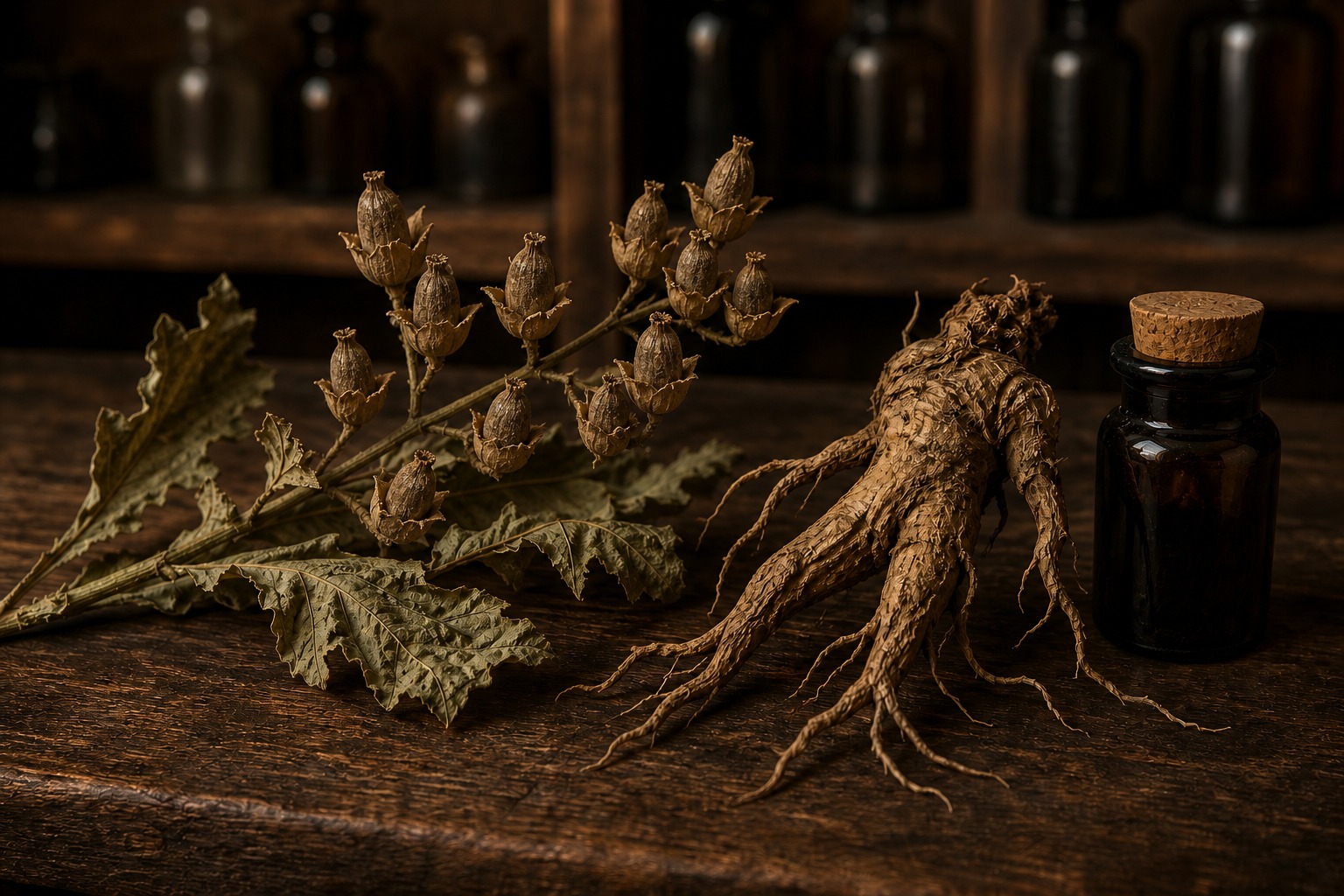
Start with the ointment. Witches were accused, across two centuries of European trials, of rubbing on a salve that let them fly to their Sabbat. The story was already thirty years old by the time Heinrich Kramer's Malleus Maleficarum repeated it in 1486, one of early modern Europe's most notorious demonological manuals. The oldest known recipe actually comes from 1456, when the German physician Johannes Hartlieb wrote down a seven-herb formula in a treatise on forbidden arts. Francis Bacon, writing decades later, didn't record a recipe so much as speculate about one, guessing that "soporiferous medicines... hen-bane, hemlock, mandrake, moonshade, tobacco, opium, saffron" might explain the reports of flight.
The chemistry involved is well documented, even if no single standardized ointment ever existed. Henbane, belladonna, and mandrake are all in the nightshade family, and recipes attributed to flying ointments in the centuries after Hartlieb sometimes contained one or more of them, plants that carry tropane alkaloids, atropine, hyoscyamine, scopolamine, capable of causing hallucination, vertigo, and a sensation of flight when absorbed through skin. What's actually disputed is whether any accused witch ever used them. Thomas Hatsis argues, in his book The Witches' Ointment: The Secret History of Psychedelic Magic, that these were genuine, if dangerous, herbal practices that got refracted into demonology by the men writing the trial records, one side of a live scholarly dispute conducted in the journal Magic, Ritual, and Witchcraft. Historian Michael Ostling argues the opposite in the same journal: that no accused witch is known to have actually used a hallucinogenic ointment, and that the whole story belongs to the magistrates, demonologists, and theologians writing about witches, not to the witches themselves. Nobody knows which of them is right. What's certain is narrower than either argument: these plants can produce the sensations of delirium and flight that trial records describe. Whether that pharmacology explains what actually happened, or whether it's simply available to explain a story that was never about practice at all, is the open question.
A note on safety: henbane, belladonna, and mandrake are genuinely toxic, capable of causing severe poisoning and death even in small doses. Nothing here is instruction. This is history, not a recipe.
What People Burned, Carried, and Wore
The ointment is the goriest part of the story, but it's a small part of it. Frankincense and myrrh have been burned together since antiquity, traded up the same caravan routes, gifted together at the Nativity. Myrrh had its own heavy job in ancient Egypt, used directly in embalming. Frankincense had a separate one in China, where it was called fanhunxiang, "calling back the soul fragrance," burned specifically to mourn the dead. Myrrh's own Chinese name, moyao, is plainer: the medicine of mo, the Chinese rendering of the Arabic murr, meaning bitter.
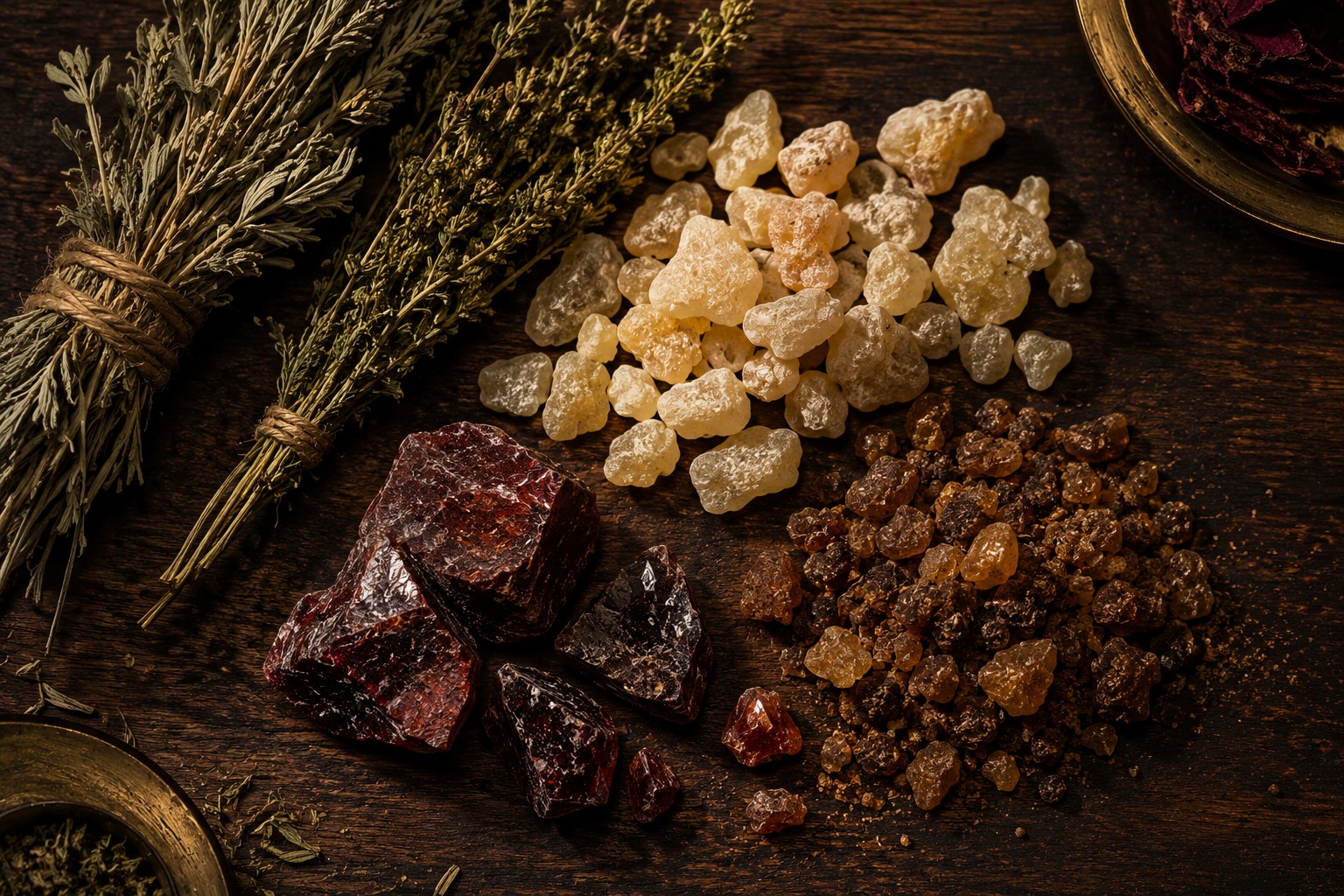
Dragon's blood resin has its own strange history, though the danger was in a name, not the plant. Ancient terminology sometimes confused red plant resin with toxic mineral pigments, and Pliny the Elder warned that physicians could substitute poisonous minium for the medicinal material they called cinnabaris, describing cinnabar workers wearing face masks against the fumes of that substitute. Actual dragon's blood is a plant resin, harvested from several unrelated genera including Dracaena and Daemonorops, and it still shows up as a base note in niche perfumery today, though a modern "dragon's blood" note may be the actual resin or simply a perfumer's reconstruction of what people expect it to smell like, a dusty, ceremonial warmth that pairs with amber and oud.
Closer to the ground, mugwort, vervain, and rue did the quieter work, herbs people actually kept in the house rather than burned for ceremony. Mugwort is Artemisia vulgaris, traditionally associated with Artemis, though the etymology is disputed, and European households hung it over doorways specifically because it was believed witchcraft couldn't get past it. Vervain was sacred enough in Rome that its branches swept and purified Jupiter's altar, and Pliny recorded that the Gauls used it for fortune-telling and prophecy. Rue earned the nickname Witchbane for exactly the reason it sounds like. Pliny the Elder recommended it as a medical antidote ingredient in ancient Rome, and centuries later it turns up in Hasidic amulets worn specifically against black magic and the evil eye, the same plant prescribed for the body in one tradition and carried for the soul in another.
What Accusers Expected Witches to Smell Like
Everything above is what people actually burned, wore, or carried. Accusers expected something else entirely: sulfur. Early modern demonology tied sulfur and brimstone directly to hellfire and the Devil's presence, and trial records sometimes treated a sulfurous smell as evidence that a demon, or someone working with one, was nearby. In the prosecution of the French priest Louis Gaufridy, witnesses described a "great light which stinks exceedingly" as proof of demonic action. Historians studying early modern France and England have found that smell functioned as a kind of diagnosis at the time, a personal signature that could mark someone as diseased, marginal, or suspect, and accusations of witchcraft sometimes rested on nothing more specific than how a person smelled to their neighbors.
None of that is what accused witches actually wore. It's what the people accusing them expected evil to smell like, sulfur standing in for sin the same way frankincense stood in for sanctity. The gap between the two is most of this piece: documented materials, burned and worn for documented reasons, against an imagined stench assigned by people who never checked.
How Witchcraft Became a Perfume Genre
None of what follows is an unbroken line back to the trial records. Modern Pagan witchcraft is a documented twentieth-century religious movement, not a surviving practice from the early modern period. Historian Ronald Hutton traces its actual origin to a specific moment, Gerald Gardner founding Wicca in 1950s England, drawing on older folklore, ceremonial magic, and Romantic-era ideas about a lost pre-Christian religion, not a continuous tradition handed down from accused witches themselves. The indie perfume scene below belongs to that modern inheritance. It's real, and it's been running for over two decades, but it's building on a twentieth-century religious movement and a Gothic aesthetic, not literally reconstructing what accused witches were said to have burned centuries earlier.
This Is a Real Scene, Not a Trend
The instinct to write this off as marketing undersells it. There's an actual indie perfume scene that's been making this seriously for over a decade, small-batch, often oil-based, sold through pagan and occult retailers rather than general fragrance shops. The seven houses below were chosen for documented note lists and history, not for scent I've personally worn, with one exception: the Nui Cobalt bottles are from my own collection, worn and tested, not just researched.
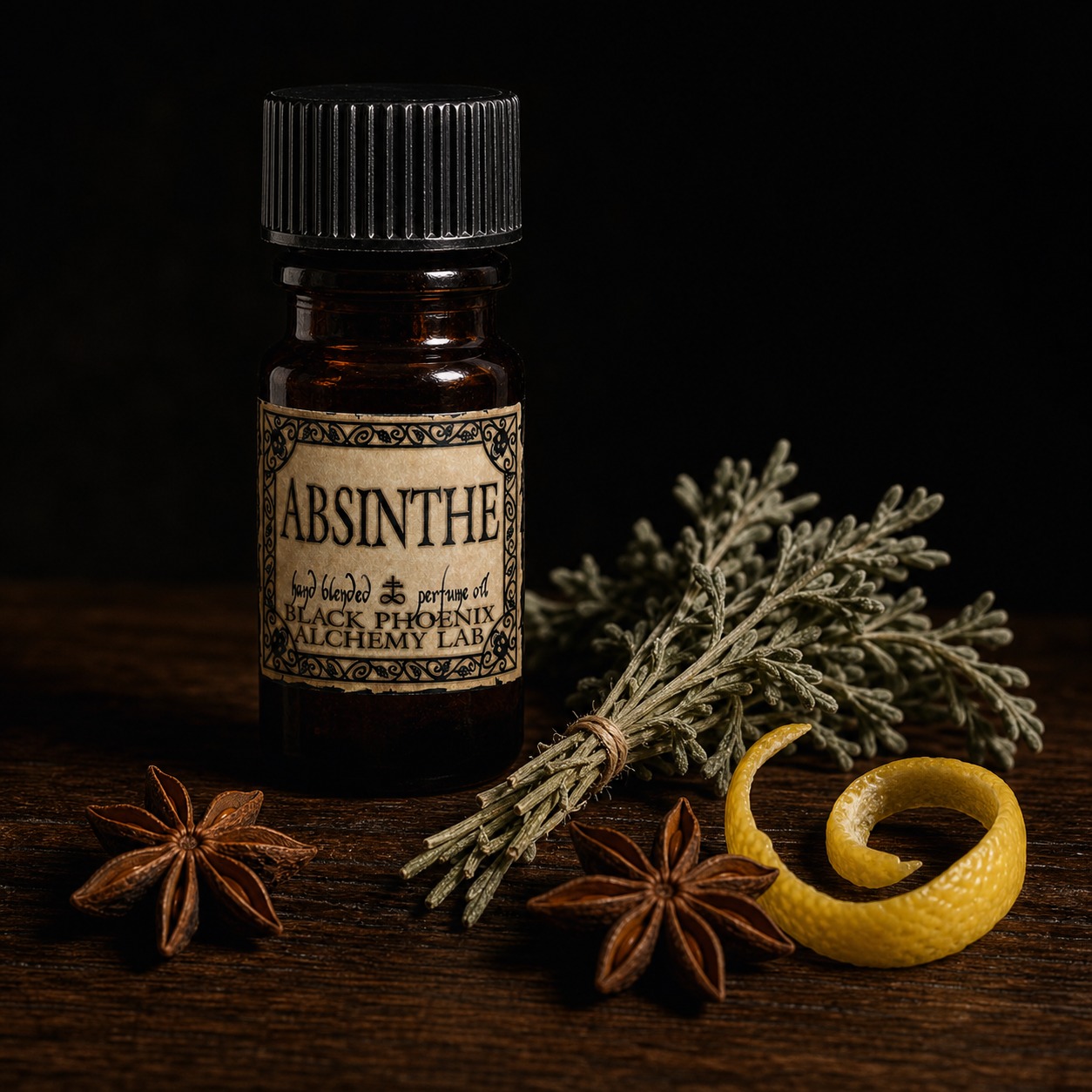
Black Phoenix Alchemy Lab, founded in 2002, is arguably the house most responsible for starting this whole genre. Their Absinthe blend, wormwood essence, light mints, cardamom, anise, hyssop, and a hint of lemon, shares the same wormwood family as the mugwort covered above, and it's a literal spirit besides, apt for a site built on both scents and spirits. The brand's own tagline: "Fall under the spell of our Green Fairy."
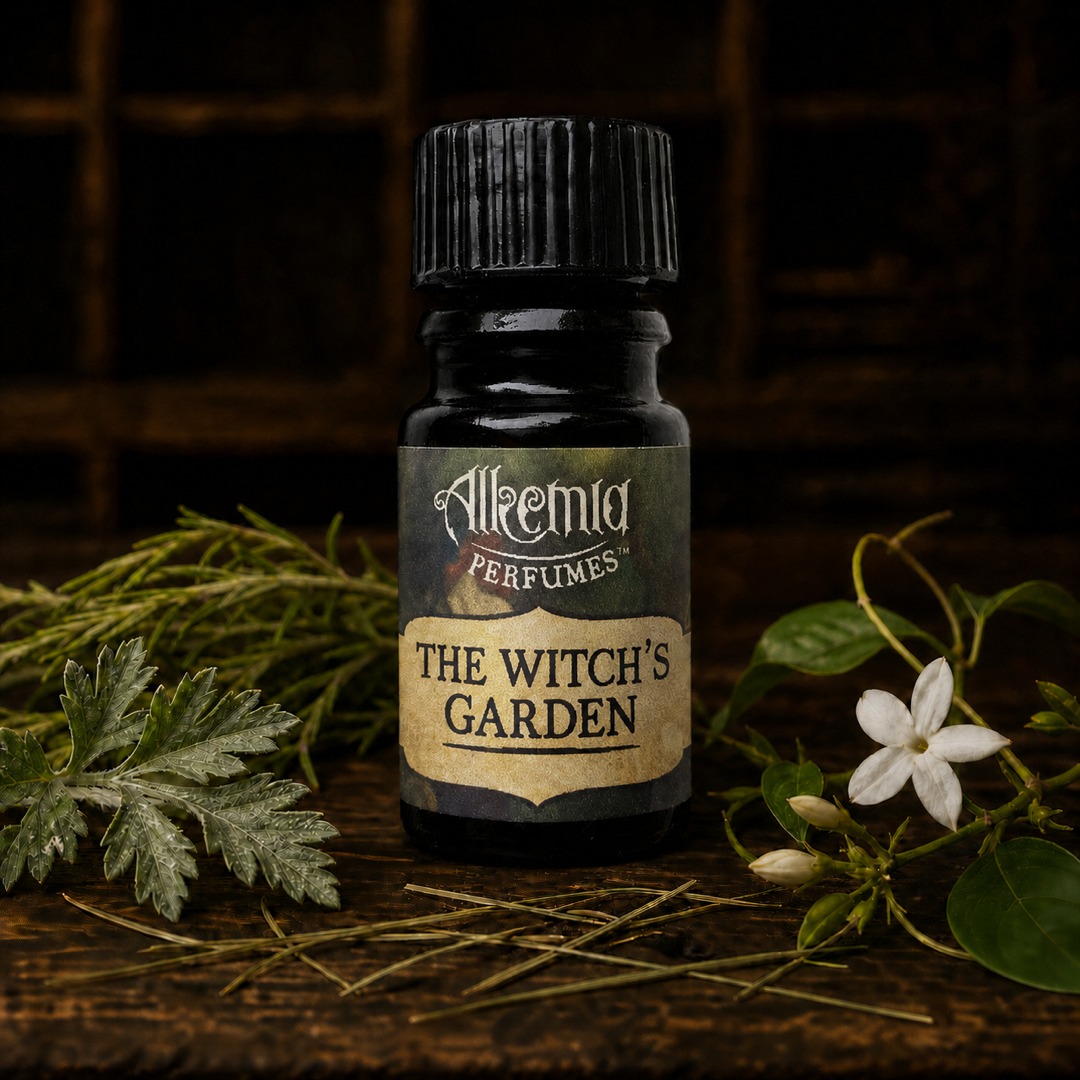
Alkemia Perfumes takes among the most literal approaches here with The Witch's Garden, poets daffodil, Russian sage, holy basil, verbena, mugwort, enchanter's nightshade, jasmine vines, sweetgrass, and oakmoss, the same mugwort covered above, not standing in for the idea of a garden but actually built as one.
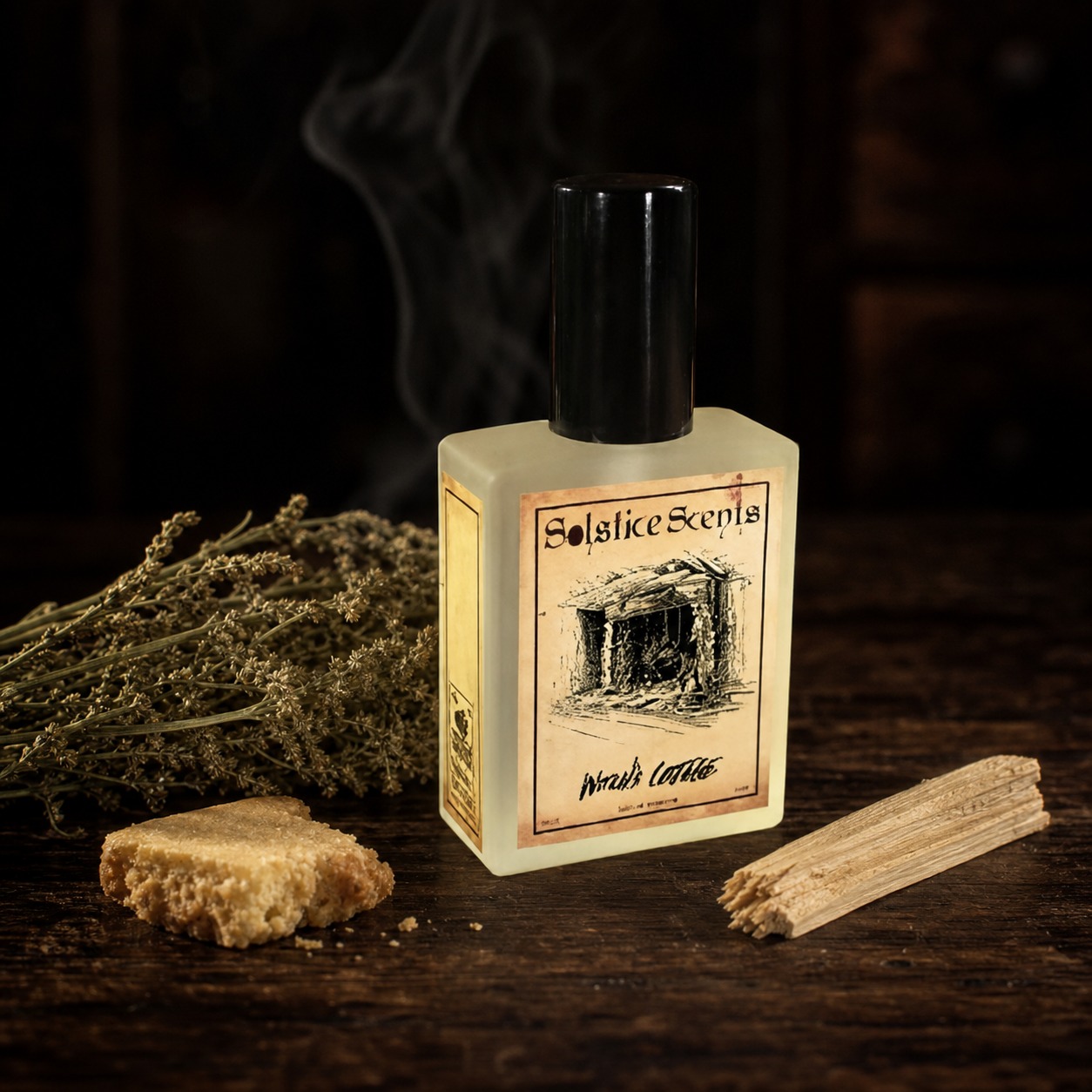
Solstice Scents takes the softer route with Witch's Cottage, warm baked goods, dried herbs, sweet Annie, soft woods, fragrant hearth smoke.
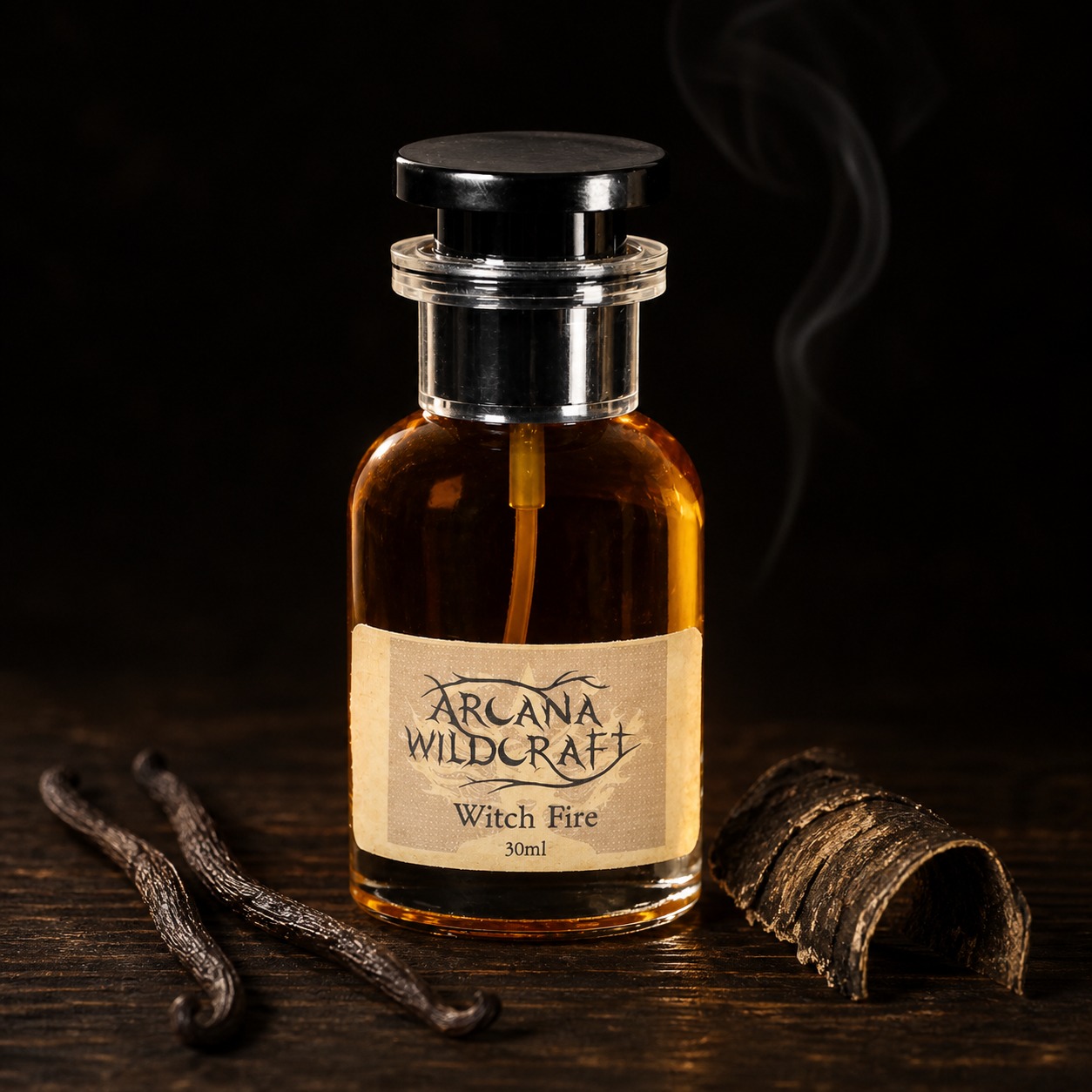
Arcana Wildcraft, one of the oldest houses in the genre, dating to 2003, describes its own process as using alchemy, aromatherapy, astrology, herbalism, and witchcraft outright, no hedging. Their Witch Fire is a vanilla bean smoke enfleurage deepened with vanilla absolutes from Uganda and Mexico and smoldered with a drop of birch tar, a rich, smoky gourmand built on a technique the brand says they may have invented outright.
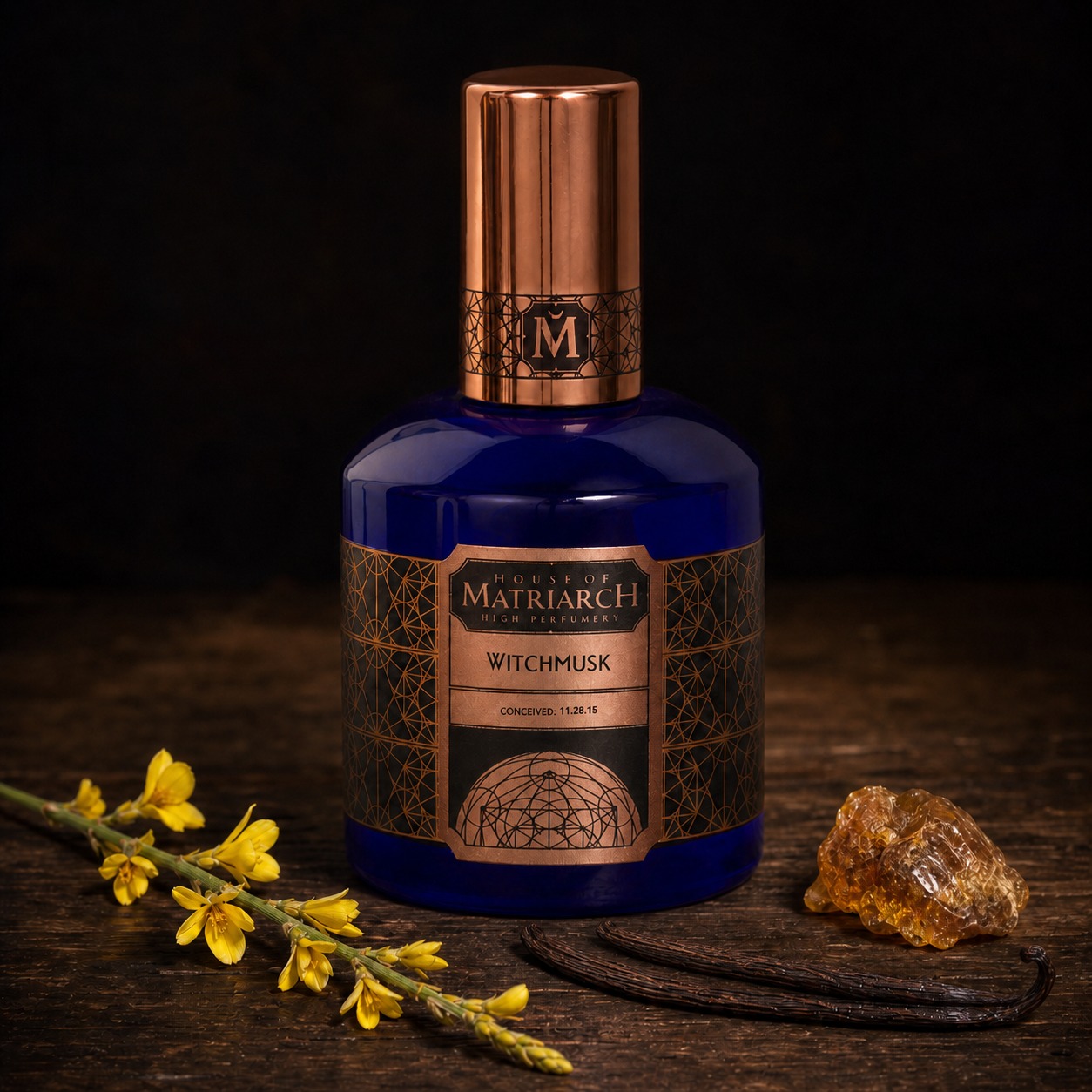
House of Matriarch's WitchMusk, vintage vanilla, cruelty-free musk, magical broom flower, patchouli powder, sabinene, amber, noble woods, isn't something you can count on finding in stock. The brand keeps it out of continuous production on purpose, sometimes years between vintages.
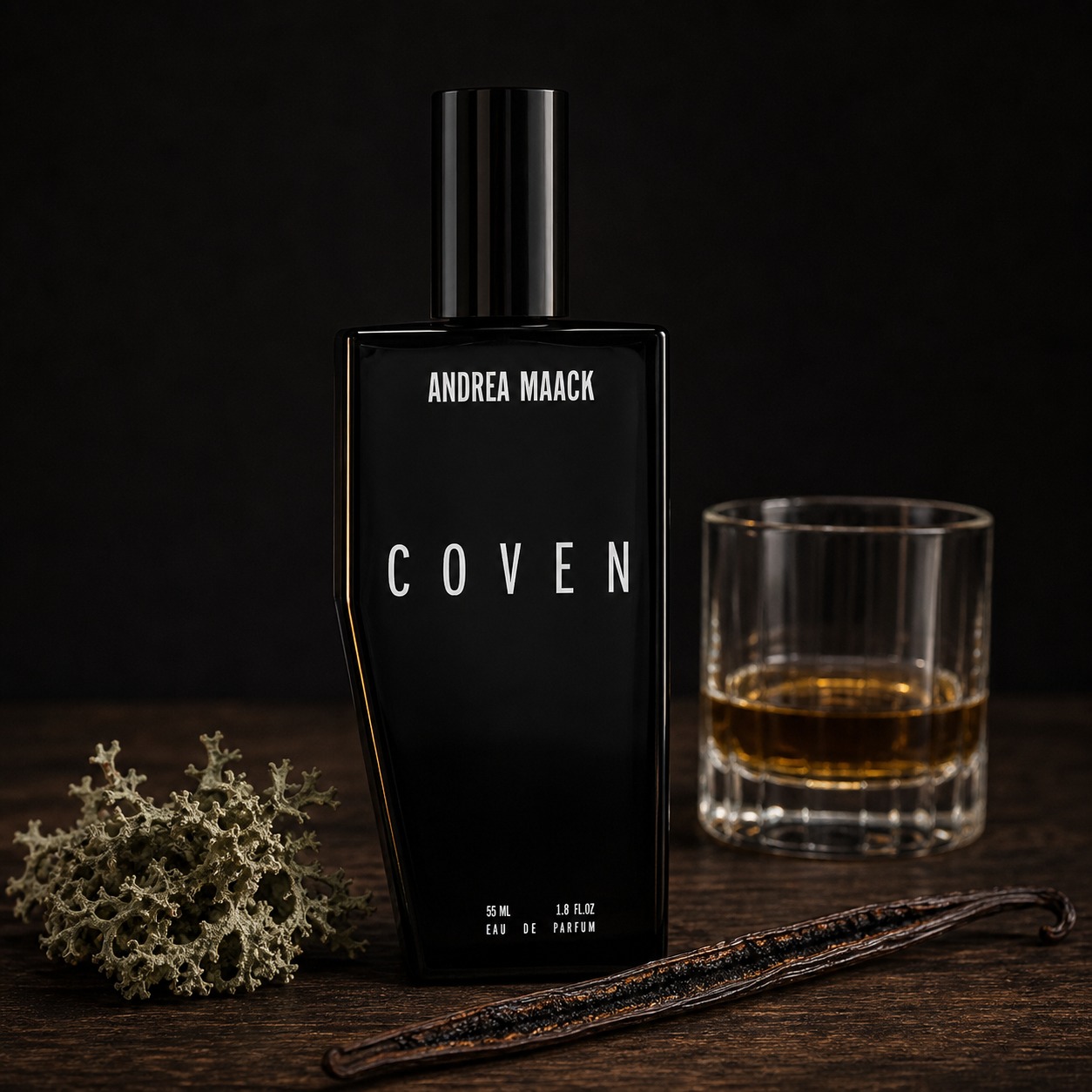
Even outside the indie-oil world, this territory shows up. Andrea Maack is a niche perfumer working out of Iceland whose house has collaborated with Dominique Ropion, one of the industry's most credentialed noses, on fragrances elsewhere in her catalog. Her own signature scent, Coven, vanilla and labdanum over cedarwood and oakmoss, galbanum and clove underneath, is built entirely around this territory. Her own copy calls it true witchcraft in a bottle.
Nui Cobalt Designs is one of the more established names in the scene, more than 560 releases cataloged, a catalog that includes titles like Awaken the Witch, Gargoyle, and Athena Glaukopis: Owl-Eyed. One of their blends, Witchy Shoppe, lists oakmoss, copal smoke, Nag Champa, frankincense, Tibetan cedarwood, tonka bean, black walnut, clove bud, Egyptian musk, a trace of sage, and a pinch of graveyard dirt.
That last note is a real practice, not an invented one, though it's worth being precise about where it comes from, and about what's actually in the bottle. Nui Cobalt's own copy doesn't specify whether "graveyard dirt" here is a literal ingredient or a fragrance interpretation of one, and there's no way to confirm that from the outside. The practice it's referencing is real either way. Graveyard dirt's documented use for spirit communication sits most specifically in Hoodoo, the African American folk-magic tradition, not generic "witchcraft." In some Hoodoo traditions, graveyard earth carries an association with the specific person buried there, and is approached through site-specific protocols and offerings that vary by lineage and practitioner, rather than a single fixed rule. Hoodoo has its own tradition of scented ritual oils entirely apart from graveyard dirt, too. Van Van Oil, one of the most traditional hoodoo formulas, is built from lemongrass, citronella, and palmarosa and gets worn directly on the body as an anointing scent, used to clear negativity and draw in luck.
The Scent for Today
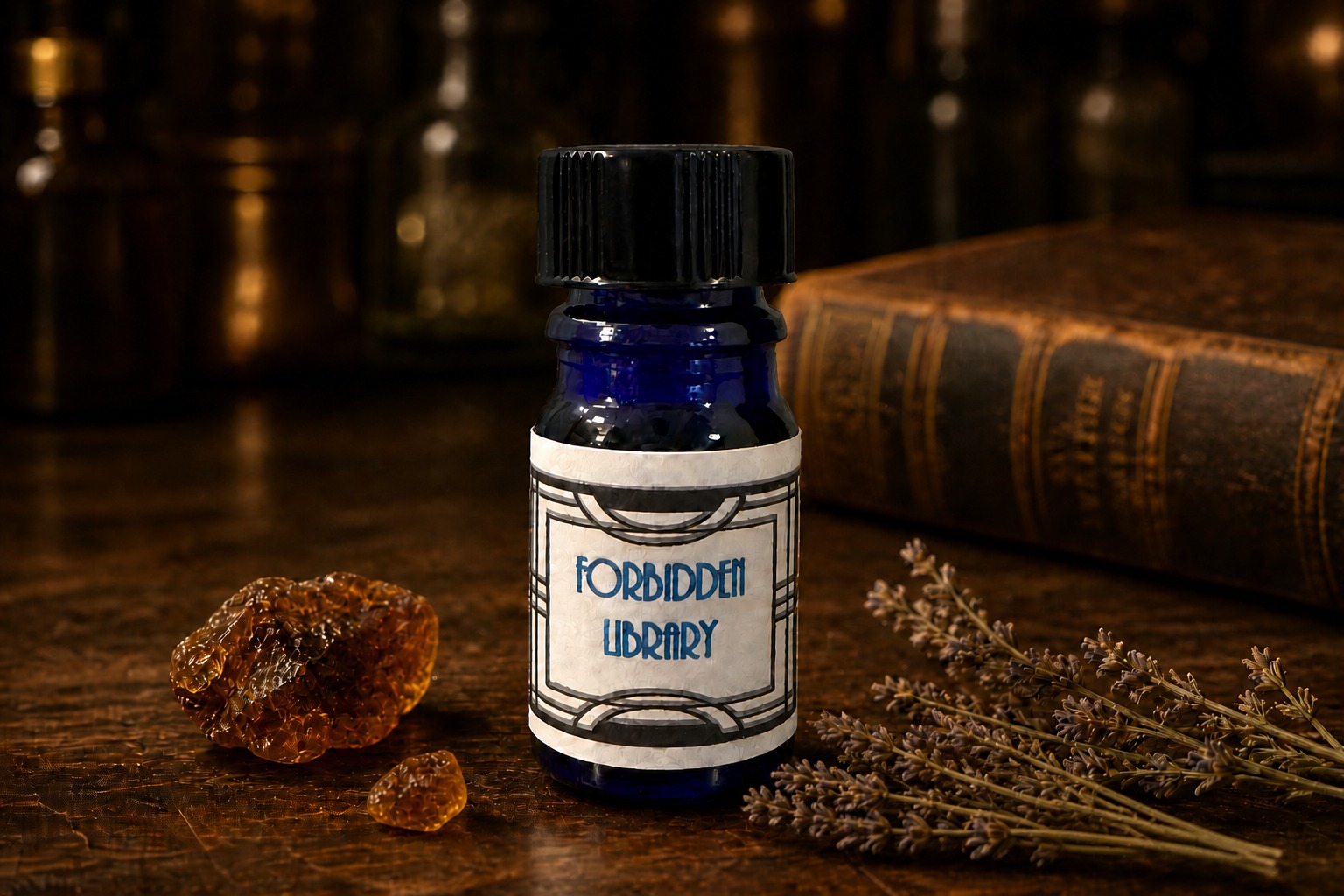
I went back and forth between two of my own Nui Cobalt bottles for today, Two Crows and Forbidden Library. Forbidden Library won. Incense and leather up top, amber, cedarwood, and aged paper underneath, #694 in my perfume collection. I read a lot, and a scent built around old books felt like the right one to wear for a piece that's really about what's actually been written down versus what just gets marketed as witchy.
Pull up a chair.
New writing on fragrance, spirits, and cigars goes up multiple times a week. Subscribe free on Substack for the Bite-Sized Brief, or pay a nominal fee to read the full article.

Sources
- The August 12, 2026 total solar eclipse and its path across Greenland, Iceland, and northern Spain: NASA.
- The uncorroborated 1806 Hinckley Township, Ohio account, preserved in an 1881 county history compiled by W. H. Perrin, J. H. Battle, and W. A. Goodspeed: WDTN, drawing on the original text at the Internet Archive.
- The oldest known flying ointment recipe, Johannes Hartlieb, 1456: Richard Kieckhefer, trans., Hazards of the Dark Arts, Penn State University Press, 2017.
- Francis Bacon's speculative account of the ointment's ingredients, from his 1626 Sylva Sylvarum: Worcester Cathedral Library.
- Thomas Hatsis's argument that the ointments were a genuine, practiced herbal tradition: The Witches' Ointment: The Secret History of Psychedelic Magic, one side of a scholarly dispute conducted in the journal Magic, Ritual, and Witchcraft (University of Pennsylvania Press).
- The case that no accused witch is known to have actually used one: Michael Ostling, "Babyfat and Belladonna," Magic, Ritual, and Witchcraft, 2016.
- Tropane alkaloid toxicity and poisoning risk: NCBI clinical overview.
- Dragon's blood's historical confusion with toxic mineral pigments, per Pliny the Elder: Pliny's Natural History, Book 33.
- Myrrh's use in Egyptian embalming, frankincense's Chinese name fanhunxiang, and myrrh's own Chinese name moyao: itmonline.org.
- Mugwort's Artemisia association and doorway-protection folklore: Domestic Medicine.
- Vervain's sacred use in Roman purification ritual and Gaulish prophecy, per Pliny the Elder: The Metropolitan Museum of Art.
- Rue's history under Pliny the Elder and its role in Hasidic amulets: Wikipedia's entry for Ruta graveolens, with additional folklore from Icy Sedgwick's folklore research.
- Sulfur's association with demons and the Devil in early modern demonology, including the Gaufridy case: Andrew Kettler, "Sulphur," Odeuropa Encyclopedia of Smell History and Heritage.
- Smell as evidence in witchcraft accusations in early modern France and England: The Many-Headed Monster.
- Modern Wicca's origin as a twentieth-century movement: Ronald Hutton, The Triumph of the Moon.
- Modern Wiccans and Pagans treating solar eclipses as spiritually significant occasions: NPR and NorthJersey.com.
- Black Phoenix Alchemy Lab's founding and the Absinthe note list: the brand's own site.
- Alkemia Perfumes' The Witch's Garden note list: the brand's own site.
- Solstice Scents' Witch's Cottage note list: the brand's own site.
- Arcana Wildcraft's founding date, its own description of its process, and the Witch Fire note list: the brand's own site.
- House of Matriarch's WitchMusk note list and its limited-production status: the brand's own site.
- Andrea Maack's background and the Coven note list: the brand's own site.
- Nui Cobalt Designs' catalog size and the Witchy Shoppe note list: the brand's own site.
- Graveyard dirt's specific role in Hoodoo: "Cemetery hoodoo: Culture, ritual crime and forensic archaeology" and Katrina Hazzard-Donald, Mojo Workin': The Old African American Hoodoo System (University of Illinois Press).
- Van Van Oil's ingredients and its traditional use in Hoodoo: aromaG's Botanica.
- Forbidden Library's note pyramid and catalog number are pulled directly from my own collection database.
- Perfume-house availability was checked August 12, 2026, and can change without notice.
A note on the images in this piece: the apothecary and ritual-material scenes are AI-generated illustrations, not photographs. The perfume bottle photos combine real product labels with AI-composited staging, except for Forbidden Library and The Witch's Garden, which are real photographs of the actual bottles, restaged.